






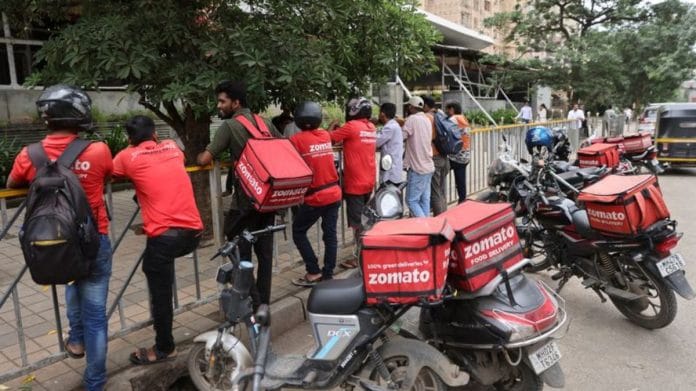


Last month, Haryana became the latest state to codify the Commission for Air Quality Management’s mandate requiring all new vehicles added to e-commerce fleets across food delivery, ride-hailing, and quick commerce in Delhi-NCR to run on CNG or electricity.
The mandate requires that every delivery to your doorstep and every ride that users book must be made in an EV or CNG vehicle. Haryana joins other NCR jurisdictions, including Delhi, Uttar Pradesh, and Rajasthan, in operationalising the CAQM mandate.
This latest intervention echoes a recurring instinct in policy circles. Once an industry, like e-commerce, becomes large and visible, burdensome compliance regimes follow. This is ill–informed on several counts.
Ecosystem nuances
Policymakers see EV fleets as a silver bullet to solve India’s growing urban pollution woes. But, e-commerce companies tend not to own the vehicles that make their deliveries. In most cases, gig workers own their vehicles, and their work is characterised by low barriers to entry.
The gig economy is also predicated on choice. E-commerce may form one of many income streams for a gig worker. Therefore, investing in an EV in service of a particular gig doesn’t make financial sense. NITI Aayog’s 2025 report, titled ‘Electric Vehicles in India’, explains why. EV ecosystem issues remain unresolved, inhibiting widespread adoption. High upfront costs, combined with a nascent EV financing ecosystem and uncertainty on a vehicle’s resale value, make the prospect of buying an EV economically unviable for gig workers.
Similarly, using these EVs daily is burdensome due to fragmented charging infrastructure and high public charging costs. CNG two-wheeler alternatives also remain limited, narrowing consumer choice in the market.
Regulatory impulse
This is not the first time a burgeoning sector has been at the receiving end of a regulatory response that fails to adequately address the root cause.
Following the telecom sector’s liberalisation in 1994, India has grown to be the world’s second-largest telecommunications market, with over a billion subscribers. However, Adjusted Gross Revenue (AGR) troubles remain an overhang for the industry. The definition of AGR, used to calculate government licence fees and spectrum charges, remains contested, creating operational uncertainty that persists to this day. For instance, the Department of Telecommunications’ estimation of Vodafone Idea’s AGR dues at Rs 64,046 crore under a broader definition dwarfs the company’s self-assessment of Rs 21,533 crore.
Policies focused on maximising revenue recovery, which created a prohibitive environment for sectoral investments. This is because policymakers see large revenues flowing into telcos, but discount the capital-intensity of their business models.
In the case of telecom, like in EV mandates, policymakers target the most visible actors. The EV mandate, if left unaccompanied by ecosystem support, risks creating a policy that costs more than it corrects. For a worker whose only qualification is a vehicle and a smartphone, losing access to one means losing their livelihood.
Also read: Where are women in India’s gig economy? The question we forgot to ask in the outcry
The way forward
The Haryana government is already considering road tax and registration fee exemptions for EVs. These could stimulate demand and ease financing pressures for both platforms and workers. However, fiscal relief alone does not address the aforementioned problems, and it must be supplemented with measures that address ecosystem challenges.
EV loans have high interest rates ranging from 15-33 per cent, making upfront financing still a burden for gig workers. The state could implement credit guarantee schemes that ease interest rates for gig workers who want to buy EVs. Additionally, co-lending arrangements could bring loan rates closer to 8-12 per cent. This could make the switch financially viable for workers.
Second, India’s national EV-to-charger ratio stands at 1:235 against an ideal of 1:20. EV charging remains a concern for workers, as taking breaks to charge vehicles affect their daily earnings. To address the infrastructural gap, e-commerce companies are already providing EV charging infrastructure at the last-mile to help workers. The state should augment these efforts via public–private partnerships.
Third, a phased transition timeline that adjusts to market realities of EV adoption by companies and workers could create deadlines that the sector can actually meet. The timelines and quotas for EV adoption can tie themselves to measurable benchmarks. For instance, EV adoption timelines can be linked to a minimum number of public charging stations per square kilometre.
E-commerce is expected to grow 15 per cent every year to $550 billion by 2035, generating around 15.8 million jobs. Regulations that do not understand the sector’s functioning and impose unnecessary costs will stifle this growth potential.
Anand Rajagopal is an analyst at Koan Advisory Group, a Delhi-based consultancy firm. Views are personal.
This article is part of ThePrint-Koan Advisory series that analyses emerging policies, laws and regulations in India’s technology sector. Read all the articles here.
(Edited by Aamaan Alam Khan)