








Cabinet Secretary TV Somanathan presented ministerial performance rankings to the Council of Ministers on 21 May 2026, in a meeting chaired by Prime Minister Narendra Modi, it marked something new in Indian governance: a sitting government publicly scoring its ministries on how fast they clear files, respond to Cabinet notes, and resolve citizens’ grievances.
The PM’s message was clear: there is no room for delay or lethargy. The exercise raises a harder question than it answers—not which ministries did well, but why the gaps exist at all, and whether this scorecard has the institutional teeth to close them.
To further shed light on the issue, we analyse the Ministry of Personnel, Public Grievances and Pensions data from 2022 to early 2026, covering all states and central ministries with more than 1,000 pending grievances. Let’s start with the states that most demand attention.
The Maharashtra-UP paradox
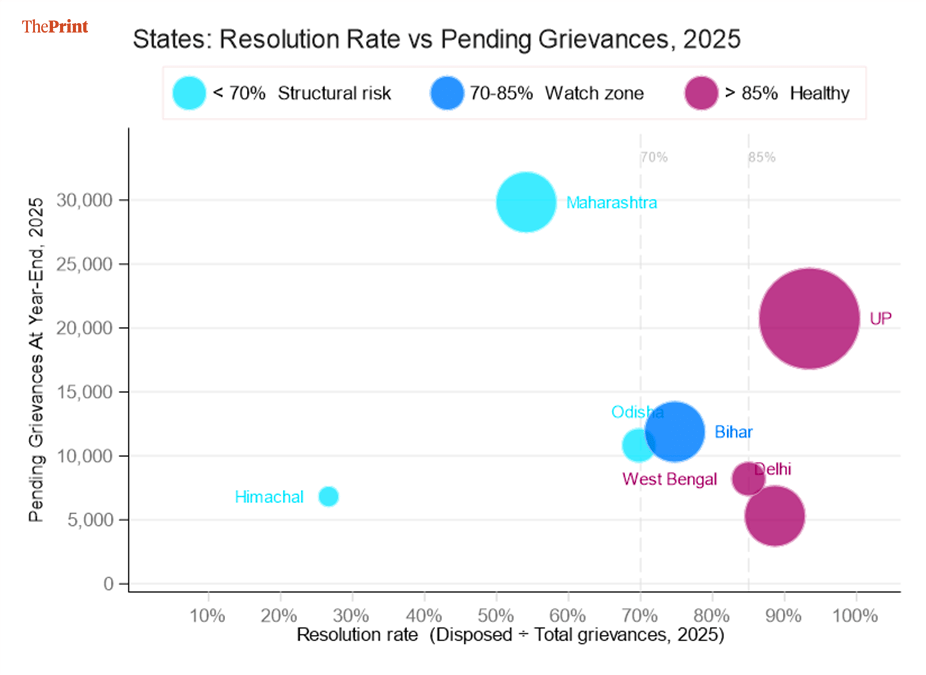
Between 2023 and 2025, Maharashtra’s pending grievance count went from roughly 14,600 to nearly 30,000—almost doubling in two years. This did not happen because citizens filed more complaints. The state received a broadly consistent 40,000-46,000 grievances each year. Its disposal machinery simply slowed—Maharashtra barely cleared 54 per cent of total grievances in 2025. Every unresolved case carries forward, compounding with new intake to create a backlog that grows independent of demand.
Contrast this with Uttar Pradesh, which received 3,04,907 grievances in 2025 (nearly five times Maharashtra’s) and resolved 93 per cent of them. For every complaint unresolved in UP at year-end, roughly three sat unresolved in Maharashtra. Scale is not the constraint. Administrative will is.
The carry-forward trap
Maharashtra is the sharpest case but not the only one. In 2025, Odisha entered the year carrying 18,363 unresolved cases from 2024, accounting for 51 per cent of its total caseload before a single new complaint was filed. Himachal Pradesh carried forward 61 per cent of its total caseload, while both Himachal and Jammu & Kashmir disposed of less than 30 per cent of grievances through the year, making their backlogs self-perpetuating.
West Bengal’s experience is the starkest warning of where this trajectory leads. In 2023, it disposed of just 205 cases out of 25,806 grievances, followed by only 78 resolutions out of nearly 40,000 in 2024. By the start of 2025, it had accumulated the largest state backlog in the dataset. It recovered to 85 per cent resolution in 2025, but no recovery undoes two years of unanswered complaints.
Understanding Grievances at the Ministerial Level
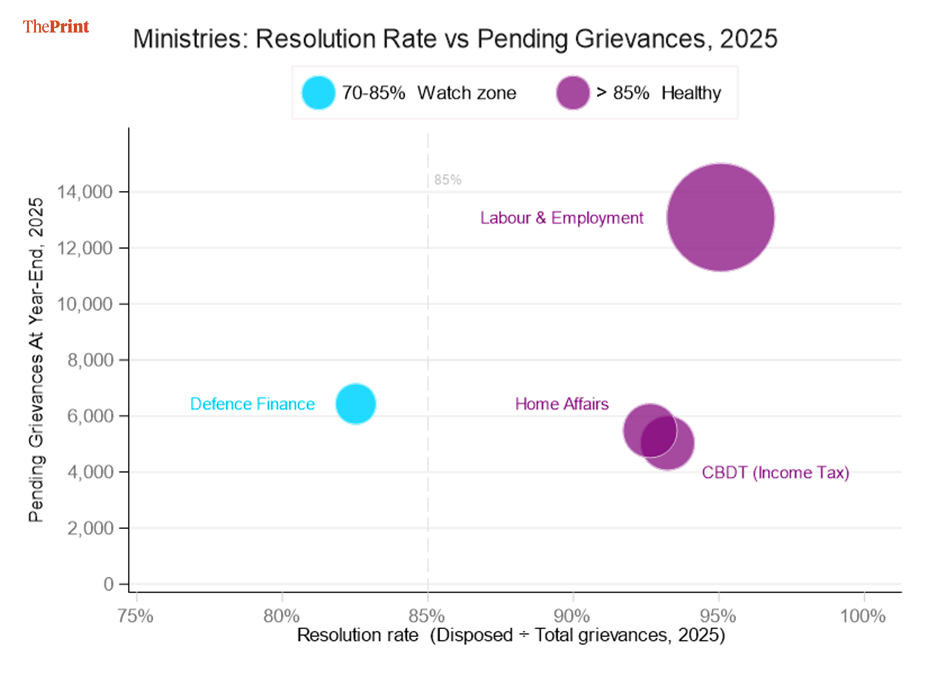
The central picture is more mixed. The Central Board of Direct Taxes (CBDT) reduced pending grievances from 13,318 in 2022 to 5,035 in 2025, a 62 per cent reduction while handling the same annual intake. The tax system did not get simpler; a leadership decision to treat disposal rates as a performance metric did the work.
However, in the Ministry of Labour and Employment, pending count quadrupled to 13,090 in 2025 (from 3,681 in 2025), but it was processing 2,52,000 disposals annually. The backlog growth could be a structural mismatch: EPFO settlement disputes, gig-economy contract violations, and informal-sector grievances could have expanded far faster than the ministry’s disposal infrastructure was designed to absorb. The ministry may be under-resourced rather than underperforming, and that distinction matters for what the review recommends and where resources flow.
The Department of Defence Finance, absent from the dataset until 2024, already carries 6,434 pending cases as of January 2026, a trajectory that deserves early attention.
Also read: India’s ‘cockroach’ moment—why Gen Z is turning unemployment into satire
From scorecard to system: what the review must do next
Five levers are available without new legislation. First, mandatory escalation triggers: any grievance unresolved beyond 60 days should automatically surface on the chief secretary’s or secretary’s dashboard, with a public record of the escalation.
Second, link disposal rates directly to officer appraisals. Ministry of Personnel, Public Grievances and Pensions already generates the data needed to score every district officer and ministry department quarterly. With the current political commitment to make better use of that data, let’s go a step ahead and use it in annual performance reviews.
Third, grievance data must distinguish between citizen-pending and state-pending. A complaint awaiting a pensioner’s life certificate is not the same as one that the government has simply failed to act on. Conflating the two inflates apparent backlogs and dilutes accountability. A simple reclassification would make the data more honest.
Fourth, Parliament’s standing committees should add grievance disposal rates to their standard annual ministry scorecards alongside budget utilisation and scheme delivery, creating the central-government equivalent of the chief-secretary dashboard.
Fifth (and most underutilised): Deploy data analytics and AI to move from reactive resolution to predictive governance. Ministry of Personnel, Public Grievances and Pensions already holds years of structured grievance data across geographies and ministries. Natural language processing can auto-classify incoming grievances by type and urgency, routing them to the right desk without the manual triage that currently creates delays.
Predictive models trained on historical patterns can flag departments at risk of backlog accumulation months before the pile-up becomes visible in annual data. Sentiment and recurrence analysis can identify systemic issues (the same complaint filed repeatedly by different citizens) signalling where policy or process reform is needed, not just faster disposal. In this regard, respective State NITI Aayogs could be the nodal agency that ensures the monitoring and rightful disposal of the grievances.
India’s first ministerial grievance review has made the mirror public. The harder work—tying scores to appraisals, deploying analytics, disaggregating the data, holding committees accountable—begins now.
Payal Seth is the lead economist and Head of the Centre of Data for Economic Decision-making (CoDED) at Pahle India Foundation. Views are personal.
(Edited by Ratan Priya)