






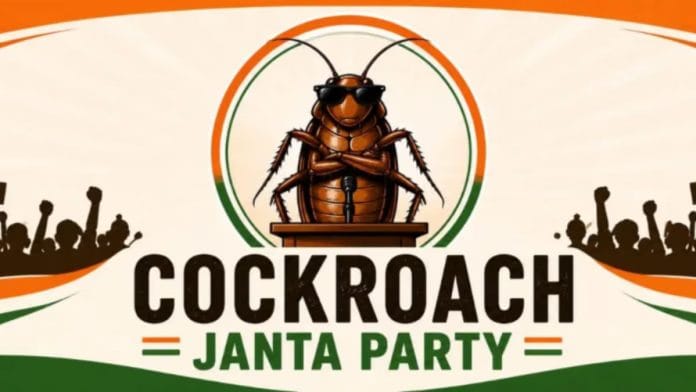


When did the cockroach become a political figure? The question sounds absurd. But that absurdity is precisely the point. In the rise of the Cockroach Janta Party, or CJP, India’s young, unemployed and digitally fluent citizens have found an unlikely metaphor for their own condition: mocked, unwanted, difficult to silence.
What began as an online joke has become a satirical vocabulary for a generation that feels overqualified, underemployed, patronised by institutions and politically unheard.
After remarks by Chief Justice of India Surya Kant on 16 May were widely interpreted as comparing unemployed young people and activists to cockroaches, CJP’s exploded online. Justice Kant, however, clarified the next day that his comments were “misinterpreted” and were specifically aimed at those using “fake and bogus degrees” rather than the Indian youth in general
Within days, the CJP reportedly gathered nearly 15 million Instagram followers. The party called itself the “Voice of the Lazy and Unemployed”. Its membership criteria are absurd: unemployed, professional procrastinator, and zero political experience. The joke is obvious. The anger beneath it is not.
OJP vs CJP
The Oggy Janata Party (OJP) makes the phenomenon more revealing. As a counter-satirical response drawing on the cartoon universe of Oggy and the Cockroaches, OJP has questioned CJP’s motives, alleged political links and self-identification with the cockroach. The CJP-OJP clash shows that digital protest rarely moves in a straight line from grievance to mobilisation. It transforms through parody, counter-parody, suspicion and meme warfare.
Why do so many young Indians find this comic grammar politically meaningful? One answer lies in the crisis of waiting. Sociologist Craig Jeffrey, writing on unemployed and underemployed young men in north India, described “timepass” as a condition produced by blocked mobility.
Young people are told to study, acquire degrees, prepare for exams and wait. But as waiting becomes endless, the psychological toll shifts from hope to deep frustration. The cockroach meme captures this suspended condition: surviving, adapting, being hated, but refusing to disappear.
This is an economic crisis. Official data shows that India’s overall unemployment rate may look low, but youth unemployment remains much higher – 9.9 per cent among those aged 15 to 29 in 2025, and 13.6 per cent among urban youth. The India Employment Report 2024 also notes that educated youth face particularly high unemployment, reflecting the mismatch between educational aspiration and available jobs.
Yet formal unemployment captures only one side of the problem. The deeper crisis is the absence of secure work. Across urban India, graduates are working as ride-hailing drivers, shop attendants, delivery workers or in jobs unrelated to their educational qualifications. This reveals the shrinking returns to education in an economy where degrees produce aspiration without guaranteeing jobs. The result is not only unemployment, but also underemployment and social misrecognition.
This mismatch matters because India’s youth have been asked to believe that education, entrepreneurship, digital connectivity and self-discipline would convert aspiration into success. Lauren Berlant’s idea of “cruel optimism” is useful here. People remain attached to promises that also injure them. For many young Indians, upward mobility has become more demanding, competitive and emotionally exhausting.
Also read: There’s never just one cockroach. Abhijeet Dipke only turned on the light
Satire matters
This is why calling such movements “lazy” misses the point. Calling someone ‘lazy’ is itself political. It shifts attention away from structural unemployment, exam irregularities, precarious work and shrinking public recruitment, and blames the country’s youth. French sociologist Pierre Bourdieu would call this symbolic violence, domination that makes the dominated accept the terms through which they are judged. CJP’s force lies in reversing the insult: if you call us cockroaches, we will organise as cockroaches.
Satire matters because it allows anger to speak without sounding like conventional political anger. James C Scott argued that subordinate groups often develop hidden transcripts: jokes, rumours and coded speech through which criticism of power circulates beneath official respectability. In the digital age, memes perform a similar function. They are portable fragments of dissent.
But satire has limits. Online humour can produce visibility without organisation, virality without strategy and affect without durable institutions. Turkish-American sociologist and New York Times columnist Zeynep Tufekci has argued that networked protests can scale rapidly but remain organisationally fragile. CJP can attract attention faster than a party office can mobilise cadres. Yet attention is volatile. A meme can become a movement, but it can also become yesterday’s joke.
OJP’s rise exposes that vulnerability. Digital politics is instantly contestable. No sooner does one satirical movement claim to represent youth anger than another questions its authenticity. Is CJP spontaneous or politically linked? Is OJP genuine counter-satire or reactionary meme-making? In contemporary India, even protest is rapidly read through suspicion: Who funds it? Who benefits? Which party is behind it?
Also read: CJP’s digital insurgency traded karyakarta for attention capital. It’s everywhere and nowhere
A July Uprising-like moment
The CJP-OJP moment, therefore, condenses four crises at once—employment, recognition, representation and language. Degrees no longer guarantee secure work. Young people feel mocked and instrumentalised. Established parties court youth through digital spectacle and employment promises, but have failed to convert youth frustration into credible programmes. The inherited vocabulary of politics no longer captures the absurdity of young people’s lives.
The cockroach, in this sense, is a powerful political symbol. It is not heroic, pure or respectable. It survives hostile environments. For a generation raised on Start-up India, Digital India and aspirational India, identifying with a cockroach is a bitter commentary on what ambition has become.
This reversal of insult into identity also has a wider South Asian resonance. During Bangladesh’s 2024 student-led quota reform movement, after protesters felt delegitimised through the historically charged label “Razakar”, students turned “Tumi ke, ami ke, Razakar, Razakar” (Who are you? Who am I? Traitors, Traitors) into a language of defiance. The historical stakes were different, but the rhetorical mechanism was similar. A term meant to shame dissent was transformed into a collective refusal of humiliation.
CJP and OJP show that Indian youth are not politically apathetic. They are politically disenchanted, economically squeezed and culturally inventive. Sometimes they speak not through manifestos, but through cockroaches, cartoons and memes.
That should worry India’s political establishment. When a generation begins to turn insult into identity, and unemployment into satire, they are not withdrawing from politics. They are announcing that conventional politics has failed to hear them.
The author is a Senior Lecturer and Researcher, Department of Cultural Sciences, Linnaeus University, Sweden, and an affiliated researcher, University of Oslo, Norway. Views are personal.
(Edited by Saptak Datta)