






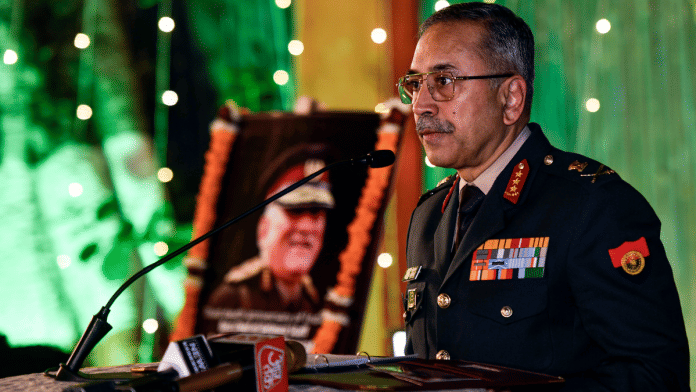


On 9 May, the government announced the appointment of retired Lt Gen N S Raja Subramani, former Vice Chief of the Army Staff and Central Army Commander, as India’s third Chief of Defence Staff, with effect from 31 May. Presently Military Advisor to the National Security Council Secretariat, he takes over at a pivotal moment in India’s quest for military transformation. He inherits a tri-services integration plan prepared after 6.5 years of deliberation by two Chiefs of Defence Staff and a dozen Service Chiefs. The onus will be on him to pilot the plan and, once approved by the government, implement it.
The General has a career profile distributed across the theatres he would be creating, as well as the requisite experience in higher decision-making and the political functioning of the government. In the western theatre, he has commanded a Strike Corps. In the northern theatre, he has commanded a Division in the northeast, functioned as the Chief of Staff of Northern Command, and served as Army Commander of Central Command. He has commanded a unit in a counter-insurgency area in the northeast. He has been a Military Advisor in Kazakhstan and served as the Deputy Director General of Military Intelligence.
He has attended the Joint Services Command and Staff College in the UK, a country with a functioning CDS system. At the apex level, he has held the appointment of Vice Chief of the Army Staff and participated in decision-making and coordination during the successful tri-service conflict, Operation Sindoor. His tenure as Military Advisor to the NSCS has given him an insight into the political, diplomatic, and inter-ministerial facets of national security. His appointment through “deep selection” post-retirement implies that he enjoys the confidence of the government.
I will stick my neck out and say that the transformation of the armed forces will commence in concert during his tenure as the CDS.
However, not surprisingly, like his predecessor, the appointment of Lt Gen Subramani got mired in controversy for exactly the same reasons. For this, I put the blame squarely on the government, as it can easily avoid political and military controversies by reforming the selection process to make it fair and transparent.
Also Read: ‘Jo uchit samjho woh karo’—five words that exposed India’s civil-military ambiguity
Why the controversy
Critics alleged that the route to the appointment of the CDS runs through the NSCS/NSA, where Lt Gen Subramani and his predecessor, General Anil Chauhan, were Military Advisors. It has been argued that the government’s preference for retired Lt Gens, who lack the institutional authority of serving Service Chiefs, implies expected political compliance and “coup-proofing” of the military.
The government’s merit-driven selection procedure is opaque and lacks credibility. The selection of a retired Lt Gen, junior to the serving Service Chiefs in rank and at times also per original seniority, as in this case, not only belittles them but also strikes at the institutional ethos in which selection for higher ranks has a deeply ingrained sanctity. Moreover, the same retired Lt Gen, who was identified, selected, groomed in the NSCS, put through the political filter, and appointed as the CDS, was not selected by the government’s same system of deep selection on merit to become a Service Chief while in service.
The primary mission of the CDS is tri-service integration, including the establishment of integrated theatre commands. Selection of a CDS from the Army for the third time in a row does not inspire confidence in the Indian Air Force and the Indian Navy, as it promotes an Army-dominated integrated system.
In all fairness, despite the lack of transparency, the government has appointed professionally competent officers as the CDS and Service Chiefs. Consequently, it is even more worrisome that after 6.5 years, not much progress has been made toward tri-service integration and the creation of theatre commands. For the record, the proposal for theatre commands prepared by General Anil Chauhan is under examination by the government.
Anomalies of the selection process
The political leadership does not interact with higher commanders and has little knowledge about them. By default, the government has to rely upon an ambiguous comparison of dossiers based on the military’s appraisal system by Ministry of Defence bureaucrats, Intelligence Bureau inputs, and spoken reputation. Keeping this in view, all governments have generally adhered to the principle of seniority-cum-merit — that is, when seniority is given priority, with merit (among very senior officers) being considered equal/relative. Unless a transparent and ethical system is established for selection based on the principle of merit-cum-seniority — that is, merit being given priority and seniority among contenders being considered relative — any interference with the principle of seniority-cum-merit will remain politically controversial.
In their quest for merit-based deep selection, the present and past governments have gone against the seniority-cum-merit system eight times — twice for selection of the CDS and six times for appointment of the Service Chiefs, invariably leading to allegations of political bias.
Citing “deep selection” in June 2022, the government issued a notification making serving and retired officers of the rank of Lt Gen or General, below the age of 62, eligible for appointment as Chief of Defence Staff. This was done despite having a pool of three Generals (Service Chiefs) and, if required, another 23 Lt Gens (Army Commanders or equivalent) selected by the government itself. Even Lt Gen Subramani could have been appointed as the COAS in 2024 if deep selection had been carried out. He could still have been appointed CDS as done now.
It soon became obvious that this was done to select a specific retired officer — General Anil Chauhan — as the CDS. The same process has been repeated for the selection of Lt Gen Subramani. That both these officers were Military Advisors to the NSCS/NSA before elevation to CDS only compounds the problem and substantiates the allegations of “political grooming”. The justification of the need for wider exposure to functioning of the government reflects poorly on the larger issue of civil-military relations and signals a disconnect between the government and the military. The need for wider exposure can also be met by posting serving officers to the NSCS and other ministries on deputation.
Presently there are no specific criteria, competency requirements, or qualifications codified for the appointments of the Service Chiefs and the CDS. There is no detailed appraisal done within the armed forces for appointments of Army Commanders (and their equivalents), or by the Defence Minister for selecting Service Chiefs. It goes without saying that the selection of the Service Chiefs and the CDS, if made on “merit” under the current circumstances, will remain subjective.
The appraisal system of the armed forces, which selects officers up to the rank of Lt Gen, including Army Commanders/equivalents who are contenders for the post of CDS, is itself in need of reform. The current system is mired in subjectivity, flaws in the character of assessors that impinge on moral courage, and regimental, arm, and association-related parochialism. This has led to inflation of annual confidential reports and far too many ‘meritorious officers’ contending for limited senior ranks. There is a question mark over genuine merit within the armed forces itself.
Also Read: Operation Sindoor 2 could unfold in 5 yrs. Pakistan is learning from Iran
Reform the system
I find it inexplicable why the government has exposed itself to criticism of politicising higher defence appointments when all genuine needs of merit and wider exposure can be met by reforming the appraisal and selection systems within the armed forces and at the government level.
In view of tri-service integration, there is a need for a common appraisal system that applies from the rank of Brigadier and equivalents to higher ranks, with an inbuilt service-specific part. There is also a need to review and refine the criteria and competencies required for all command and staff appointments, particularly for higher ranks — Lt Gen and above — right up to the CDS.
In addition, there is a need to introduce a system of ‘deep selection’ to identify and groom officers for higher ranks. To achieve this, it would be prudent to have a three-year zone of consideration for each higher rank. A common tri-service system must be adopted to reassess merit at each stage of selection. Meritorious officers of the rank of Maj Gen or equivalent must be given wider exposure by posting them to the NSCS and other ministries.
A Senior Officers Management Committee consisting of the CDS and Service Chiefs, assisted by staff, must be set up. This committee must assess the potential of all Lt Gens and their equivalents for appointments as Army Commanders and equivalents, and, in due course, as Theatre Commanders, based on specific competencies and qualifications. Formal interactive interviews should also be held.
The government must independently carry out a similar exercise for the selection of the Service Chiefs and the CDS. It should review the eligibility criteria for the appointment of CDS, which must be restricted to serving Army Commanders and equivalents, and later Theatre Commanders and the three Service Chiefs. The practice of “recommissioning” retired officers must stop.
A committee under the Defence Minister, consisting of the NSA, Cabinet Secretary, and CDS, must be set up for the selection of future Service Chiefs and CDS. It must scrutinise the dossiers, check spoken reputation, and interview the officers to shortlist three names in order of priority. The final decision should be left to the Appointments Committee headed by the PM.
Let there be no doubt that in a democracy, the selection of the CDS and Service Chiefs is the prerogative of the political government.
It is also a universal truth that there is always a “first among equals” in military leadership. For the transformation of the armed forces, as in war, it is not the ‘senior-most’ but ‘the most meritorious’ General who counts. The challenge before a democratic government is to find ‘the man’ in a fair, transparent, and ethical manner.
Lt Gen H S Panag PVSM, AVSM (R) served in the Indian Army for 40 years. He was GOC in C Northern Command and Central Command. Post retirement, he was Member of Armed Forces Tribunal. Views are personal.
(Edited by Asavari Singh)