




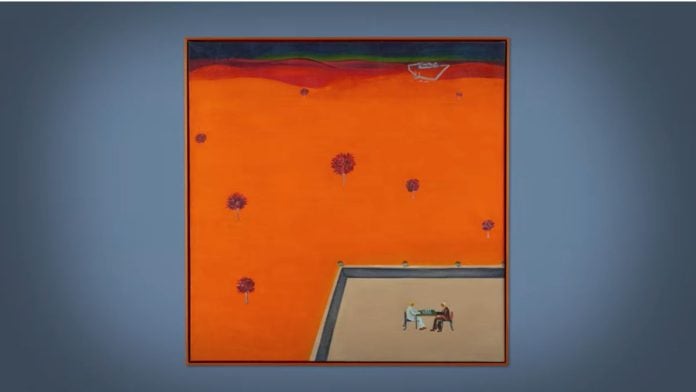

On 29 September, Bhupen Khakhar’s painting ‘Old Men Playing Chess’ sold at Sotheby’s London for $4.16 million, more than four times its high estimate and a record for the artist. The buyer has not been named.
The more interesting fact for collectors is where the painting came from: it was consigned directly by Khakhar’s Estate.
Sotheby’s explained why that matters to the work’s meaning. Manjari Sihare-Sutin, its Worldwide Head of Modern & Contemporary South Asian Art, told me:
“The significance of ‘Old Men Playing Chess’ goes far beyond the record price. Painted for Bhupen Khakhar’s seminal 1972 exhibition ‘Truth is Beauty and Beauty is God’, it was accompanied by an extraordinary manifesto-like catalogue in which Bhupen interpreted the works himself. Of the eight works in that exhibition, three remained with Bhupen and subsequently his Estate, and ‘Old Men Playing Chess’ was the last of those three still held by the Estate. That provenance gives the work a very particular connection to the artist and to this foundational moment in his career.”
“Bhupen has long enjoyed significant international institutional recognition, and it was particularly meaningful to see a work of this importance, coming directly from his Estate, meet such strong international demand. The £3.1 million result reflects not only the quality and history of this particular painting, but the growing international appetite for an artist whose place in the broader history of modern and contemporary art has long extended beyond the Indian context.”
Estate provenance is a strength. It also means that two legal systems met in this sale, and each answered different questions. English law governs the auction itself and decides whether the buyer took a good title, because the title to a painting passes under the law of the place where it is at the time of being sold. Indian law answered the earlier questions. Khakhar was an Indian artist who made Baroda his home in 1962, so Indian law decided who inherited the painting; and because the painting was in India, Indian law also decided whether it could leave. Once it left the country, those rules stayed behind: its next sale will be governed by the law of wherever it then is, and the heirs’ copyright is protected in each country by that country’s own law.
What stays with the heirs in India and in Britain
The buyer owns the canvas, not the copyright to the painting. In India, copyright passes only through a written assignment and lasts for 60 years after the artist’s death; for Khakhar, who died in 2003, that is until the end of 2063. Britain grants no longer a term: because the painting’s country of origin is India, UK law borrows India’s term. That rule comes from the Berne Convention, of which both India and Britain are members. Each country sets the term of protection for itself, but unless its own law provides otherwise, the term may not exceed the one fixed in the work’s country of origin.
This Khakhar sale could earn the heirs no resale royalty but perhaps a next sale is different. In India, since 1994, the Copyright Act has granted artists and their heirs a resale right on original paintings sold for more than Rs 10,000. It never appears to have operated: no forum has been asked to fix the share, and no case of an artist exercising it has been reported. A London resale raises an international question. Berne makes the right optional and reciprocal: it can be claimed in a country only if the artist’s own country also grants it. Britain grants it to the heirs of an artist whose state gives British artists the same protection. Whether Khakhar’s heirs could make a claim on a London resale, therefore, depends on whether Indian law extends its resale right to British artists.
Why this Khakhar could travel but a Ravi Varma cannot
Indian law also decided whether the painting could reach London at all. Works by Raja Ravi Varma, Amrita Sher-Gil, the three Tagores, Nandalal Bose, Jamini Roy, Nicholas Roerich, and Sailoz Mookherjea may not be exported without the central government’s authority. Their market is domestic by law. Khakhar’s is international by default, which is why an Indian estate could take one of his defining works to a London saleroom. Where it goes next is no longer for Indian law but for the country it is in to decide. To leave Britain, for instance, it needs an export licence, because it is more than 50 years old.
Also read: Jamini Roy to MF Husain, Delhi exhibition houses the many modernisms of Indian art
Three questions
For anyone buying from an estate, three questions follow from this sale. Who has the authority to sell under the law of the artist’s domicile, and can they show it? Which rights stay with the heirs in each country where the work will hang or be reproduced, and for how long? And is the work free to cross borders, now and when you come to sell it? The answers decide what a collector owns, much after the price is forgotten.
Anusha Madhusudhan is an Indian-qualified international lawyer specialising in art and cultural heritage matters. She tweets @itsAnushaM. Views are personal.
(Edited by Aamaan Alam Khan)