



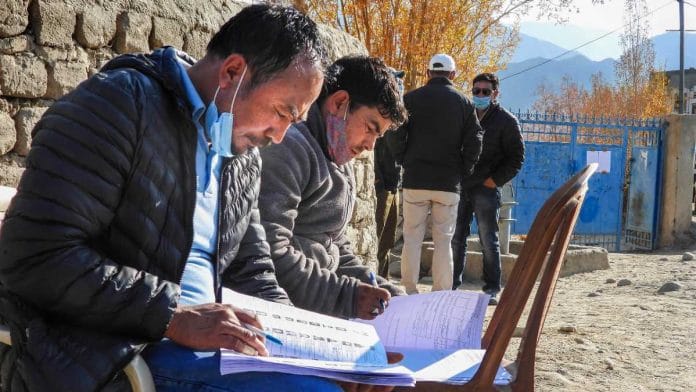
As Ladakh gears up for elections to its eight hill councils, the headlines are covering the parties, the campaigns and the protests over statehood and the Sixth Schedule. But the elections are also in the news for a somewhat strange reason: the weather.
The elections are scheduled for 4 December, which political parties and civil society groups describe as the peak of winter. On 10 November, Kargil even observed a bandh called by the Kargil Democratic Alliance over the polling date and other grievances.
The questions that need to be carefully examined are why the government chose to hold the polls in winter and why the date has become quite so contentious.
Also Read: Is CM Vijay making Tamil Nadu do a U-turn on federalism and state autonomy?
Ladakh’s first eight-council hill polls
On 4 December, voters in Ladakh will choose members of the Ladakh Autonomous Hill Development Councils (LAHDCs), which are district-level bodies with powers over local development and budgets.
Earlier, there were just two such bodies: the Leh council, formed in 1995, and the Kargil council, formed in 2003. But earlier this year, six new councils were constituted for the districts of Drass, Zanskar, Sham, Nubra, Changthang, and Sankoo. This will therefore be the first time that elections are held for all eight hill councils.
Delimitation of 100 constituencies across the eight districts is complete, with 36 of the 100 seats reserved for women. Leh has 22 constituencies, Kargil 21, Sankoo 13, Changthang 10, Nubra, Sham and Zanskar nine each, and Drass seven.
Councillors are chosen by the voters of each constituency, and the elected councillors then pick the council’s executive head. The Leh council’s members elected their Chief Executive Councillor in 2020, and the Kargil council’s members did so in 2023. Under the State Election Commission’s schedule, nominations close on 17 November. Polling, if required, will take place on 4 December between 8 am and 5 pm, and the process will end by 8 December. Panchayat and municipal polls will be held on 21 November, before the council vote.
Why the administration chose 4 December
The government’s case rests on the calendar and the budget. Chief Secretary Ashish Kundra said that if the polls are held now the newly elected councils would have more time to prepare their budgets by March for the next financial year. If the councils are constituted later, he said, the budget preparation cycle could be missed, delaying the process by a full year. He also argued that winter is not the barrier that critics are making it out to be.
Kundra said schools usually stay open until 15 December and cited improved road connectivity. He said there should be no particular difficulty for adults in voting on 4 December and called the polls an important step toward deepening democracy.
Why the opposition wants a postponement
The Kargil Democratic Alliance (KDA) and the Leh Apex Body are among the groups that have called for the polls to be postponed until after winter, arguing that the timing could shut out many voters.
KDA co-chairman Sajjad Kargili said around 20 to 30 per cent of Ladakh’s population, including students, the elderly and business owners, migrates to other areas in winter. Ladakh MP Mohmad Haneefa Jan made the same point, saying a December poll could deprive a sizeable section of the electorate of its right to vote.
Timing is not the only objection. The KDA called a shutdown in Kargil to protest against the winter date, alleged irregularities in delimitation and what it called the erosion of democratic rights in the Union Territory.
The dispute also touches on Ladakh’s larger constitutional demands. The KDA and the Leh Apex Body have campaigned for statehood and Sixth Schedule status. In talks with the Centre, they have also pressed for a Union Territory-level elected body with executive and budgetary powers.
Their worry appears to be that a hill council poll held on the administration’s terms leaves that demand unaddressed. Three organisations—the Ladakh Nambardar Association, the Ladakh Gompa Association and the Ladakh Buddhist Association—have announced a boycott of the panchayat and municipal elections.
Also Read: Chandrababu Naidu wants demonetisation 2.0. There’s still questions about the first round
Voter access is not a mere technicality
In a democracy, an election should rest on the basic principle that the public should be able to participate in it. It defeats the purpose if the participants, whether candidates or voters, lose confidence in the process. The issue in Ladakh highlights this very fact.
The State Election Commission’s push to hold the elections on 4 December, while the opposition points to the challenges of Ladakh’s bitter winter, raises the question of why the Commission is so determined to hold the elections at the earliest, even if, as the opposition says, this might lead to mass disenfranchisement.
The administration’s concerns about the budget cycle are real, and a delay of a year would be costly for the new councils. But the opposition’s concern is equally important. An election means little if a sizeable part of the electorate cannot take part in it or chooses to stay away. If students, the elderly and traders are away for the winter, the legitimacy of the councils elected in December will be open to question.
The question of access is more than a technicality. A date that suits the calendar but not the voters risks defeating the very purpose of the exercise.
Sanjay Kumar is a professor at the Centre for the Study of Developing Societies (CSDS) and an election analyst. Arindam Kabir is currently working as a researcher with Sanjay Kumar at CSDS. Views are personal.
(Edited by Asavari Singh)