


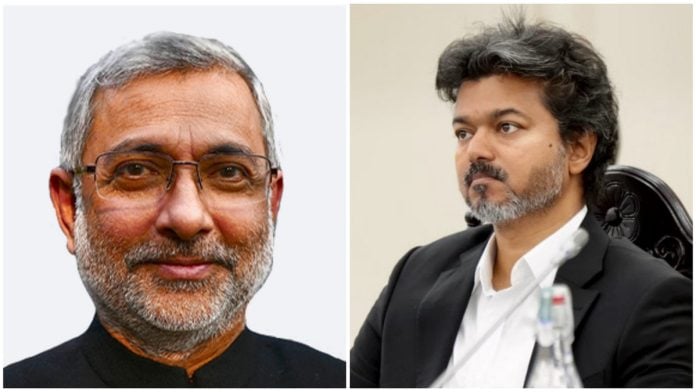
In his first six months as Tamil Nadu Chief Minister, Joseph Vijay has been very deferential to the powers that be in Delhi. While the country has been in turmoil over the Special Intensive Revision of electoral rolls and the Opposition’s bid to remove Chief Election Commissioner Gyanesh Kumar, Vijay has maintained a deadly silence. Some in the political arena have interpreted this as a sign of his fear of the BJP government at the Centre and his willingness to please its masters.
Until now, it was conjecture. But he has almost confirmed it by abruptly terminating the High-Level Committee on Union–State Relations, chaired by Justice Kurian Joseph, a former Supreme Court judge.
This Committee had been constituted by the previous Government of Tamil Nadu in April 2025 to examine the increasing challenges to federalism and state autonomy and find solutions.
Also Read: Tamil Nadu’s AI book scam is a massive failure of oversight
Kurian report’s case for more state autonomy
This was the fourth major exercise of its kind in India. The Rajamannar Committee (1969-71), constituted by the Tamil Nadu government, advocated important constitutional reforms to restore state autonomy. At the national level, the Sarkaria Commission (1983-1988) and the Punchhi Commission (2007-2010) examined Union-state relations and made numerous recommendations. Since then, several constitutional, fiscal, administrative and institutional developments in Centre-state relations have warranted a fresh and comprehensive review.
The Kurian Joseph Committee commenced work on 1 June 2025 and submitted Part I of its report to the Tamil Nadu government on 16 February 2026. The report addresses various challenges and gives several pragmatic solutions.
The committee proposed that every constitutional amendment bill must secure the support of at least two-thirds of the total membership of each House under Article 368(2). Barring a few exceptions, all amendments would require ratification by state legislatures under the double-majority rule. The report said Parliament must consider any proposal for a constitutional amendment adopted by at least two-thirds of state legislatures representing at least two-thirds of India’s population.
The committee also took up the issue of “gubernatorial overreach”. It recommends that the President should appoint as Governor one of three candidates approved by a majority of the total membership of the state legislative assembly. The Governor so appointed would serve a single, fixed, non-renewable five-year term and could be removed only through a resolution passed by a majority of the state legislative assembly. In other words, the Centre cannot recall the Governor at will, making him/her ultimately answerable to the state’s elected House.
All territorial reorganisation under Article 3, the committee notes, should require a state-specific constitutional amendment and the concurrence of the affected states. For creating a new state, if the legislature withholds consent, the committee called for a consultation with the people in that state. The President may order a referendum in the affected area, which will succeed only if at least three-fourths of voters participate, and two-thirds approve. No territorial reorganisation would be permitted during President’s rule. A new Article 3A would bar the creation of new union territories and require periodic referendums every 10 years for existing ones, except Delhi.
The report rejects the ‘One Nation, One Language’ idea and proposes replacing the three-language formula with a two-language formula. English is needed for economic mobility and global competitiveness, and the regional language or mother tongue for cultural continuity. It also called for amending Article 343 to constitutionally recognise English as a permanent official language of the Union.
On delimitation, the committee proposed extending the freeze on inter-state seat allocation, anchored to the 1971 Census, until 2126, or until the Total Fertility Rates of all states converge within a narrow band. It also demanded equal representation of states in the Rajya Sabha and suggested “a uniform allocation of six seats per State.”
On elections, the report rejected the ‘One Nation, One Election’ proposal. It suggested making members disqualified for defection ineligible to contest any election for six years. On the conduct of elections, the committee suggested returning to the division of responsibilities in Article 289 of the draft Constitution, which assigned elections to Parliament and to the offices of President and Vice-President to the Central Election Commission, and state legislature elections to the respective State Election Commissions.
The committee proposed transferring education from the Concurrent List back to the State List. It called for disbanding the National Testing Agency, abolishing NEET at all levels and restoring control over admissions to states and universities in line with public health needs. State control over medical education and workforce planning should be restored, and the Union should desist from intruding in the states’ domain, it said.
On GST, the committee demanded “restoring legislative supremacy” by clarifying that “the Council’s decisions are advisory, subject to the concurrent legislative powers of the Union and the States.” It also proposed establishing an independent GST Council Secretariat and a GST Dispute Settlement Authority—a three-member tribunal chaired by a retired Supreme Court judge.
Also Read: Vijay holds closed-door meet with TVK MLAs. His advice: exercise caution, think before you speak
An ‘incisive’ report
The report was laid before the Tamil Nadu Legislative Assembly in February. It was widely circulated, triggered constructive debates across the country and received accolades from a wide range of experts and others. Committee member K Ashok Vardhan Shetty compiled some of their responses.
KK Venugopal, former Attorney General of India: “I am glad that the report addresses matters squarely, takes note of the ills that currently beset us and offers meaningful remedies. The work done by the High Level Committee in bringing out this report is indeed commendable.”
Justice C Saravanan, High Court of Madras: “The Report is of considerable significance and will serve as a valuable reference in future on important issues relating to Union-State relations and constitutional governance.”
Ashok Lavasa, former Election Commissioner: “The analysis is incisive and the recommendations merit serious consideration.”
Sanjay Hegde, senior advocate, Supreme Court: “The Justice Kurian Joseph Committee . . . has produced the most comprehensive accounting yet of how far Indian constitutional practice has drifted from [its] founding design. . . [Tamil Nadu] deserves commendation for commissioning this inquiry. In an era when States are expected to remain quietly grateful for whatever autonomy the Centre permits, this act of constitutional assertion is itself a form of public service.”
Faizan Mustafa, vice-chancellor, Chanakya National Law University: “As someone who has taught Constitutional Law for three decades, I have no hesitation in saying that the very well written report, if implemented, would certainly strengthen fundamental constitutional principles of our liberal democracy and federalism.”
Gautam Bhatia, Constitutional Expert and Author: “A thoughtful and rigorous examination of the Constitution’s power-map, and a powerful proposal for a new and more balanced federal compact.”
Shetty included the report in his Substack, saying the committee’s official website may be taken down. Part II was to cover other important areas, including emergency provisions, interstate river water disputes, local government, climate change, Union-state legislative and financial relations, mines and minerals, and the Inter-State Council.
Vijay’s U-turn on federalism
On 6 November, with just over six months remaining before the 31 May 2027 deadline for submission of Part II and the research almost complete, the Vijay-led Tamil Nadu government ordered the discontinuance of the committee and transferred its unfinished work to the State Law Commission.
The government justified the decision on the ground that the Kurian Joseph Committee, which had been constituted by executive order, was a non-statutory body whose functions overlapped with those of the State Law Commission. This argument, however, is untenable because the Law Commission is also an executive body, first established in 1994 and reconstituted through executive orders.
This committee and its strong recommendations come in the middle of the BJP-led Union government recentralising political, fiscal and administrative power in India, thereby reversing the decentralising trends of the coalition era (1989-2014). India’s federal system has recently shifted towards greater central control due to four key factors: (1) the ideological orientation of the ruling BJP, (2) the return of one-party dominance, (3) the weaponisation of India’s election system and (4) the Prime Minister’s leadership style.
The key mechanisms of recentralisation include the weakening of federal safeguards, fiscal centralisation and the erosion of state autonomy through administrative control, political interventions and misuse of the office of the Governor. The move toward ‘One Nation, One Election’ would further concretise the centralisation of power. Such central control has undermined state autonomy and exacerbated intergovernmental tensions. It is evident that Modi’s governance marks a departure from cooperative federalism, emphasising a centralised national vision aligned with the BJP’s ideological and political objectives.
Dravidian governments in Tamil Nadu have been the strongest bulwark against this recentralisation and onslaught on the federal structure of India. Tamil Nadu has been in the vanguard of the fight for federalism and state autonomy since 1962, and these are the ‘Holy Grail’ for the Tamils. Any U-turn on these goes against the grain of Tamil Nadu and India’s constitutional scheme of things.
MG Devasahayam is a retired IAS officer and chairman of People-First. He also served in the Indian Army. He is the author of ‘Emergency and Neo-Emergency: Who Will Defend Democracy?’ Views are personal.
(Edited by Asavari Singh)