






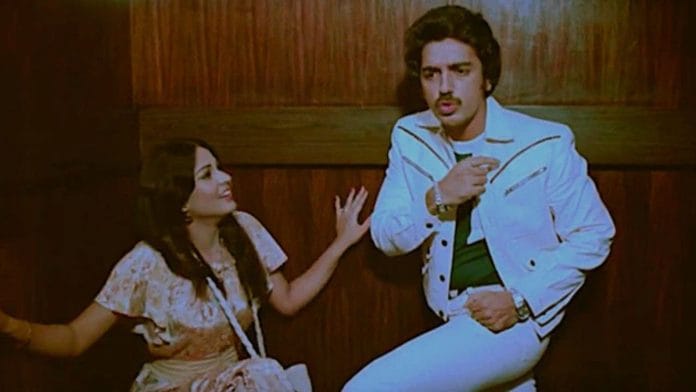


More than three decades before Bahubali caught the popular imagination, and eleven years before Mani Rathnam released Roja in Tamil and Hindi, legendary producer-director of Telugu and Tamil cinema, K Balachander, had made a crossover film unlike any other. The film was Ek Duuje Ke Liye and it was released in Hindi.
Balachander, a recipient of the Dadasaheb Phalke Award, was known for making films with a powerful emotional core. Human relationships were his forte. Many of his films touched upon unconventional or taboo subjects. His greatest strength was storytelling. These stories were meant to provoke and challenge the mores of Indian society.
Balachander put human beings under a microscope and depicted all aspects of the human condition—good, bad and ugly. He enjoyed exposing the hypocrisy of Indian society through his film and non-film writings. MG Ramachandran, Gemini Ganesan and Jayalalithaa were keen to act in a film written or directed by him.
Two contemporary superstars of Tamil cinema, Kamal Haasan and Rajinikanth, consider Balachander their mentor. He gave them several meaty roles to sink their teeth into. Notable among these are Apoorva Raagangal (1975) and Avargal (1977). Moondru Mudichu (1976), also starred Sridevi, another Balachander protégée, along with Rajini and Kamal.
It wasn’t surprising therefore, that Balachander chose Kamal Haasan for his first Hindi blockbuster.
Ek Duuje Ke Liye wasn’t Balachander’s first foray into Hindi films. In 1974, he co-wrote (along with Inder Raj Anand) and directed the Hindi film Aaina, which had Mumtaz in the lead role.The film was a remake of Balachander’s own Tamil film Arangetram (1973). Kamal Haasan worked as assistant choreographer in the Hindi version and also made an uncredited appearance. The film follows a Brahmin girl who resorts to prostitution to support her large family. The story was perhaps too bold for the Hindi audience, and the film opened to a lukewarm response. The Tamil version, on the other hand, was a critical and commercial success.
Also read: In Angry Young Man era, Khel Khel Mein stood out for its wisecracking rogue — Rakesh Roshan
A new kind of hero
In 1978, Balachander directed a Telugu film Maro Charitra which dealt with a cross-cultural romance between a Tamil man and a Telugu woman (played by Kamal Haasan and Saritha).The film was not only a commercial success but attained cult status over the years.
Ek Duuje Ke Liye is a Hindi remake of Maro Charitra.
To emphasise the cultural divide for a North Indian audience, Balachander re-wrote the film as a doomed love story of a Tamil man, Vasu, and a North Indian woman, Sapna. The male lead was played by Kamal Haasan. It was his Hindi debut.
Balachander picked a relatively new actress, Rati Agnihotri for the female lead. Twenty-year old Rati Agnihotri had acted in a few Tamil and Telugu films before, but Ek Duuje was her Hindi debut.
The film had Madhavi and Rakesh Bedi (of Dhurandhar fame) in important supporting roles. The film was set in Goa, Hyderabad and Mangaluru. The song sequences were mostly shot on the beaches of Goa and Vishakhapatnam (where the Telugu original was set).
The film was released in 1981. In those conservative, post-Emergency years most commercial film makers were making escapist cinema, with the exception of middle-of-the-road film makers like Gulzar, Basu Chatterjee and Hrishikesh Mukherjee. Realism was considered the forte of art cinema. As for leading men, the Angry Young Man of the 1970s, Amitabh Bachchan, and his contemporaries like Dharmendra and Vinod Khanna, were slowly yielding space to younger actors like Rishi Kapoor, Sanjay Dutt and Sunny Deol.
The leading man of Hindi cinema of the 1980s was more often than not a fair, clean-shaven, North Indian beefcake who could bash up a dozen men to protect his lady love (whose sole job often was to merely adorn her man’s arm). Balachander rode boldly into this hypermasculine landscape, determined to bring his social drama film, bereft of macho males, into Hindi cinema. Kamal Haasan was not your usual hero. Hindi cinema audiences had never seen a moustachioed, lean, lithe man romance the heroine. Not only was his body language more graceful than most, he even danced the Bharatanatyam! In one fell swoop, Balachander had smashed the stereotype of the leading man.
True to his character, Balachander didn’t flinch when it came to laying bare the prejudices that Indians bear toward each other. Most Indian communities are parochial, and even today, tend to judge those from “other” communities on their language, attire, food and customs.
Cross-cultural marriages were rare in that decade. Parental opposition was a trope that was very popular with audiences, because it mirrored the reality of 1980s India. Hence Hindi films like Kumar Gaurav-Vijeta starrer Love Story, which was also released in 1981, found wide acceptance. Sunny Deol and Amrita Singh’s debut film Betaab (1983) had a similar theme. Both these films had a happy ending, where the lovers are united forever after a lot of song, dance and drama.
Ek Duuje Ke Liye twisted this trope, and brought several realist elements into the film, like the stalker who keeps pursuing the heroine till the very end.The plot follows two young next door neighbours in Goa. They fall in love but their parents are shocked and refuse to accept their alliance because of their completely different cultural backgrounds. Their parents lay down a condition—the young lovers should stay apart for a year to test their love. They agree. After many misunderstandings and a lot of heartbreak, the lovers head toward their favorite ruins in Goa in hope of being reunited. But fate has other plans in store.
The two young lovers realise that the world won’t let them live in peace. In an act of desperation, they hold hands and jump off a cliff.
Also read: 1976 film Chhoti Si Baat is one of Bollywood’s most progressive portrayals of masculinity
Tragic love story
The introductory scene between the neighbours sets the tone for what is to come. The loud and cantankerous North Indian matriarch played by Shobha Khote, throws egg shells in the open, which the wind carries into the neighbour’s garden. These shells land in the Tamil patriarch’s hands as he worships the morning sun. The lady refuses to apologise. This scene heralds the beginning of an unpleasant relationship between the neighbours, characterised by daily bickering which escalates soon, resulting in open hostility.
The language divide that has resurfaced today, with Hindi and Tamil speakers insisting that their language be accepted and spoken by the other, was tackled quite boldly in EDKL. The girl’s mother and the boy’s father insist on speaking their respective native language while looking down upon the “other” language. The young are seen to be more accepting and accommodating. They insist that love has no language. Vasu offers to not only learn, but to compose a poem in Hindi for the sake of his lady love. This was Balachander’s way of showing the mirror to prejudiced Hindi-speaking audiences.
Fortunately, no one took offence at such scenes when the film was released. As we all know,the world loves a good love story, especially a tragic one. Hence the film became a pan-India hit.
The character played by Madhavi, a widow named Sandhya who is both mentor and companion to Vasu, was well received. These unconventional relationships were commonplace in Balachander’s films. For instance, Apoorva Ragangal’s protagonists were two couples with a very large age gap—a widower is in a relationship with a much younger woman, and his son falls in love with the mother of the same woman.
Ek Duuje Ke Liye was driven by melodrama and powerful performances. The music composed by Laxmikant-Pyarelal made a tremendous contribution to the success of the film.The songs captured and enhanced the mood of the film brilliantly-for instance, the initial lovers’ ditties such as duets Hum Baney Tum Baney and Mere Jeevan Saathi are sunny, whereas the later songs of heartbreak such as haunting track Solah Baras Ki Baali Umar sung by Lata Mangeshkar,evoke in the viewer emotions of despondency, and empathy towards the lovers.
In an interview to The Hindu, playback singer SP Balasubramaniam mentioned that Laxmikant was not happy with his voice. “Because he had not heard me before that. He said ‘This Madrasi boy — for them everybody from the south was a Madrasi — he may not do justice to my Hindi composition’,” Balasubramaniam said.
But Balachander insisted that SPB’s accent wouldn’t matter because the hero struggles with speaking Hindi until the very end of the movie. Balasubramaniam ended up making a smashing debut in Hindi cinema. EDKL earned him the National Award for Best Playback singer (Male) for the song Tere Mere Beech Main. Lata Mangeshkar made a terrific team with SPB.
Anand Bakshi, who brought the Tamil terms Apadiya (really?), Rumba (very) and Nalla (nice) into the Hindi film music lexicon, won the Filmfare award for Best Lyricist for Tere Mere Beech Main.
The track’s longevity can be judged by the fact that pop star Britney Spears sampled it to create the hook of her Grammy-winning hit Toxic (2003).
The opening lines of Hum Tum Dono Jab Mil Jayen, a song that plays as the lovers have settled well into their trial separation, act as an indicator of what’s to come –
Hum tum dono jab mil jayenge, ek naya itihaas banayenge
(When we are finally united, we will create history)
Aur agar hum na mil paye toh, toh bhi ek naya itihaaas banayenge
(And if we are unable to get together,we will still create history).
The powerful saga of the ill-fated lovers definitely made history, beyond box office statistics. Impact of the film was so powerful that there were some media reports of lovers dying by suicide after watching the film.
Balachander changed the climax to a happy one at the request of certain social organisations but had to restore the original ending under pressure from fans.
EDKL brought a breath of fresh air into Hindi cinema.The film forced Hindi cinema to recognise diversity—of how leading men and women should look, their body language, the spoken languages of lead characters (the film was released without any subtitles despite having dialogues in Tamil), the playback singers, the milieu, the atmosphere and the cultural mores of society. The South Indian was no longer “the other”. They had become the protagonist.
There was a time when the “Madrasi” man in a Hindi film was a subject of much mirth—Master Pillai played by Mehmood in Padosan was the perfect example of this caricature. EDKL threw this caricature out of the window.
More than three decades before Hindi film audiences warmed up to Prabhaas playing Baahubali and Allu Arjun’s one liner “Pushpa jhukega nahi saala” became the rage, Kamal Haasan had already shown North Indian audiences that the ‘Madrasi’ man could be the hero.
Nirupama Kotru is a senior civil servant. Views are personal.
(Edited by Theres Sudeep)