



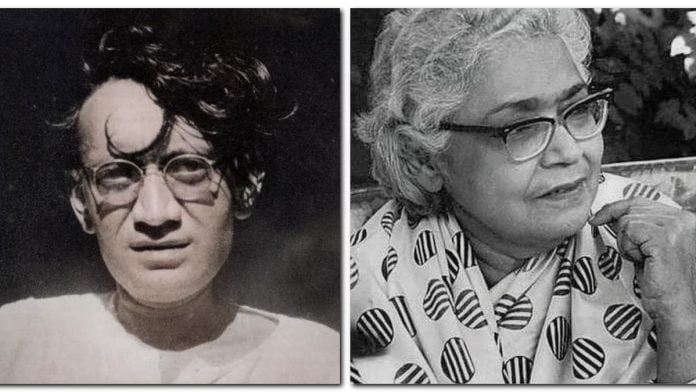
Eighty-one years ago, legendary Urdu storytellers Saadat Hasan Manto and Ismat Chughtai were charged with obscenity by the British colonial rulers under the Indian Penal Code. In November 1946, they emerged as winners for free speech in landmark cases that are as relevant today as they were then.
The storyteller’s tale in India is closely tied to these two shining stars of modern Urdu fiction. They gave literary expression to social realities and changed the course of fiction-writing in the country by giving voice to what was once considered unspeakable.
Manto (1912-1955), considered the finest short story writer ever born, as we Punjabis like to boast, was born in the tiny village of Samrala. His art lay in laying bare what he witnessed in the world around him. He exclaimed to a judge in court, “A writer picks up his pen only when his sensitivity is hurt.” His partner in ‘telling all’ was Chughtai (1915-1991), who minced no words when it came to baring the fault lines of a hypocritical society.
Around the same time in the 1940s, both came under the radar of the British colonial authorities. The story that Chughtai was summoned for was ‘Lihaaf’ (The Quilt). It drew attention to same-sex love, and the shock for the times perhaps was that the protagonists were women. Manto’s story ‘Bu’ (Odour) explored psychological obsession and human desire. They fought the court battle side by side.
Also Read: Javed Akhtar’s ‘Mamu’ & John Keats of Urdu poetry—Majaz Lakhnavi’s verses outlived him
Justice and juttis
These two writers, then based in Mumbai and great admirers of each other’s writings, were to come together as partners in crime in a Lahore court for writing what was considered unsayable in their times.
Pre-Partition India revelled in keeping the vagaries and whimsies of intimacy under cover at all costs! But these two progressive writers viewed silence about the realities of life, with all their rough and tumble, as a pretence they could not be partners to. So they left the comfort of their chosen city of Mumbai, then Bum-Bum Bombay, packed their bags and reached Lahore, the capital of undivided Punjab, to face trial in 1945.
Given those times, it was not a case that any lawyer would have taken up easily. But an upcoming lawyer in his thirties, with an interest in literature and great admiration for the two bold writers, came forward to defend them. He was none other than Hira Lal Sibal, father of well-known lawyer and politician Kapil Sibal.
The readers and admirers of the two writers stood by them, including eminent writers such as Faiz Ahmad Faiz, Rajinder Singh Bedi and Ahmad Nadeem Qasmi. Many offered to pay the fines. But neither Manto nor Chughtai was willing to bow down. Nor was their young lawyer, who would go on to become a legend of the Chandigarh High Court, a Padma Bhushan recipient and a ‘Living Legend of the Law’, as honoured by the International Bar Association.
He would later relate fond memories of the trial to me: “I argued that the intention of the authors was not to promote immorality but to bring forth the reality of human truths that were often pushed under the table. I also pointed out that specific words could not be pulled out as obscene and it was spirit and intention of the complete text that had to be understood.”
The defence successfully established that words such as ‘aashiq’ and ‘chest’ were not obscene and both writers were acquitted of the charges.
Manto did not have to pay a fine, but prejudice against women daring to write on matters such as these resulted in a fine of Rs 50 being slapped on Chughtai.
Looking back, she would laugh and recount: “Back in Mumbai, when asked what I had gone to Lahore for, I would end their curiosity by saying, to buy shoes. Well, that was not a lie, for both Manto and I bought beautiful Punjabi juttis (shoes) from the Anarkali Bazaar of Lahore.”
This was her little joke about the two coming out as winners, although the intention had been to hurl shoes at them!
Nirupama Dutt is an author, poet and journalist. Views are personal.
(Edited by Asavari Singh)