




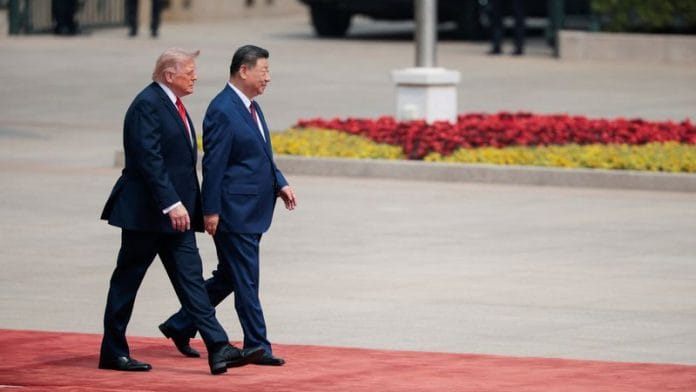

United States President Donald Trump has landed in China for the first time in nine years. The world has changed radically. The relationship has not.
History has a habit of recycling geopolitical anxieties. For the past decade, every serious conversation about the US and China has eventually loomed toward the same spectre: the Thucydides Trap.
“What made war inevitable,” wrote Thucydides, chronicling the rivalry between Athens and Sparta in 400 BC, “was the growth of Athenian power and the fear which this caused in Sparta.”
Harvard professor Graham Allison revived the concept for contemporary geopolitics, particularly the China–US rivalry. In his book Destined for War (2017), Allison analysed 16 historical cases where a rising power threatened to displace a dominant one. In 12, the outcome was war. The exceptions, he argued, required extraordinary leadership, restraint, and a willingness to subordinate short-term pride to long-term stability. That remains a demanding checklist—and it is not obvious that either Washington or Beijing is meeting it; the former even less so.
The ghost of Thucydides in Beijing
The Beijing summit of May 2026 has done nothing to bury the existing framework. Chinese Premier Xi Jinping has repeatedly invoked the T-Trap while speaking of America’s decline and China’s rise, drawing not-so-subtle parallels between Athens and Sparta. It’s a veiled warning for Washington not to cross Beijing’s red lines, especially on Taiwan.
Trump’s response was, to say the least, classic Trumpian. After meeting Xi in the Forbidden City, he took to Truth Social the following morning, rejecting any notion of American decline and blaming it all on “Sleepy Biden”. Instead, he projected strength—beaming of victories in Venezuela and Iran, stating that his military campaign in the latter would continue.
But bluster and self-flattery are hardly new.
Nine years and a world apart
Trump’s first state visit to China in 2017 was wrapped in ceremonial warmth, commercial optimism, and a private dinner. It promised over $250 billion in business deals. Trump called Xi a “very special man”, beginning a pattern of praise that survived even the trade war he launched less than a year later.
What followed—tariffs, technology restrictions, the Covid-19 pandemic, recriminations over supply chains, and mounting tensions over Taiwan—meant that Joe Biden never visited China at all. The relationship under him was defined by managed hostility rather than any pretence of warmth or flattery.
The high point of that hostility came in August 2022, when then-US House Speaker Nancy Pelosi visited Taiwan, triggering massive Chinese military exercises and raising fears of a Fourth Taiwan Strait Crisis.
Those were also the early months of Russia’s full-scale invasion of Ukraine. Much water has since flowed under the bridge. The Ukraine War drags on, the West looks fragmented, the Middle East hangs in a prolonged state of no peace and no war, even as the Strait of Hormuz remains disrupted.
China, meanwhile, has used these years strategically. It has expanded its lead in renewable technologies, deepened its position across the emerging economies, and diversified more than half of its trade away from the US and Europe toward developing markets. At the same time, it has watched with discomfort as Washington became increasingly aggressive and yet entangled in Iran with no clear exit strategy.
Also read: Dhaka is afraid of BJP-ruled Bengal
Four Ts of US-China relationship
The summit agenda is crowded, but four issues, though misaligned, dominate: trade, technology, Taiwan, and Tehran.
On trade, Washington wants Beijing to buy more American goods—particularly Boeing aircraft and agricultural products such as soybeans. There have been reports on a likely “board of trade” and “board of investment”, institutional mechanisms designed to lend durability to bilateral agreements.
China’s interests are different. It is navigating domestic economic headwinds and seeks stability above all else: no fresh technology restrictions and no new shocks to supply chains already strained by the Gulf crisis.
The stance on artificial intelligence remains ambiguous. The US and China are the two dominant powers in the field, and both understand that the way they manage this competition will shape the future digital order. Yet, neither side is certain what a feasible framework would look like—or whether domestic politics would allow one.
Then there are rare earths. China dominates global rare earth processing, while the United States retains a lead in advanced chip technologies. Both sides remain locked in a broader struggle over export controls, though there is consensus that neither wants the fragile truce of 2025 to collapse.
And then, there is Taiwan—Beijing’s central red line.
Xi has pressed Trump directly on the issue, seeking movement on America’s long-standing policy of strategic ambiguity. Beijing wants the US to oppose Taiwanese independence as well as greater transparency and prior notifications on American arms sales to Taipei.
Trump has not announced any formal concession on Taiwan, apart from delaying a new $13 billion arms package.
Yet, he has gone further than previous administrations by indicating a willingness to discuss arms sales with Xi. Critics argue that the move edges away from the spirit of the Six Assurances that underpin America’s Taiwan policy.
Whether this represents genuine strategic recalibration or merely Trumpian theatre remains uncertain. But it has already handed the US president a useful media narrative on the fourth T: Tehran.
US, China’s interests in Iran
It is on Iran that the US-China summit has produced its most instructive outcome so far.
Trump claimed that Xi agreed the Strait of Hormuz “must remain open” and that Iran “can never have a nuclear weapon”. For Washington, that is not insignificant. Securing such Chinese alignment on Hormuz and Iranian nuclear ambitions matters at a time when the strategic outcome of Trump’s “Epic Fury” campaign remains obfuscated. It isolates Iran’s Islamic Revolutionary Guard Corps further.
Here, context matters.
China is the world’s largest buyer of Iranian oil, yet it is also heavily dependent on energy imports from the Gulf states, which have already faced disruptions. Nearly half of China’s daily crude imports come from the Gulf, alongside LNG, petrochemicals, and helium, which is critical for its semiconductor and electronics industries.
China’s helium dependence reveals its vulnerabilities. Having ended helium reliance on the US, Beijing now depends heavily on Qatar and Russia, but mainly on Doha. Sustained disruption around Hormuz would therefore pose not only an energy problem but also a technological one.
This explains why Beijing was always likely to oppose prolonged instability in the Gulf—sheer economic necessity despite the cushion of its vast strategic reserves.
Trump may have extracted a tactical understanding from Xi, even without a joint statement yet, but whether China meaningfully pressures Tehran remains another question entirely.
China’s record suggests caution. Beijing has frequently assured Europe that it would encourage restraint from Russia over Ukraine while simultaneously benefiting enormously from discounted Russian hydrocarbons under sanctions.
The Gulf, however, is a different game. Iran’s war with its neighbours threatens a regional order on which China’s far larger economic relationships with Gulf monarchies depend.
For Xi, tactical cooperation on Iran with Washington may also carry domestic value. Any perception of extracting concessions from the US on Taiwan strengthens his standing within the Communist Party at a time when he has purged almost everyone in his pursuit of consolidating power internally. A contingency over Taiwan in 2027 looks operationally unlikely.
At the same time, America’s allies—Japan, Australia, South Korea, and partners such as India—are recalibrating rapidly. Trump’s rhetoric on allies and burden-sharing has introduced uncertainty into the Indo-Pacific, even if the broader US grand strategy has not fundamentally shifted.
Also read: Tamil Nadu’s debt is not necessarily bad. It’s a sign of growth
The Trap, revisited
The Thucydides Trap is not decided by a single summit. It emerges incrementally through misread signals, accumulated mistrust, and the erosion of structural conditions that avoided conflict.
US Secretary of State Marco Rubio, who travelled to Beijing despite active Chinese sanctions—perhaps a historic first for his rank—framed the outcome reasonably. The US, he said, was not asking China for help with Iran.
It was an honest and revealing formulation. Washington understands that any Chinese cooperation on Tehran will remain transactional, conditional, and bound entirely by Xi’s self-interest.
What the Beijing summit of May 2026 reveals is that the architecture of the relationship is being renegotiated in real time. And the advantage may ultimately lie with the side possessing greater patience, greater strategic coherence, and a clearer understanding of what the other is willing to concede and what it will not.
That said, the fact remains that current geopolitics is marked by talks of a long game and short-term shocks of the unexpected.
Swasti Rao is a Consulting Editor (International and Strategic Affairs) at ThePrint. She tweets @swasrao. Views are personal.
(Edited by Prasanna Bachchhav)
China’s rise is not contingent on USA’s decline. However, USA is growing increasingly paranoid about China. Its manufacturing prowess, export performance, domination over technologies of the future. Renewable energy of value to all other countries, including in Global South. It is USA that talks of decoupling, deglobalisation, tariffs. 2. What the summit has demonstrated to the world is that China is acting like a responsible superpower. Does not abduct the President of Venezuela and his wife in the middle of the night. Does not launch joint strikes ( with Israel ) on Iran in the midst of serious negotiations. Has granted Zero tariff access to 53 African countries to its market. 3. On Taiwan, President Xi has showed willingness to go to war with USA. A message also meant for PM Sanae Takaichi who started her tenure with an expansive statement on offering security support to Taiwan. 4. This visit underlines the need for India to recast its USA and China policies. Quite extensively.