




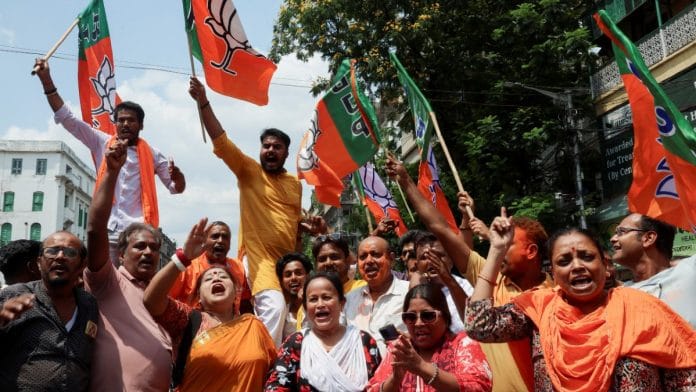

An unexpected development following the West Bengal Assembly election result has been Bangladesh’s response to Chief Minister Suvendu Adhikari’s push for stricter border fencing in the state.
Humayun Kabir, the foreign affairs adviser to Bangladesh Prime Minister Tarique Rahman, told reporters that he was “not afraid of barbed wire”. It’s an amusing response — why should a peaceful nation have any issue with a neighbouring country securing its border?
While Kabir said that Bangladesh has no interest in interfering in India’s internal matters and would engage only with the central government through dialogue, his reaction suggests something else.
It’s evident that the BJP’s victory in West Bengal has created a sense of unease within Bangladesh. For sections of Bangladesh’s political establishment, the Trinamool Congress being in power created more room for accommodation during negotiations over water sharing, border management, and security cooperation.
But with the BJP now in power both at the Centre and in the state, there is an expectation that India’s eastern policy may move with greater coordination and efficiency in India’s interest—while leaving far less room for accommodating Bangladeshi concerns.
That may also explain why Bangladesh now seems more open toward looking at China for investment and technical expertise around the Teesta River.
If anything, the Bangladeshi diplomat’s statements seem more like a response to assumptions and political anxieties than to any immediate reality. At the same time, Bangladesh still talking about dialogue is a positive sign, and that is where India needs to work carefully. For a long time, Bangladesh has remained within India’s sphere of influence; if that starts changing, it would also reflect a failure of Indian diplomacy and strategic outreach.
Also read: Tarique Rahman’s govt is on a mission of de-Yunusification. It will fix India-Bangladesh ties
Distrust can’t define India-Bangladesh ties
It is interesting to see such reactions over borders that are ultimately supposed to work in the interest of safety for both nations. Border fencing is not only about illegal infiltration, but also smuggling, trafficking, and broader security concerns.
That is why Bangladesh’s appeal to India to maintain a “humane approach” seems stretched. After all, India’s military and political intervention in 1971 did play a major role in Bangladesh becoming a sovereign nation.
At the same time, history also gives India legitimate security concerns and New Delhi has every right to look after its own interests without immediately being viewed with suspicion.
India’s relationship with Bangladesh has never been only about border security or politics. New Delhi has always supported Dhaka through financial aid, development projects, infrastructure support, and Lines of Credit over the years. Just recently, India sent 5,000 tonnes of diesel as fuel assistance.
During the Rohingya refugee crisis in 2017, India helped Bangladesh manage the massive influx of refugees fleeing violence in Myanmar under Operation Insaniyat.
Beyond governments and diplomacy, there is another dimension of India-Bangladesh ties that often goes unacknowledged. India gave refuge to author Taslima Nasrin, standing by her right to exist and speak freely despite the threats and controversy surrounding her.
This is why the tone adopted by Bangladesh’s foreign affairs adviser seems misplaced.
Bangladesh also needs to remember the shared history between the two nations. Not every Indian security measure should immediately be seen through the lens of hostility or offence. Every country will ultimately protect its own interests; India is no different.
In the end, both nations need to find a way to work together while respecting each other’s sovereignty, because geography and history have tied them too closely for constant distrust to become the foundation of the relationship.
Amana Begam Ansari is a columnist, writer, and TV news panellist. She runs a weekly YouTube show called ‘India This Week by Amana and Khalid’. She tweets @Amana_Ansari. Views are personal.
(Edited by Prashant Dixit)
Why should it be. Bangladesh’s per capita income is slightly higher than India’s, a lot more than Bengal’s. Intuition suggests there is no reason for illegal immigrants to swarm in. 2. PM Tarique Rehman will be making his first official visit to China. Also a lot of warmth with Pakistan. USA now deals with Nepal, Bangladesh, Maldives independently of India, widening their options. 3. Transit rights through Bangladesh – road, rail, river – are important for the north east. I think it would be in India’s interest to repair the frayed relationship.
They should be afraid as they have send their dear citizens to come and live here illegally on aadhar card and ration card .Neither central govt or congress or tmc takes it seriously..btw I am from kerala and here also many illegeal Bangladeshis were found living in cities of kerala like Ernakulam on fake id’s for 14 years