







On my recent visit to London, I was an accidental spectator to a city consumed by a feverish passion for a sport I never took a great fancy to: football.
Some of my previous visits were associated with a game I like: tennis. Thanks to an indulgent sports editor who was willing to experiment with someone outside his department, I covered the Wimbledon Championships, for The Hindu for a few years.
There was a genteel, decorous air that pervaded the tournament, so pervasive that it could soak up Rafael Nadal’s trademark grunts, subsume the occasional raucous cat-call by an over-excited spectator, and allay the maddening rush of deadline-fuelled anxiety.
As I returned to my Central London hotel after filing my nightly reports, the city seemed impervious or unaffected by what took place in that corner of a foreign field in SW19, a bubble where sweat and athletic exertion was tempered by icy pitchers of Pimms, punnets of strawberries and soft sun-kissed afternoons.
More than a club
London was very different this time around. Football was in the air, in your face. English Premier League (EPL) champions Arsenal were set to play French giants Paris Saint-Germain (PSG) in the final of the UEFA Champions League in Budapest, Hungary. The following day, the north London football club was to hold a rally, irrespective of the Budapest outcome, to celebrate their victory in the EPL, England’s premier football competition.
It was impossible to miss the number of red and white Arsenal T-shirts on people a week before the Champions League final. There were animated conversations in cafes, cheery exchanges between strangers, and chants of ‘whatever the weather, the streets are our own’.
They did own the streets, particularly on the day of the match, where people crowded inside and outside pubs, alternatively despairing and exulting, tearing up and cheering, their hearts in their mouths and on their sleeves. Arsenal lost in the penalty shootout after holding PSG 1-1, but the disappointed fans had the following day’s celebrations to look forward to.
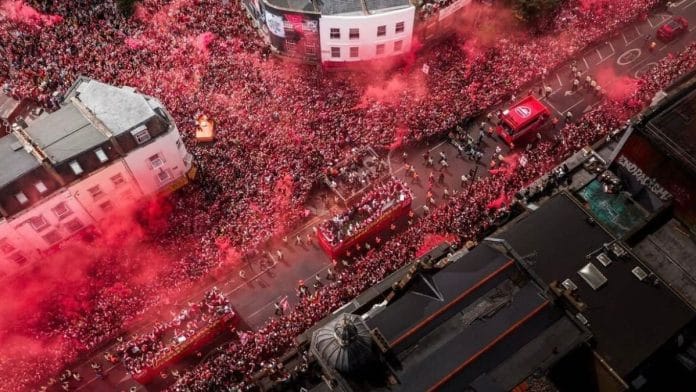
On that Sunday, an estimated 1.5 million Arsenal fans showed up to cheer the open bus victory parade through the borough of Islington. In percentage terms, this amounts to more than 17 per cent of people in the Greater London area and more than 2.5 per cent of the population of England. And remember, this was to honour a club, not a national team.
There were, of course, global celebrations as well in places as far flung as Dubai, Kenya, Indonesia, India and many other countries. In football-fanatic Kerala, an Arsenal fan club booked a 1,000-seater hall in Kochi to watch the UEFA final. There was an open bus rally in Kozhikode, and celebrations were reported from other places such as Kolkata, Bengaluru and Mumbai.
Also read: Japan is Asia’s best shot in the 2026 FIFA World Cup. Expectations have never been higher
A cricket-like sport
What is it about football that makes it so globally popular and invested with so much passion?
This is best addressed as two separate questions. The main reason for the first one is simple and well-known. Football is the most accessible and the least gear-heavy major sport. It is also pretty adaptable.
A beach or an empty patch of land can serve as a ground, a couple of sticks or even slippers as goal posts, and barefoot gets the job done if you can’t afford shoes. This is why it took root in the relatively poorer nations of Africa, Asia and Latin America. The legendary Diego Maradona, whose ball-on-a-string dribbling was honed in a shanty town near Buenos Aires, was not the only player who owed his greatness to street football.
There is a cricket parallel here, which holds at least in South Asia, where subcontinental ‘jugaad’ with its frugal innovations has tightened the game’s magic-like grip on the people. Durable rubber balls instead of expensive leather cherries, wickets chalked on walls, residential alleys and parking lots serving as playing grounds, and rules that adapt to the area (for instance, out if you hit into the street or onto a nearby balcony) are some of these innovations that have made gully cricket an almost universal form of recreation.
Anyone who grew up in a small town in Kerala, as I did, will know that the thick stalk (petiole) of a coconut frond can make a pretty nifty cricket bat.
Also read: Football needs Brazil to be Brazil again. Carlo Ancelotti might just be the right person
Nice try, IPL
The passion and fierce loyalties football engenders are harder to explain and cannot solely be attributed to its popularity. I suspect, counterintuitively perhaps, that this is because there is a sense in which football is really a slow game. It does not yield the frequent highs of other games—be it aces or passing shots in tennis or wickets or boundaries in the shorter forms of cricket.
You could wait a long time for a goal, as I did mid-match with some beer-swilling strangers outside a London pub. In this case, the second strike from Arsenal never came. The anticipation of something that takes a long time coming creates a diverse range of feelings—exasperation, anxiety and hope being just three—and a flash of explosive relief when it does come. It is the preceding creative tension that makes fans cry, strangers hug and create those moments of communal rapture.
At home, the Indian Premier League (IPL) has used the European Club model, with its deep tribal loyalties and intense rivalries, to emerge as one of the world’s richest sports leagues. Financially, it is a staggering success, having surpassed in just 15 years the valuation of the EPL, which is more than twice its age.
I don’t think that the IPL has fostered a similar sense of belonging and community as the EPL, though. The thought crossed my mind outside the pub in the Bloomsbury area, when the bearded bloke standing next to me wrapped a friendly arm around my shoulder while explaining one of the game’s finer points. Okay, it wasn’t quite a hug. But I couldn’t help thinking —would this be regarded, in any other context, as a reckless display of affection for an Englishman?
Mukund Padmanabhan is a professor of philosophy at Krea University and former Editor of The Hindu. Views are personal.
(Edited by Saptak Datta)