







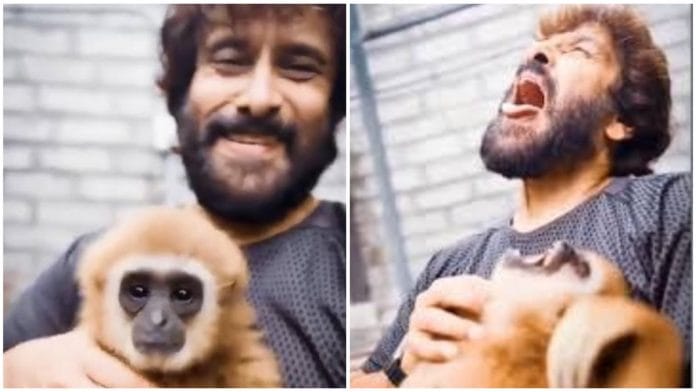


A viral video of Tamil actor Vikram cuddling a Lar gibbon at a private home in Chennai has set off a probe into how the endangered primates arrived there. It’s also put a spotlight on the murky yet booming world of exotic pet trade in India.
The case points to a bigger problem in India’s wildlife governance. While there are regulations for possession and movement of exotic animals, oversight and enforcement remain a challenge.
Until February 2021, more than 40,000 individuals across 30 Indian states had voluntarily declared possession of exotic pets under a disclosure scheme by the Ministry of Environment, Forest and Climate Change. It was the first credible glimpse of a market that has grown largely in the shadows. The country’s exotic pet sector was valued at USD 42.6 million in 2024, with industry projections placing it at nearly USD 76 million by 2030. Yet the trade has not been governed with any commensurate seriousness.
We recently published a report, Safeguarding Biodiversity and Public Health: A Legislative and Policy Analysis of Exotic Pet Trade in India, along with Kritika Balaji, an independent researcher, in an attempt to map, comprehensively, what this trade costs beyond the transaction.
Drawing on legislation, published literature and domain expertise, our report examines four interconnected areas: public health risk, ecological harm through invasive species, strain on public institutions and animal welfare. Across all four, it finds a trade that has consistently outrun the governance systems meant to contain it.
Also Read: Coffee, community, conservation—how a Karnataka coalition is working for people and elephants
The health dangers of exotic pet trade
The public health case is perhaps the most urgent. An estimated 75 per cent of emerging infectious diseases are zoonotic in origin, and the conditions of the exotic pet trade — live animals transiting multi-country supply chains, crowded into markets alongside domestic livestock and handled by enforcement officers and private owners with minimal biosafety training — are near-ideal for pathogen spillover. Reptiles commonly carry salmonella; exotic birds can transmit avian influenza and psittacosis; non-human primates carry pathogens capable of causing fatal encephalitis in humans.
The risks are not theoretical. In May and June 2025, customs officials in Bengaluru and Mumbai intercepted consignments containing venomous species for which no antivenom exists, including spider-tailed horned vipers. Yet the country’s disease surveillance systems — the Integrated Disease Surveillance Programme and the National Animal Disease Reporting System — are not at all oriented toward exotic wildlife.
The National One Health Mission, while institutionally promising, has not extended its mandate to the exotic wildlife trade, which represents precisely the human-animal interface where zoonotic risk is concentrated.
An ecological risk
On the ecological front, India already hosts over 150 confirmed invasive alien species, many traceable to the pet trade. Species such as the red-eared slider, alligator gar and loricariid catfishes have established populations across Indian river systems and water bodies, with documented damage to native biodiversity and fishing livelihoods.
The legal architecture to prevent further introductions, principally Section 62-A of the Wildlife Protection Act (WLPA), has never been operationalised. This is an opportunity to improve governance before the consequences become permanent, since established invasive populations are effectively impossible to eradicate.
As the report indicates, the institutional burden falls most visibly on India’s zoos and forest departments, called upon to manage outcomes for which they were not designed.
Between 2019 and 2022, Aizawl Zoological Park in Mizoram received 910 exotic animals seized along the Myanmar border; fewer than a third survived to December 2022, with deaths attributed to climatic unsuitability, stress and the absence of species-appropriate facilities. Nationally, of 157 zoos in operation during the 2022-23 reporting period, 45 had not filled the four mandatory posts of veterinarian, education officer, curator and biologist. Eight operated without a veterinarian at all. Post-seizure management (repatriation, long-term captivity or humane euthanasia) proceeds without standardised national protocols, with outcomes varying arbitrarily across states and institutions. NGOs and rescue centres fill the gap on an ad hoc basis, absorbing costs that public systems are not equipped to bear.
Also Read: Roofed turtles, iguanas, ball pythons as pets is bringing Indians false sense of glamour
Animals pay the price
Animal welfare concerns run through every stage of the trade. Conservative estimates suggest three animals die for every one successfully traded. During a single seizure at Bengaluru airport in January 2026, seven of eight albino sugar gliders and four of eleven iguanas had died in transit.
In the absence of enforceable care standards for exotic species under Indian law, animals in private ownership experience chronic physical and psychological distress, with no regulatory floor on enclosure conditions, nutrition or veterinary access.
Petting zoos and exotic animal cafés — a growing commercial category where children routinely handle exotic species at birthday parties and public events — exploit a definitional loophole in the Wildlife Protection Act. Facilities engaged in trade are exempt from zoo registration requirements; instead, they can register under the Performing Animals Rules and sidestep Central Zoo Authority (CZA) oversight entirely, with no enforceable biosecurity, welfare or veterinary standards applicable.
Online platforms present a parallel enforcement vacuum. The IT Act’s intermediary framework requires takedowns only on notification, imposing no proactive monitoring obligation for wildlife listings. Sellers routinely claim permits that cannot be verified in real time, and the Wildlife Crime Control Bureau’s cyber cells, while active, are outpaced by a market that has migrated to encrypted messaging applications and, in documented cases, cryptocurrency payments.
The 2022 amendments to the Wildlife Protection Act, which brought species listed in the Convention on International Trade in Endangered Species of Wild Fauna and Flora (CITES) under Schedule IV and extended enforcement authority to forest officers, were a significant and overdue step. The report acknowledges this unequivocally. But the amendments leave non-CITES-listed exotic species governed only by a DGFT licence and a state no-objection certificate, a standard wholly inadequate to the volume and diversity of the trade. The broader architecture for disease surveillance, invasive species prevention, post-seizure management, and welfare enforcement remains fragmented across ministries with no integrating framework.
What this report ultimately documents is a trade that has been partially regulated at the point of entry but largely ungoverned in its consequences. Closing that gap requires operationalising Section 62-A with a notified national invasive species list; extending the One Health Mission’s mandate to exotic wildlife; closing the petting zoo loophole through mandatory CZA oversight; mandating platform-level disclosure and monitoring obligations for online trade; and investing in the quarantine infrastructure and veterinary capacity that responsible enforcement demands.
India has demonstrated it can reform complex wildlife governance when political will is present. The 2022 WLPA amendments are proof of that. The question is whether that resolve can be extended to the full breadth of challenges this trade presents before its consequences outrun the capacity to address them.
Shubhra Sotie is former senior specialist, wildlife research and policy, Humane World for Animals India. Sumanth Bindumadhav is director of Wildlife Protection at Humane World for Animals India. Views are personal.
(Edited by Asavari Singh)