



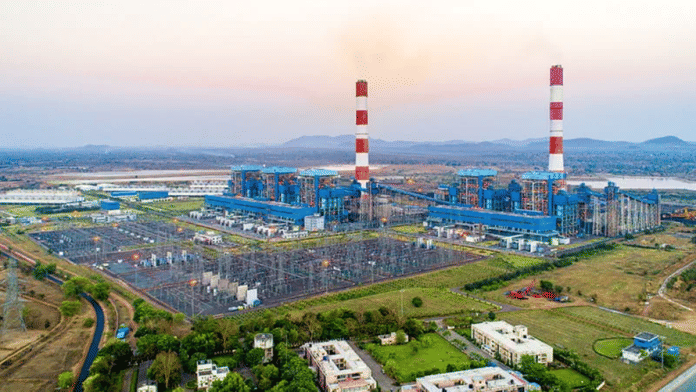
India’s power sector is often described as a single national grid. Yet the geography of electricity generation and the fuels underpinning each state’s capacity portfolio tell a different story.
In 2025-26, the country’s electricity map looks less like a unified system and more like two distinct regimes: one of generation-rich, increasingly non-fossil states and another of generation-constrained, thermal-dependent economies.
Per-capita electricity generation varies sharply across states
Per capita electricity generation measures the amount of electricity produced within a state’s borders relative to its population. It does not measure electricity consumption or household access. It shows where India’s generating infrastructure is physically located.
In 2025-26, Himachal Pradesh generated about 4,904 kilowatt-hours (kWh) per person, followed by Chhattisgarh at 3,143 kWh, Sikkim at 3,053 kWh, and Arunachal Pradesh at 2,118 kWh. Gujarat generated 1,258 kWh per person, while Andhra Pradesh, Telangana, Uttarakhand, Tamil Nadu, and Madhya Pradesh each generated more than 1,000 kWh per person.
At the other end, Assam generated only 155 kWh per person, Bihar 259 kWh, Uttar Pradesh 431 kWh, Kerala 230 kWh, and Goa 21 kWh. Delhi generated just 106 kWh per person locally, although its residents and firms consume substantially more electricity supplied through the regional grid.
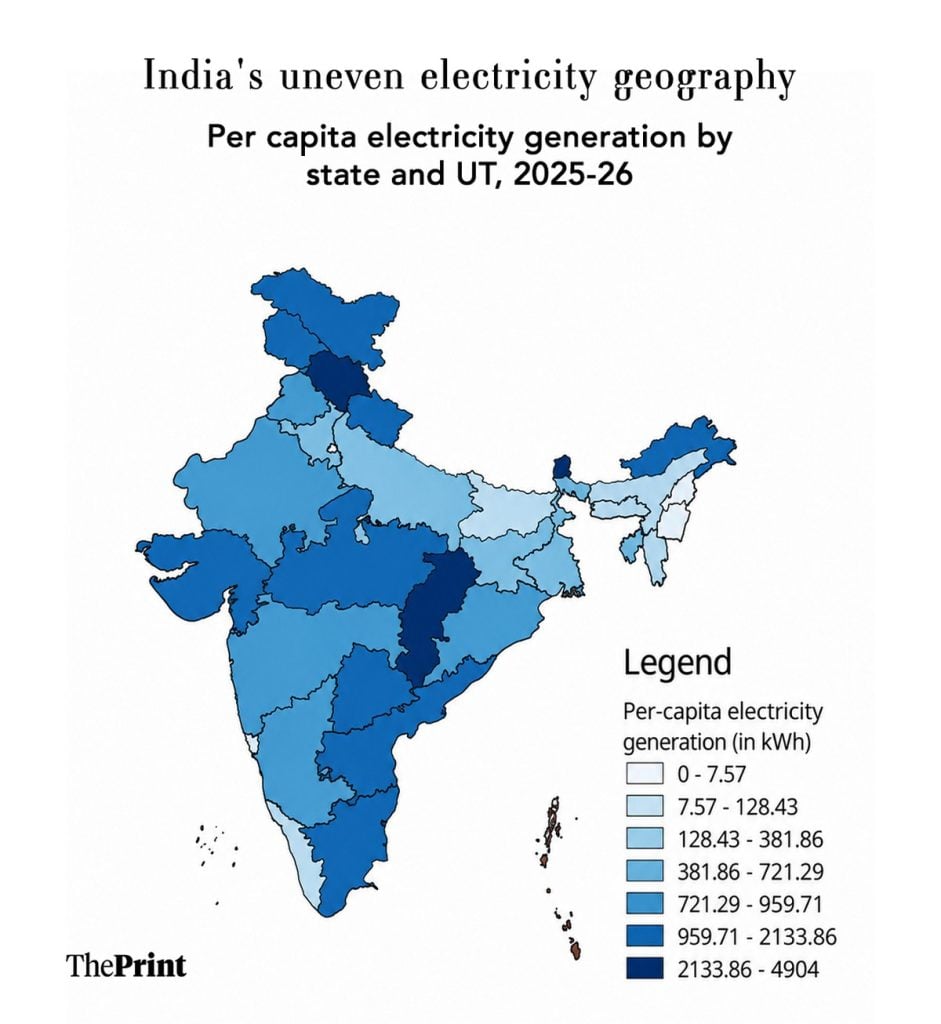
The map makes this spatial inequality visible. The Himalayan states, parts of peninsular India, and a few industrial hubs appear in darker shades, indicating high local generation relative to population. Much of the Hindi heartland, the North-East, and several coastal states appear in lighter shades, signalling low generation relative to population.
The map shows where the physical backbone of the electricity system is concentrated. High-generation states such as Himachal Pradesh, Chhattisgarh, Sikkim, and Gujarat host large generating stations that serve not only their own residents but also feed the wider national grid. Low-generation states, by contrast, depend heavily on inter-state transfers and central-sector allocations to meet local demand.
In other words, low-generation states occupy a different position in the national electricity economy as net recipients rather than net producers of power. This position has implications for industrial location, energy security, and states’ ability to attract electricity-intensive investments.
Also Read: India is spending Rs 14,500 crore on energy storage. Why does the grid need it?
The thermal and non-fossil divide
A second, equally important divide emerges when we examine the composition of each state’s allocated generating capacity.
Using data on installed capacity, including allocated shares in central and joint sector utilities, states can be classified by the share of their capacity that comes from non-fossil sources (hydro, nuclear and renewables) versus thermal sources (primarily coal and gas). Here too, the picture is one of sharp regional divergence.
In Himachal Pradesh, non-fossil sources account for 97.2 per cent of allocated capacity; in Arunachal Pradesh, 89.3 per cent; in Sikkim, 88.8 per cent; and in Rajasthan, 74.1 per cent. Karnataka and Tamil Nadu, two large industrialising economies, have non-fossil shares of 70.9 per cent and 64.1 per cent respectively. Gujarat, often seen as an industrial powerhouse, has a non-fossil share of 62.8 per cent, driven by large solar and wind capacity alongside hydro and nuclear.
At the other end of the spectrum lie states whose allocated capacity remains overwhelmingly thermal. Bihar’s portfolio is 91.7 per cent thermal; Jharkhand’s is 89.1 per cent; Chhattisgarh’s is 83.9 per cent; West Bengal’s is 79 per cent; and Uttar Pradesh’s is 71.5 per cent.
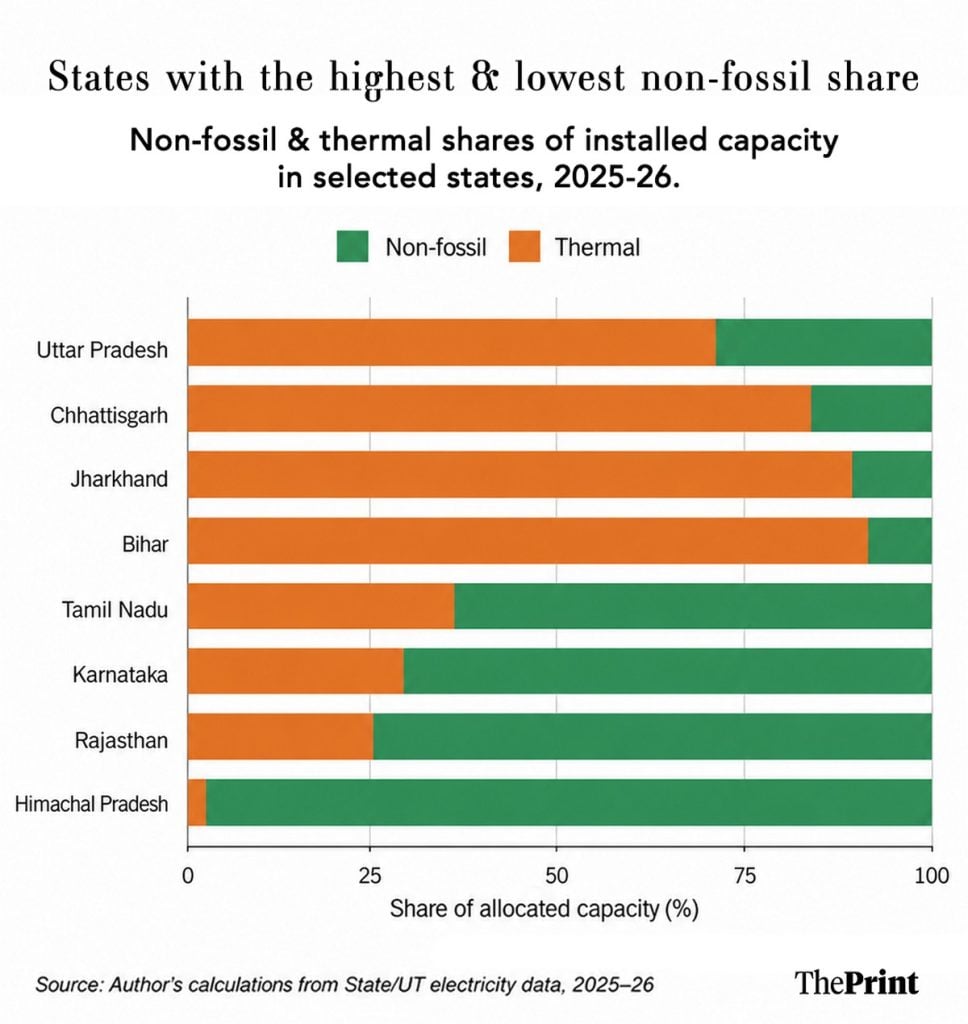
The accompanying bar chart captures this divide: green-dominated bars for Himachal Pradesh, Rajasthan, Karnataka and Tamil Nadu; orange-dominated bars for Bihar, Jharkhand, Chhattisgarh and Uttar Pradesh.
This fuel divide has implications beyond emissions. Thermal-heavy states are more exposed to coal price volatility, fuel supply risks and future carbon constraints. Non-fossil-rich states, particularly hydro-dependent ones, face different challenges: seasonal variability, climate-related risks to river flows and the need for storage and grid flexibility. Both groups must manage the fiscal stress of distribution utilities, but their transition pathways will differ fundamentally.
Why the electricity map matters for development
The significance of these divides extends well beyond the power sector. Electricity infrastructure is a key determinant of industrial location, job creation and long-run productivity. States that generate abundant, relatively clean electricity at scale are better positioned to attract energy-intensive industries, data centres and green manufacturing. States that remain generation-constrained and thermal-dependent risk being locked into a slower, costlier and more carbon-intensive development path.
It is tempting to interpret low per capita generation as a sign of backwardness and high generation as a sign of progress. That would be misleading. As Delhi shows, residents and firms can draw on the regional grid to meet demand. Small states and Union Territories with tiny local generation bases may still enjoy high levels of electrification and appliance ownership. But as noted earlier, much of the power such states and UTs use may come from beyond their borders.
The combination of low local generation and high thermal dependence is concerning as well. Bihar, for instance, generates just 259 kWh per person within its borders and relies on a capacity portfolio that is 91.7 per cent thermal. This dual disadvantage — limited local generation and a carbon-intensive capacity mix — raises questions about energy security, fiscal sustainability and future competitiveness.
Beyond one-size-fits-all reform
These patterns suggest that India’s electricity and climate policies must move beyond uniform national targets and recognise regional heterogeneity.
Generation geography matters
States with low per capita generation need targeted support to expand local capacity, improve reliability and reduce dependence on distant plants and long transmission corridors. This does not mean every state must become self-sufficient; the national grid is a strength. But strategic investments in local renewable energy, distributed generation and grid infrastructure can reduce vulnerability and improve states’ bargaining position in power markets.
Energy-mix divide requires differentiated transition strategies
Hydro-rich states such as Himachal Pradesh, Sikkim and Arunachal Pradesh are already running largely non-fossil systems. Their priority should be to manage the environmental and social impacts of hydropower, invest in storage and grid stability, and explore green hydrogen or energy-intensive industries that can leverage their clean electricity.
Renewable-rich states such as Rajasthan, Karnataka and Tamil Nadu must focus on integrating variable renewable energy, building storage and ensuring that distribution utilities can absorb high shares of solar and wind without financial stress.
Thermal-dependent states face a harder task. Bihar, Jharkhand, Chhattisgarh, Uttar Pradesh and West Bengal cannot simply “switch off” coal. They need credible transition pathways that combine efficiency improvements in existing thermal plants, gradual diversification into renewables and possibly nuclear power, and investments in skills and economic diversification for communities dependent on coal value chains. National climate and industrial policies should explicitly recognise these states as transition regions, with dedicated financing, just-transition frameworks and support for alternative livelihoods.
Distribution reform must be linked to the realities of generation and mix
High-loss, financially stressed DISCOMs in thermal-dependent states will find it harder to invest in clean energy and grid modernisation. Central schemes such as the Revamped Distribution Sector Scheme (RDSS) should be calibrated to reward states that combine loss reduction with credible plans to diversify their capacity mix and expand local non-fossil generation.
Data transparency and public communication need improvement
Most public debates focus on connections and access, which have improved dramatically. Far less attention is paid to where electricity is generated, what fuels underpin each state’s system and how this shapes regional inequality. The maps and charts presented here are a starting point for a more honest conversation about India’s uneven electricity geography.
Emerging frontiers in energy generation and distribution
Two emerging developments could reshape India’s power mix. They are the growth of data centres and the opening up of nuclear power to private participation.
Data centres as large electricity consumers—and possible distribution actors
Data centres are becoming major electricity consumers as artificial intelligence, cloud computing and digital services expand. In 2025, data centres accounted for roughly 0.5 per cent of national electricity consumption. It is estimated that India’s data centre capacity will grow fivefold by 2030.
States are preparing for this growth in different ways. Andhra Pradesh, for instance, has introduced a policy allowing large data centres to obtain a deemed distribution licence. This will enable them to develop internal distribution infrastructure and procure power directly from renewable generators or captive plants, through power exchanges or under bilateral contracts.
While this could increase demand for renewable electricity, it also raises questions about grid planning, cost allocation and the financial position of conventional DISCOMs if large consumers increasingly procure power outside the conventional distribution system.
Private nuclear power and the renewable–non-renewable balance
India has also begun opening its nuclear sector to wider private participation. The Sustainable Harnessing and Advancement of Nuclear Energy for Transforming India (SHANTI) Act, 2025, provides a framework for private participation in nuclear generation under licence. The Union Budget for 2025-26 also signalled amendments to the Atomic Energy Act and the Civil Liability for Nuclear Damage Act to encourage private investment in nuclear projects.
Private nuclear generation could provide firm, low-carbon electricity and reduce reliance on coal in thermal-dependent states. However, it may also alter the renewable–non-renewable balance. Nuclear power is non-fossil but not renewable. If private nuclear capacity expands, India’s clean-energy accounting will need to distinguish clearly between renewable, other non-fossil and thermal capacity.
A national grid, multiple electricity futures
India’s electricity story is no longer simply about extending wires to villages. It is about the geography and fuel mix of the power system those wires connect to. The evidence from 2025-26 shows a country in which some states are emerging as clean-energy powerhouses, others remain locked into thermal dependence, and many occupy an intermediate position.
If managed well, this diversity can be a strength. Different regions can specialise in different parts of the energy value chain, from hydro and renewables to thermal flexibility and storage. If mismanaged, it risks hardening regional divides, with some states racing ahead on clean, abundant power and others struggling with costly, carbon-intensive systems.
The choice now is between a one-size-fits-all approach that ignores regional realities and a differentiated strategy that uses India’s diversity as the foundation for a more equitable and sustainable energy transition.
Ashish Aman Sinha is an assistant professor at the Jindal Institute of Behavioural Sciences, OP Jindal Global University. Views are personal.
(Edited by Asavari Singh)