






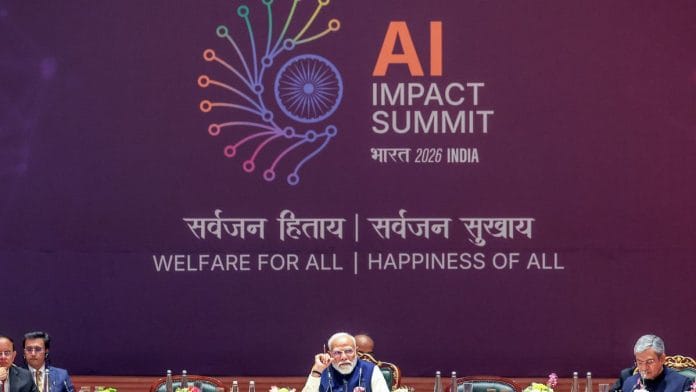


On 13 April 2026, the Ministry of Electronics and Information Technology issued an Office Memorandum constituting the AI Governance and Economic Group—AIGEG. The document runs to a single page. For a nation of 1.4 billion people standing at the most consequential technological inflexion point in human history, that single page is both a beginning and an indictment.
To be fair, AIGEG is better late than never. The group brings together the Minister of Electronics and IT as Chairperson, the Minister of State as Vice Chairperson, the Principal Scientific Advisor, the Chief Economic Advisor, the CEO of NITI Aayog, and Secretaries of Telecommunications, Economic Affairs, and Science and Technology. The National Security Council Secretariat has a representative. The MeitY Secretary serves as Member Convener. It is a respectable gathering of senior officialdom. But senior officialdom, however distinguished, is not the same as governance. And coordination is not the same as command.
What is missing?
The composition of AIGEG reveals its limitations with uncomfortable clarity. The Ministry of Defence is absent. Whether this reflects deliberate exclusion for reasons of operational security or simply an oversight, the gap is significant. Artificial intelligence is already transforming warfare—autonomous systems, predictive targeting, electronic intelligence, and battlefield logistics are being reshaped in real time. A national AI governance body that does not formally include defence is governing half a revolution.
The National Security Council Secretariat’s presence is welcome; but it must be matched by equivalent permanence from the innovation ecosystem that is actually building these systems.
The Ministry of Education is equally absent. AI will render entire curricula obsolete. The reskilling imperative runs from primary school arithmetic to doctoral research methodology. A child entering Class 1 today will enter a labour market in 2040 that looks nothing like the one we are preparing her for. If the body tasked with AI governance has no permanent representation from the ministry responsible for human capital formation, it is governing the economy, while ignoring the people who must live in it.
Industry is absent as a permanent member. Academia is absent as a permanent member. The entrepreneurs building AI systems, the researchers understanding their limits, the economists associated with independent institutions modelling their distributional consequences — none of them sits at the AIGEG table. They may be called upon occasionally, summoned to sub-committees and invited to make presentations. Sporadic consultation is not the same as structural inclusion. The knowledge required to govern AI well does not reside exclusively in the civil service.
Also read: India’s AI Mission is flying blind without technocrats
The employment crisis
India’s political class has been slow to reckon with what AI is already doing to white-collar employment. Back-office processing, legal drafting, financial analysis, medical diagnostics, customer service, software testing, and content generation—these are not sectors that AI might eventually affect. They are sectors where AI substitution is actively underway. The jobs being displaced are precisely the jobs that India’s expanding middle class has relied upon for upward mobility. Call centre employment, which absorbed hundreds of thousands of graduates annually, is facing structural compression. Entry-level legal and accounting work, long the training ground for India’s professional class, is being automated faster than the profession can adapt.
AIGEG’s Terms of Reference do acknowledge the labour market dimension. The group is mandated to assess employment impacts, classify AI use cases as “deploy”, “pilot”, or “defer”, and develop mitigation strategies. These are worthy objectives. But objectives without authority are aspirations. A ten-member inter-ministerial committee convened by a Joint Secretary-level official cannot compel a reluctant ministry to restructure its skilling programmes. It cannot override a procurement decision that locks in automation at the cost of employment. It cannot set binding timelines for AI readiness assessments across the public sector. Coordination without coercive authority produces reports, not results.
What India actually needs
There must be a Supreme AI Council that operates at the apex—setting national AI strategy, establishing binding deployment frameworks, and arbitrating between competing ministerial interests. It must be chaired by the Prime Minister, with real authority, full representation, and a mandate to act — not merely to meet.
AIGEG, suitably expanded and restructured, should function as the implementing and monitoring arm of that Council—translating strategic direction into departmental action and reporting back on compliance and outcomes.
The composition of both bodies must be fundamentally broadened. Defence must be at the table permanently. Education must be at the table permanently. Industry leaders—not rotating nominees but identified principals—must hold standing membership. Academic researchers in AI, economics, law, and ethics must be embedded in the governance structure, not called upon as and when convenient.
Also read: How India uses AI to empower the next billion users
The central challenge
No governance architecture will succeed if it does not place human capital transformation at its core.
India’s educational pipeline—from primary school to postgraduate research—must be redesigned with AI literacy as a foundational requirement, not an optional add-on. This is not about teaching children to use chatbots. It is about building the cognitive infrastructure for a generation that will collaborate with, compete against, and ultimately be responsible for governing AI systems we cannot yet fully anticipate.
The Union Budget must reflect this priority. The National Education Policy provides a framework; what is needed is a time-bound, funded implementation with AI integration as a non-negotiable strand from Class 6 onwards. University curricula in law, medicine, engineering, economics, and the social sciences must be overhauled. Research funding for Indian AI—not merely for the adoption of foreign models but for indigenous capability development—must scale by an order of magnitude.
Also read: AI model Claude Mythos has alarmed the US. Why India must act now
A memo is not a mandate
The AIGEG Office Memorandum will be cited as the moment India formally acknowledged that artificial intelligence required governance. But this is just the beginning of the journey.
India has navigated technological transitions before—the Green Revolution, liberalisation, and the IT services boom. Each required not merely policy coordination but political will at the highest level, sustained over years, with institutional structures built to match the scale of the challenge.
Artificial intelligence is a larger disruption than any of these. It demands a larger response. AIGEG is a puddle. India needs an ocean.
The Prime Minister must lead. Nothing less will do.
The writer is a retired IAS officer of the Punjab cadre and a former Special Chief Secretary to the Government of Punjab. He writes on governance, public policy, and constitutional affairs. Views are personal.
(Edited by Theres Sudeep)
When our country lacks the money and expertise to build and maintain pavements, governing artificial intelligence is beyond our wildest dreams