







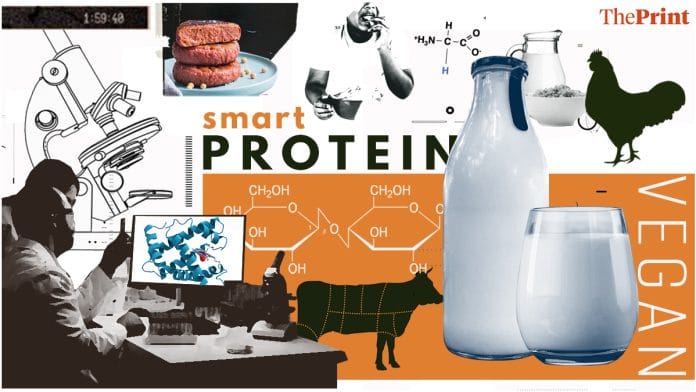


The Indian protein story is complicated—we actually eat enough protein. A new analysis by the Council on Energy, Environment and Water shows that Indians consume about 55.6g of protein daily at home against an average recommendation of 43.7g. But a closer look reveals that we are not eating the right kind of protein. Nearly half of it comes from cereals like rice and wheat.
The National Institute of Nutrition recommends that only one-third of our protein come from cereals. But they account for half. Cereal protein is ‘incomplete’, lacking essential amino acids that the body cannot synthesise and has lower ‘bioavailability’, meaning our bodies struggle to absorb it compared to protein from pulses, dairy, eggs, or meat. Relying on cereals for protein is akin to building a house with poor-quality materials.
Who eats what protein
We analysed who eats what using the latest National Sample Survey Office’s Household Consumption Expenditure Survey (2023-24) and found that almost all plates are lopsided. The dal-roti/dal-chawal meal embodies food security at its most fundamental level. But cereals dominate, while pulses, our most accessible source of good-quality protein, are grossly underconsumed by nearly 95 per cent of households. Not a single state meets the recommended intake of pulses. Even relatively better-performing states, such as Himachal Pradesh, fall short.
On average, Indians eat less than one bowl of dal a day, when it should be closer to three. Rotating local and seasonal pulses like moong, chana, masoor, and urad is essential to source a full range of amino acids, but most Indian households rely predominantly on just one type.
While plant-based protein intake is inadequate across the board, consumption of animal-source proteins shows sharp regional and income disparities. In the North and West, including Rajasthan and Haryana, dairy dominates. In the South and East, fish, meat, and eggs are more prevalent.
In rural India, the poorest 10 per cent of households consume only one-third of the recommended milk intake, while the wealthiest decile exceeds it by 110 per cent. (This does not account for indirect consumption of milk through processed dairy products and dairy derivatives.) A similar gap exists for eggs, fish, and meat in rural areas: The poorest meet barely 38 per cent of requirements, while the wealthiest exceed them at 123 per cent.
Also read:Startups to govt policies—India wants to lead the lab-grown meat revolution
Economic and ecological sense
For lower-income households, rice and wheat are the most accessible route to a full stomach. This is where millets such as bajra and jowar can step in. These often-overlooked cereals offer a superior protein and micronutrient profile compared to rice and wheat. When adjusted for protein quality, millets are also more cost-efficient, offering a realistic pathway to nutritional adequacy where animal proteins are unaffordable or culturally unacceptable. A shift toward millets is also a planetary necessity amid climate change. Unlike resource-intensive crops like rice and wheat, millets are climate-resilient, use less water, and improve soil health.
Addressing India’s protein quality gap requires moving beyond a ‘one-size-fits-all’ approach toward regionally tailored strategies that respect local dietary cultures, while improving affordability. A critical first step is translating complex nutritional science into accessible benchmarks.
Public messaging should move away from notional ‘grams’ toward actionable goals, such as consuming three bowls of dal daily, alongside consistent intake of diverse sources such as dairy and eggs.
For vulnerable groups, particularly children and mothers, expanding the provision of eggs or milk within the PM POSHAN (mid-day meal) scheme and Anganwadi centres is a practical pathway to reducing nutritional inequity. Ensuring high-quality protein sources through supplemental nutrition programmes can help bridge the gap created by market prices for lower-income households.
The historical success of rice and wheat procurement under the Minimum Support Price (MSP) and their distribution across India’s food safety nets is a proven blueprint. By extending consistent procurement, aggregation, and primary processing support to pulses and millets, the government can stabilise market prices and reduce volatility while incentivising farmers to diversify into these climate-resilient, nutrition-dense crops. The Economic Survey 2025-26 advocates for voluntary crop diversification over altering MSP structures. It proposes that fiscal savings from improved cereal stock management be redirected into direct income support, in the form of per-acre/per-quintal incentives, to drive the diversification toward pulses and millets. Integrating these into the Public Distribution System through ‘one millet, one pulse’ monthly kits could embed protein diversity directly into food safety nets.
Finally, the push for Aatmanirbharta in pulses must be recognised as both an agricultural and a public health priority. Expanding PM Dhan Dhanya to support diverse local pulse varieties would secure the most cost-effective, high-quality protein and pulses for Indian households. By diversifying a fraction of current cereal acreage, specifically in water-stressed regions or underutilised rabi fallows, into pulse production, India can simultaneously address its groundwater crisis, enhance farm livelihoods, and secure the country’s nutritional future.
Placing dietary diversity at the centre of national food policy is essential. Protein intake alone is not enough; protein quality is the real test.
Ritika Dube is a Sustainable Food Systems Advisor, and Suhani Gupta is a Research Analyst at the Council on Energy, Environment and Water (CEEW). Views are personal.
(Edited by Theres Sudeep)
Please tell our farmers to grow less rice and more pulses.