





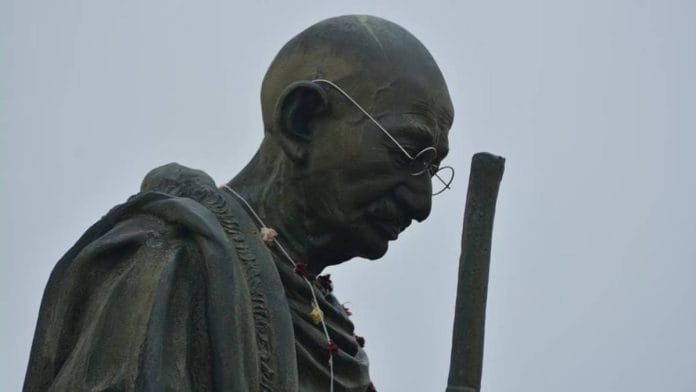


This morning, when the day started somewhat inclemently, a friend said to me: “You see even Nature is weeping not because Gandhi is dead but because we shall make hypocritical speeches today praising him and then forget him tomorrow!”
We had a Gandhi Centenary Year in 1969-70. Khan Abdul Ghaffar Khan, the “Frontier Gandhi”, happened to visit India at that time and, when he saw what he did in India, he made the following remark: “How soon we have forgotten Gandhi. I am pained to find that the country and the people whom Gandhi served so long had forgotten him so soon”.
State capitalism
Professor Hugh Tinker, a well-known liberal writer about India, says similarly: “If Gandhi had survived the one hundred and one years he expected to live once, he would, I think, have been saddened but not unduly surprised by the India of 1969.”
So we Indians have a right to be proud of the fact that we had Gandhi with us. We also have reason to be ashamed that we have made so little use of this wonderful leader and prophet we had amongst us.
In February/March 1977, the Janata Party’s Manifesto was full of Gandhi and to that extent we can claim that Gandhi came back into the centre of the picture. But if one studies what has happened since that Manifesto was published, one will have to concede sadly that that was a flash in the pan. In fact, they have turned their backs on Gandhi and gone back to Karl Marx, their real mentor.
In fact, we have been more unkind to Gandhi than to Godse. The question therefore arises, is Gandhi relevant today? Gandhi is relevant today. In fact he is more relevant today than he ever was, not only in India but also internationally.
Two lessons to learn
Now, there are two ways in which one can think of Gandhi’s relevance and learn from him. One of these is his policies, his principles, his way of life. The other perhaps, more important still, is the precepts about conduct which he gave to us.
Let us take the less important first — the policies or the way of life of Mahatma Gandhi. Gandhi was no believer in a readymade, distant Utopia. Gandhi was fond of quoting that Christian hymn:
“Not for me the distant scene
One step enough for me”
For instance as far back as 1929 he said; “We do not know our distant goal … It will be determined not by our definitions but by our acts, voluntary and involuntary. If we are wise, we will take care of the present and the future will take care of itself.” Gandhi had a talisman. He of course cared for the Daridranarayan, for the poor.
A wonderful test
He gave Indians a wonderful test: “If ever you are in doubt, think of the face of the poorest man you have ever seen and consider what effect the step that you contemplate will have on him. What will it mean to him? Will it enhance his human personality and his dignity?” So his heart was with the poor, but he was wise enough to know that the service of the poor did not warrant wrong methods and wrong paths. For instance, he was completely against State Socialism. He had no use for the Government being used as an instrument for doing justice to the poor. So he was for a Welfare Society, but not for the Welfare State, which many years later Jayaprakash described as a “creeping paralysis”. He rejected the Welfare State, but accepted the welfare community — the difference being that, in one, the Government moves in on behalf of the poor, and then we know what happens, and in the other the people themselves create a society based on love and brotherhood. It was for the second that Gandhi stood. He rejected the first.
Recently a new book called “Gandhi Today” has been published. In that Gandhi is quoted: “If the State suppressed capitalism by violence, it will be caught in the coils of violence itself. The State represents violence in a concentrated, organised form. It can never be weaned from violence to which it owes its very existence. Hence, I prefer the doctrine of trusteeship.” Or again: “What I would personally prefer would be not a centralisation of power in the hands of the government, but an extension of the sense of trusteeship. Therefore, Gandhi rejected socialism with nationalisation and all its trappings.
Gandhi made it very clear that he had no use for Socialism and warned against nationalisation. By destroying private ownership and property and giving power to the Government, we would create a tyranny worse than we had ever known. According to him the path of social justice meant that people who work in a factory, the Managers, the Supervisors and workers should own the machines. But their ownership should be an ownership as trustees for the community.
Also read: Govt looms behind every transaction like an invisible monster: K H Subramaniam
Limited government
He said once: “I look upon an increase in the power of the State with the greatest fear because, though apparently doing good by minimising exploitation, it does the greatest harm to mankind by destroying individuality which lies at the root of all progress.” He emphasised the self-dependence of the individual.
Abraham Lincoln, another great man, said similarly: “Do not try to do for the people what they can do better for themselves.” It was the same message as Gandhi’s.
So Gandhi believed in limited government, not the kind of government that dabbles in everything, but a government limited to its own legitimate purpose of maintaining law and order, defending the country from aggression, providing the infrastructure on which economic life can be raised. Now that is what Gandhi was against and he said repeatedly which we have forgotten: “That government is best that governs the least”. “Render unto Ceaser what is Ceaser’s and to God what is God’s.”
Today Ceaser has taken most of what belongs to God or the individual conscience.
Ends and means
The more important thing about Gandhi’s teachings was not his political line, but what he said we as individuals could do — his injunctions about conduct. Probably the most important thing about them is the relation between ends and means, the interlinking of ends and means. There is a very common shallow saying: “the end justifies the means”. That is, if the end is good, then murder, lying, deceit, treachery, everything is legitimate in the pursuit of that noble idea. Gandhi saw the fallacy in this: that by these methods, however clean your objective may be, it will get soiled by the method. It means that there are no short cuts to what one wants however revolutionary or progressive the objective be.
Gandhi, secondly, was no pacifist. He admired courage, he had no use for the coward. Gandhi wanted the people to resist violence non-violently, but he did not preach non-resistance. He preached resistance to evil, but without violence. When people said: “Gandhi, would you prefer violent resistance or non-resistance?” he said he preferred violent resistance. If a man cannot fight non-violently, let him fight with arms, but let him not run away. Gandhi put courage before non-violence. This was a very big compromise for a man who loved non-violence.
Courage was in his view a very important element. It is not often realised that he regarded fear as a very craven and base thing that must be expelled from the human heart.
Meaning of satyagraha
Gandhi was a great social revolutionary and believed that even one man had the right to oppose a bad law, a law that is immoral or oppressive. But he said that the man must have the courage of his convictions and face the consequences. He mustn’t run away. Gandhi wanted social reform but not by passing laws through Parliament.
He did not believe a law can make people good. He knew you could not make people good by passing laws but by inspiring them with courage, the courage of their convictions. Satyagraha means the courage of the individual to stand up against a wrong or immoral law.
A choice of evils?
There was another important precept which we forget: “Do not choose the lesser evil, resist all evil.” Louis Fischer in his magnificent book “The Great Challenge” has a whole chapter on it. He calls it “Double Rejection.” Reject this evil and reject that evil, don’t ask which of the two is a lesser evil.
There are people who say: “Compared to Mrs. Gandhi, Janata is the lesser evil.” “So don’t say anything about Janata, because that will bring Mrs. Gandhi back”, we are told. Now that is where Gandhi would have parted company, immediately saying you are choosing the lesser evil and making it a bigger evil. Therefore do not protect the lesser evil from the bigger. Because that way you are doing harm to the lesser evil and benefiting the bigger evil.
Finally flexibility. Gandhi used to say: “Consistency is the virtue of the ass.” He was not at all ashamed of admitting that he was wrong. We all make mistakes every day. Some of us admit them while others pretend we don’t.
Now he said about that: “I have never made a fetish of consistency…. A careful eye would notice a gradual and imperceptible evolution. I have grown from truth to truth.”
We do not have to be political leaders, we do not have to be Ministers or Party leaders to practise some of these things. The smallest of us, the most humble amongst us, has something to learn from what Gandhi taught. This teaching has today become more relevant than ever, both in India and abroad.
This essay is part of a series from the Indian Liberals archive, a project of the Centre for Civil Society. This essay is excerpted from the booklet Freedom First with the title “Relevance Of Gandhi”, which was published in January 1979. The original version can be accessed here.
(Edited by Saptak Datta)
Would never utter the two names in the same sentence.