






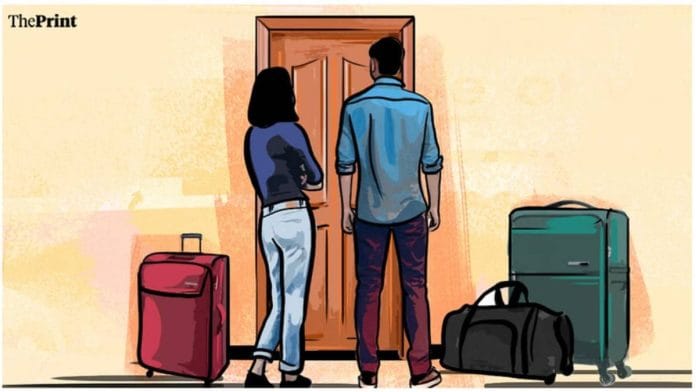


A couple may live together for years, share rent, expenses, intimacy and even children—yet when the relationship breaks down, Indian law struggles to answer a simple question: What exactly was this relationship in the eyes of law? A marriage without rituals? A private arrangement between consenting adults? Or merely an emotional partnership carrying no legal consequences at all?
That uncertainty is no longer theoretical. It is now reaching courts through maintenance claims, domestic violence proceedings, rape allegations, inheritance disputes and ugly battles over property and separation. Family courts and magistrates are increasingly dealing with disputes arising out of relationships that exist outside formal marriage but often resemble marriage in every practical sense.
Indian society has changed far more rapidly than the legal system anticipated.
The old assumption was simple: Intimacy belonged inside marriage. That is rapidly collapsing, particularly in urban India. Relationships today are shaped by mobility, financial independence, emotional dissatisfaction, delayed marriages and changing expectations from companionship itself. The law, meanwhile, is still trying to catch up.
Legally, one issue is now reasonably settled. Consenting adults have the constitutional right to live together outside marriage. It was recognised in Lata Singh v. State of UP (2006), where the Supreme Court held that an adult woman is free to live with anyone of her choice. A few years later, in S. Khushboo v. Kanniammal (2010), the Court refused to criminalise consensual live-in relationships merely because they offended social morality.
That settled one constitutional question. It created several others.
Also read: Shared groceries & dreams, no legal protection. Extra-marital live-ins are uncharted territory
The nature of marriage
If two adults can legally live together outside marriage, what happens when the relationship collapses? Can one partner seek maintenance? Can long-term cohabitation create inheritance rights? Can a failed relationship later become a rape prosecution on allegations of false promise of marriage? And what happens where one or both partners were already married to somebody else?
These questions have no single legislative answer because India still has no dedicated law governing live-in relationships. Courts have therefore been building the framework case by case, often cautiously and sometimes inconsistently.
Where both partners are unmarried, courts have shown the greatest willingness to extend legal protection.
In D. Velusamy v. D. Patchaiammal (2010), the Supreme Court attempted to identify when a live-in relationship could qualify as a “relationship in the nature of marriage.” Shared residence, prolonged cohabitation, legal age and social presentation as spouses were treated as important indicators. Casual or transient relationships, however, were excluded.
Soon after, in Chanmuniya v. Virendra Kumar Singh Kushwaha (2011), the Supreme Court observed that strict proof of marriage should not become a ground to deny maintenance to women who had spent years in relationships resembling marriage.
That distinction matters enormously in real life. A woman who leaves employment, becomes financially dependent and spends years in a relationship may suddenly discover that the law treats her very differently depending upon whether the relationship is viewed as “marriage-like” or merely informal companionship.
As a result, women in certain live-in relationships can invoke remedies under the Protection of Women from Domestic Violence Act 2005 and may also seek maintenance under Section 144 of the Bharatiya Nagarik Suraksha Sanhita.
Also read: Love, lies, laundry & UCC—inside India’s live-in relationships
Navigating emotional betrayals
The legal position changes sharply when one of the partners is already married.
Where a married woman enters a live-in relationship with an unmarried man, courts have generally refused to extend marriage-like protections. The reasoning is technical but decisive: A person already in a subsisting marriage lacks the legal capacity to legally marry somebody else. That, in turn, weakens claims based on the idea of a marriage-like relationship.
This has serious consequences. Maintenance claims often fail. Even allegations of rape based on false promise of marriage become legally difficult because courts increasingly question how a married person could legally rely upon a promise which could not have been fulfilled without dissolution of the earlier marriage.
The reverse—a married man and an unmarried woman—has generated the most contentious litigation. In Indra Sarma v. V.K.V. Sarma (2013), the Supreme Court refused protection to an unmarried woman who knowingly entered into a relationship with a married man. The Court held that such arrangements may fall outside the protection intended for relationships “in the nature of marriage.”
But real relationships are rarely as neat as legal categories.
Many women allege that they entered these relationships believing the man would eventually divorce and marry them. Men often respond by arguing that consensual adult relationships are later converted into criminal proceedings after emotional breakdowns. Courts are now repeatedly being forced to distinguish between genuine deception and failed emotional expectations.
That distinction has become particularly important in “false promise to marry” prosecutions.
Over the last few years, courts have shown growing reluctance to automatically convert failed relationships into rape cases. Judicial reasoning has gradually evolved toward a more fact-sensitive approach: Was the promise dishonest from the very beginning, or did the relationship simply fail later?
The difference is critical.
A deliberately fraudulent promise made only to obtain consent may still attract criminal liability. But courts are increasingly observing that every failed relationship, broken engagement or emotional betrayal cannot automatically be labelled rape.
That shift itself reflects a larger social reality. Adult relationships today are often emotionally fluid, unstable and prolonged without formal commitment.
The criminal justice system was never designed to become an emotional referee for every collapsed relationship. Yet, the emotional collapse of relationships is now routinely entering criminal courts.
Another major shift came in Joseph Shine v. Union of India (2018), where the Supreme Court struck down adultery as a criminal offence.
The judgment changed the legal vocabulary surrounding intimate relationships outside marriage. The State can no longer criminally prosecute consenting adults merely for engaging in extramarital relationships.
But the judgment did not erase the consequences.
Adultery may no longer lead to imprisonment, but it continues to trigger divorce proceedings, maintenance disputes, custody battles and allegations of emotional cruelty. Indian law has effectively removed the police from the bedroom, but not the family court.
There is also an uncomfortable legal grey zone, which courts are slowly beginning to encounter. Emotional relationships outside marriage that may not involve physical intimacy at all.
Human relationships are layered. Emotional attachment, companionship or psychological intimacy outside marriage may deeply damage a matrimonial relationship, but the law does not automatically classify emotional companionship as either criminal misconduct or legal adultery. Courts are increasingly required to separate moral discomfort from legally-actionable conduct.
Not every emotional departure from marriage amounts to a legal wrong, even though it may devastate families personally.
Also read: Live-in couples in small town India have it rough – Varanasi to Vadodara, Aligarh to Alwar
Inheritance and maintenance
Beneath all this litigation lies a deeper social shift that Indian courts cannot ignore. Many live-in relationships today do not emerge from rebellion against marriage itself. They often emerge from loneliness, emotional incompatibility, urban isolation, delayed marriage, financial independence or dissatisfaction within existing relationships.
Companionship is increasingly being viewed not as a permanent social obligation, but as a matter of continuing emotional consent. That is creating friction with legal structures originally built around permanence, stability and traditional family units.
The maze becomes even more complicated when live-in relationships are interfaith.
Constitutionally, courts have repeatedly protected the right of consenting adults from different religions to live together. Yet interfaith relationships frequently attract family hostility, police complaints and allegations involving religious conversion laws in several states.
In many cases, the breakdown of an interfaith relationship leads not merely to separation, but to criminal allegations involving coercive conversion, kidnapping or sexual exploitation. Courts are therefore increasingly being forced to distinguish between genuine coercion and social opposition disguised as criminal litigation.
The conflict is no longer purely about relationships. It is often about autonomy, religion and social control.
Interfaith live-in disputes also create complications involving succession, personal laws and inheritance rights. While secular remedies may remain available in some cases, personal law complications often continue to shadow such relationships in the background.
The position becomes even more sensitive once children enter the picture.
In S.P.S. Balasubramanyam v. Suruttayan (1992) and later in Dhannulal v. Ganeshram (2015), the Supreme Court recognised the legitimacy and inheritance rights of children born from prolonged live-in relationships.
Courts have consistently refused to punish children for the nature of relationships chosen by their parents.
But inheritance disputes between partners themselves remain deeply contested. Property claims often depend upon whether courts are willing to presume the existence of a marriage from long cohabitation. Emotional reality and legal recognition do not always move together.
Another unresolved issue is beginning to surface quietly beneath the legal debate: Money.
Maintenance law in India evolved around the idea of female financial vulnerability. But urban relationships are changing rapidly. In many modern live-in arrangements, women may be financially stronger than their male partners. Questions of emotional and economic dependency are becoming increasingly gender-neutral even though the legal framework still largely reflects older assumptions.
Courts may eventually confront a question family law was never originally designed to answer: Can a financially dependent male partner seek legal protection in a long-term live-in relationship?
Modern relationship litigation is also becoming intensely digital. Chats, photographs, hotel records, screenshots, payment trails and social media exchanges now routinely enter court records. Marriage law was designed for a world where relationships ended quietly inside homes. Modern relationships end through screenshots, police complaints and forensic extraction of private conversations.
Behind every legal doctrine, however, lies something deeply human—emotional dependency, betrayal, humiliation, loneliness and financial vulnerability.
And perhaps that is the real difficulty for courts. Statutes can regulate marriage more easily than they can regulate emotional realities.
Live-in relationships have recognition. Now it’s time to tackle the harder question—whether Indian law can create a balanced framework of rights and responsibilities for relationships existing outside marriage without converting every emotional collapse into either criminal litigation or endless financial warfare.
Jitendra Mohananey is an advocate and former corporate finance professional. He writes on constitutional law, family law, and the evolving legal framework governing personal relationships in India. Views are personal.
(Edited by Theres Sudeep)