






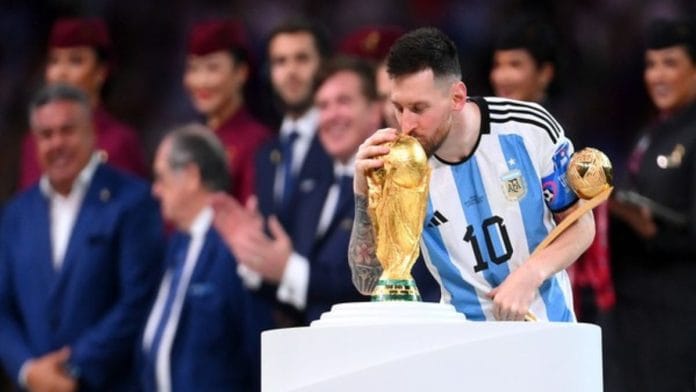


With less than a month to go for the 2026 World Cup, FIFA still does not have a broadcaster locked for making the tournament available to viewers in India. Key players who bid on media rights, JioStar and Sony, are being conservative with their bids at the moment.
JioStar offered $20 million for India rights. As JioStar’s current offer is far less than FIFA’s initial expectation of $100 million, and even its revised expectation of $35 million, the global football federation remains less than keen on accepting Jio’s bid and granting the media rights.
Meanwhile, India’s public broadcaster, Prasar Bharati, on Wednesday told the Delhi High Court that it holds no legal responsibility to acquire the broadcasting rights for the FIFA World Cup 2026.
It is important to understand that the cooled appetite of broadcasters to invest in World Cup rights has little to do with demand. For the 2022 edition, 110 million people streamed the games, and 84 million tuned in on linear television. Indeed, the uncertainty around the World Cup telecasts airing in the country is possibly because India’s broadcasting regulations have steadily made the purchase of sports rights commercially unviable.
The three barriers
The first issue is the Sports Broadcasting Signals (Mandatory Sharing with Prasar Bharati) Act, 2007, which requires sporting events of “national importance”, such as the FIFA World Cup, to be shared with Prasar Bharati. Under this law, private broadcasters spending hefty sums on rights must provide an advertisement-free feed of the matches to Doordarshan.
This creates a commercial distortion. Broadcasters acquire rights because the exclusivity these rights guarantee enables them to recover investments through advertising and subscriptions. But mandatory sharing weakens exclusivity by creating a parallel free feed that directly competes with the rights holder. Every viewer migrating to the public broadcaster reduces advertising inventory and subscription revenue, undermining the ability of private broadcasters to recover costs.
Second, the broader regulatory environment governing broadcasting further compounds the problem. Over the last two decades, the TRAI’s tariff and interconnection regulations have systematically shifted economic value away from broadcasters and toward distributors such as DTH and cable operators. An Esya Centre report finds that the TRAI regulations enable distributors to capture as much as 80 per cent of the average revenue per user despite broadcasters bearing the primary costs and risks associated with content creation and acquisition.
This becomes especially problematic in sports broadcasting, where acquiring rights itself involves enormous upfront expenditure. Illustratively, for the media rights for the last World Cup, Viacom18 paid around $62 million.
Third, broadcasters operate under strict advertisement caps imposed under the Cable Television Networks Rules, 1994. Under these Rules, TV channels cannot broadcast more than 12 minutes of advertisements in an hour, of which only 10 minutes may be commercial advertisements. These limits reduce the advertising time that broadcasters can monetise during live sports broadcasts.
Cumulatively, these regulations do not allow broadcasters to recoup any of the expenditure made on rights. This is an absurd situation given that sports are a key driver of viewership on TV. In 2022, around 722 million Indians consumed sports-related content on TV. The reach of sports is so wide that it even eclipses the user bases of large technology firms.
For example, YouTube’s user base is 518 million in the country. Sports should, then, be a key driver of revenue and growth for broadcasting, and broadcasters should be falling over themselves to purchase rights. But there is limited incentive to invest in something when the inability to recoup costs is all but guaranteed by the regulatory frameworks in place.
Also read: India’s TV, radio industries are sinking. TRAI must address overregulation of legacy media
Indian regulators to blame
Importantly, the issue of the decreased appetite of broadcasters to purchase sports rights extends beyond the commercial prospects of the broadcasting sector. Sports broadcasting is a critical revenue source for sports leagues and franchises. In the US, media rights form the economic backbone of leagues such as the NFL and NBA, with billion-dollar broadcasting contracts underwriting team valuations, player salaries, stadium investments, and league expansion.
Similarly, in India, the IPL’s transformation into one of the world’s most valuable sporting properties has been driven overwhelmingly by media rights revenues. Currently, the IPL’s broadcasting and digital rights deals are worth tens of thousands of crores, with media rights reportedly contributing roughly 75 per cent of league revenues. Industry analyses further reveal that broadcasting revenues now account for the overwhelming share of franchise income and central league earnings.
The takeaway here is that if broadcasters are unable to recover the money spent on sports rights, the consequences will not remain confined to their sector alone. Sporting leagues will themselves lose value. Investment in athletes, infrastructure, and grassroots development may decline sharply. Put another way, a regulatory environment that undermines the commercial sustainability of sports broadcasting ultimately weakens the sporting ecosystem itself.
If Indian viewers struggle to watch France’s Kylian Mbappé or Argentina’s Lionel Messi on their television screens this summer, or IPL down the road, they have only Indian regulators to blame. India must roll back its regulations on broadcasting if it wants to continue seeing sportspersons on the screen, and the field.
Meghna Bal is an advisor to Koan Advisory and Director of the Esya Centre, a New Delhi-based think tank. Views are personal.
(Edited by Saptak Datta)