



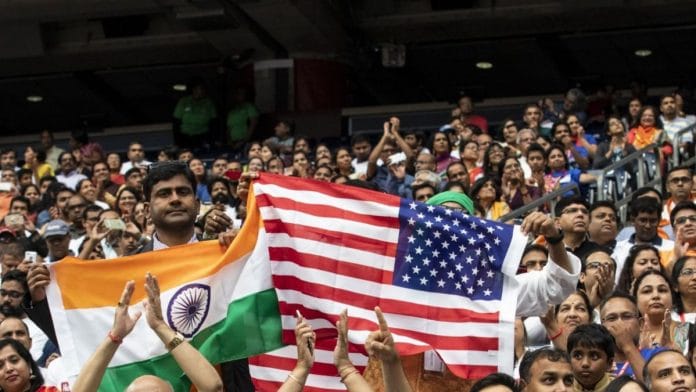
Indian Americans are a relatively new and fast-growing immigrant community — now 5.2 million members, up from only about 360,000 in 1980. Conversations with them about their community’s place in the United States often follow a familiar arc — a recitation of extraordinary achievement.
Prosperity frequently comes up: in 2023, Indian Americans reported a median annual household income of $151,200, nearly double the US median of $80,610. So, too, does professional prominence: community members lead many of the largest US-based tech companies, account for as many as 10 per cent of America’s doctors, and own more than 50 per cent of its small- and mid-sized hotels and motels.
Indian Americans, like immigrants to the United States from across the globe, strive to carry their culture forward and sustain core ideals while adapting to new environments and building new relationships. Recently, they have been contending with charged public discourse about immigrants in the US.
Giving can be a powerful expression of the community’s commitment to the United States and to India. And Indian American giving is on the rise. A joint report on Indian American diaspora philanthropy by Indiaspora, Dalberg, and the India Philanthropy Alliance found that diaspora giving has increased dramatically over the past decade to $4-5 billion in 2024. The increase is mainly because a much higher share of donor household income is being given away — rising from an estimated 1-2 per cent in 2018 to 4-5 per cent in 2024.
Recently, our team at Bridgespan, in partnership with the Ford Foundation, interviewed more than 60 donors, non-profit leaders, and other experts to learn more about the Indian American diaspora’s giving and explore its potential for impact. We heard many encouraging stories that point to a vibrant ecosystem of giving.
An opportunity
While a significant share of Indian American philanthropy supports organizations and movements in the United States, the potential of the community to have a major impact in India has never been greater. In the context of Viksit Bharat, the Indian American diaspora has an opportunity to contribute to India’s development goals over the next 20 years, as the country continues to benefit from its demographic dividend.
A report from Give Grants identified an opportunity for the Indian American diaspora to contribute to causes such as climate action, gender equity, food security, and economic growth. Indeed, several studies and reports over the past several years attest to the potential impact of diaspora giving in India.
Many of the donors in our most recent interviews see India as having a mature, vibrant social sector — allowing their funding to make a real difference. And private funding can do things that government or corporate social responsibility (CSR) funding rarely can, such as helping NGOs serve as R&D hubs that complement larger-scale public programmes.
Based on our research, we believe Indian American philanthropy, both directed toward the United States and to India, will continue to be shaped and reinforced by three powerful currents described by those we interviewed:
Expressing values and interests. In the interviews, we saw how Indian American philanthropy is profoundly shaped by the values and interests that inform donors’ worldviews, whether it be faith traditions, the influence of parents and other family members, their professional experiences building companies in the United States, or how they believe philanthropy can achieve lasting positive change.
“My parents made clear that they can only do what they do now in large part thanks to their education,” explained Sapna Saxena, Co-Founder of Neel Capital Management, who also runs the Saxena Family Foundation, which gives in both the United States and India. “As long as my parents and I are around, money will always be focused on education in India because of respect for my parents and for where we come from.”
Building community. Indian American giving is often inspired and supported through collaboration, peer networks, and community activities and organizations. It’s a two-way street: engaging in community enables giving, and the act of giving enables community. Collaboration can be a particularly powerful way to build community among donors — helping reduce the risk of giving alone while offering the opportunity to learn from and influence others.
California resident BU Patel and his family have built significant wealth through the hospitality industry and a diversified investment portfolio. The family’s Tarsadia Foundation made a multi-year gift of $10 million to help Dasra launch the Rebuild India Fund, a collaborative giving vehicle that provides flexible, multiyear funding to grassroots organisations serving some of the most marginalised and overlooked communities across India. Said Shirish Dayal, executive vice president of Tarsadia, “We hoped to engage other people and help change how funding is done—doing it in a way that is locally guided and longer term.” With donors from both India and the US, the fund is an example of building ties between Indian American donors and Indian donors around shared values and goals.
Also read: The history behind America’s growing anti-Hindu hostility
Engaging across generations. Philanthropy is deeply connected to society and public life, but it is also deeply personal. Many of the Indian American donors we spoke with view their philanthropy not only as a way to have an impact on the world, but also as an avenue for transmitting culture and values across generations. We heard many stories of parents engaging their children in philanthropy to keep the family connected to their traditions and culture. “For those of us who were born here, brought up here, and grew up here, it’s challenging to sustain and pass on our language and culture to our kids,” explained Manisha Bharti, CEO and Global Executive of Pratham USA. “As we become parents, philanthropy can become the way we share our values and traditions with our own children.”
America’s vibrant and ambitious Indian diaspora community has shown it can and will give generously in the United States, in India, and across the globe. Wherever the giving is directed — whether in large or small amounts — we believe that Indian American philanthropy will continue to draw its strength and vitality from how it expresses values and interests, builds community, and strengthens connections across generations.
Rohit Menezes is a partner at the San Francisco office of The Bridgespan Group, a global nonprofit that collaborates with social change organisations, philanthropists, and mission-aligned private capital investors. Views are personal.
(Edited by Aamaan Alam Khan)