



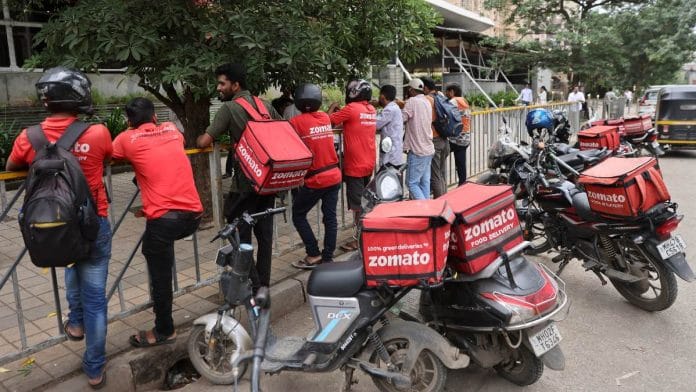
India’s gig economy has grown for a decade largely in the dark. The workers who deliver our food, drive our cabs and repair our homes have only been counted, when at all, through one-off studies and industry projections rather than the official statistical system. That is now changing.
On 23 October, the Ministry of Statistics and Programme Implementation (MoSPI) released a concept note proposing that, from January 2027, the Periodic Labour Force Survey (PLFS) treat households with at least one digital platform worker as a separate sampling stratum. A yes-or-no question in the household listing will ask whether any member has done platform work in the past 365 days. Such households will be sampled separately to ensure enough are surveyed. The reason given by the National Statistical Office is that the 2026 PLFS “did not capture an adequate number of digital platform workers”.
What’s not in doubt is that this is no marginal workforce. The Economic Survey 2025-26 put the gig workforce at 1.2 crore in 2024-25, up 55 per cent from 77 lakh in 2020-21, making up more than 2 per cent of all workers. About 40 per cent of them earn less than Rs 15,000 a month.
But as one of us told Reuters, the proposal is only half a step. It will count gig workers on apps but not those who work outside them. Nor will it tell us who controls the work or address the gap in labour law that leaves the employer undefined. The government has invited comments for 15 days. Here is what MoSPI and the Labour Ministry should hear.
Also Read: Rental e-scooters were meant for office-goers. Gig workers now bring up to 90% of business
Gig is not the same as platform
Policy talk uses “gig” and “platform” as though they were one thing. They are not. Gig describes the terms of work: paid by the task or the job, short in duration, with no promise of the next one. Platform describes the channel: a digital intermediary that matches a worker to a customer and, increasingly, manages the work itself.
The two overlap, but neither contains the other. A mason picked up at a labour naka, a plumber hired through a neighbourhood WhatsApp group, or a catering helper called in for the wedding season is a gig worker who has never logged in to an app. NITI Aayog’s 2022 report recognised this when it split gig workers into platform and non-platform categories, estimating 77 lakh in all for 2020-21 and projecting 2.35 crore by 2029-30.
Conversely, not everyone who works through a platform is a gig worker. A cab driver paid a monthly sum by a fleet operator who has attached his car to an app, or a quick-commerce picker on fixed shifts in a dark store hired through a staffing agency, gets work via the platform but on terms closer to a job. A freelance designer on an online marketplace, on a months-long contract with a foreign client, is a third case again.
The new screening question asks only about platform work. The naka mason will answer ‘no’ and disappear into the general pool, where the gig character of his work is invisible. Nor has anyone told enumerators whether a WhatsApp group run by a labour contractor counts as a “digital platform”.
The result will be a clearer picture of platform workers, while the rest of the gig workforce will be left darker by comparison.
A law that defines workers by what they are not
The confusion begins in the law. The Code on Social Security, 2020 defines a gig worker as one who earns “outside of traditional employer-employee relationship”, and platform work as “outside of a traditional employer employee relationship” in which an online platform connects organisations or individuals. Both definitions are negative. They describe these workers by what they are not, with reference to a relationship that neither this Code nor the other three labour codes define.
Three consequences follow. First, gig and platform workers are kept outside the definitions of “worker” and “employee” in the Code on Wages, the Industrial Relations Code and the Occupational Safety, Health and Working Conditions Code. Of the four codes that came into force on 21 November 2025, only the Social Security Code specifically recognises gig workers. There is no statutory minimum wage, access to dispute machinery, or enforceable limit on hours for them.
Second, the definitions are too vague to use in the field. No enumerator can ask a respondent whether his work lies “outside a traditional employer-employee relationship”.
Third, the welfare architecture reaches only workers who have an aggregator. The Social Security (Central) Rules, notified on 8 May 2026, make a worker eligible only after 90 days with one aggregator, or 120 days across several, in a financial year. Benefits are funded through aggregator contributions capped at 5 per cent of what they pay workers. The non-platform gig worker has no aggregator to log his days or pay his dues. Even for platform workers, no benefit scheme had been notified when the rules took effect.
We welcome the formal recognition of gig and platform workers. But recognition without a definable relationship gives them a welfare register, not labour rights.
The absent employer
This silence produces what we call the absent employer: present everywhere in control, absent everywhere in obligation. The algorithm allocates tasks, sets the price, monitors the worker by GPS and ratings, disciplines through incentives and penalties, and dismisses through “deactivation” or ID blocking, often without reasons. Yet the platform insists it is only a technology intermediary.
Where a fleet operator or staffing agency stands in between, the worker may not know who his employer is, and each party can point to the other. The mirror image is a platform payroll that shows no workers at all.
The costs are documented. Prisoners on Wheels, a 2024 survey of over 10,000 app-based cab drivers and delivery workers across eight Indian states, found 78 per cent of delivery workers putting in more than 10 hours a day, and more than 60 per cent of drivers from Scheduled Castes and Scheduled Tribes working over 14 hours, against 16 per cent from the general category. A third of delivery workers earned under Rs 10,000 a month. The Fairwork India ratings for 2024 found only two of 11 major platforms with a policy guaranteeing the local minimum wage after work-related costs, and not one willing to recognise a collective body of workers. When delivery workers struck on New Year’s Eve 2025 over pay, safety and ten-minute delivery targets, Blinkit later dropped its ten-minute promise. Workers had to strike to be heard.
One worker, three labels
The PLFS sorts workers into three statuses: self-employed, regular wage or salaried, and casual labour. Gig work breaks this scheme.
Consider three workers.
Ravi owns his scooter and delivers for two food apps. He will be recorded as self-employed, an own-account worker with no employer, even though an app decides when he works, what he earns and whether he may continue.
Salim drives a car leased from a fleet operator, pays the fleet a daily rent and takes rides from the app. He bears costs like an entrepreneur but is controlled like an employee. Depending on how he describes himself, the enumerator may record him as self-employed, as casual labour or, if the fleet owner pays him a fixed sum, as a regular employee.
Priya is a salaried accounts clerk who takes beauty-service bookings through an app at weekends. Her principal status is regular salaried. Her gig work appears only if the subsidiary-status question catches it, and that requires at least 30 days of such work in the year.
Each label carries a different set of rights. As self-employed, a worker has no employer and no labour-law protection. As a gig or platform worker under the Code, she gets welfare-board social security, if she clears the 90-day bar. As an employee, she gets minimum wages, regulated hours, provident fund and health insurance. A survey that records only these labels cannot tell us which labour laws and protections apply to a worker.
Name the worker, then count her
The countries that have made progress in protecting gig workers did the hard thing first. They defined who the worker is, then built statistics to count them.
The European Union estimated 28.3 million platform workers in 2022, 93 per cent of whom were self-employed; about 5 million were likely misclassified. It also found that 41 per cent of time spent on platform work went unpaid, in searching and waiting. Its Platform Work Directive, which member states must transpose by 2 December 2026, presumes an employment relationship where the facts show direction and control, and puts the burden of disproving it on the platform.
Spain went first. Its 2021 “riders’ law” presumed food-delivery riders to be employees. Glovo resisted, was fined in 2022 and 2023, and in December 2024 announced that it would move about 15,000 riders on to employment contracts. The lesson is that a presumption works only with enforcement behind it.
The UK Supreme Court held in 2021 that Uber drivers are “workers” entitled to the minimum wage and paid leave. New Zealand’s Supreme Court went further in November 2025, ruling unanimously that they are employees — though the government then passed a law in February 2026 with a contractor “gateway test” that unions say lets firms sidestep the ruling. Classification is contested terrain everywhere.
Two models short of full employment status are especially relevant to India. Australia created an “employee-like” category in 2024, and in August 2026 its Fair Work Commission issued its first minimum standards order, guaranteeing food-delivery workers on Uber Eats and DoorDash between A$31.30 and A$32 an hour of engaged time, with accident insurance and a dispute process. Singapore’s Platform Workers Act, in force since January 2025, requires platforms to pay pension contributions that rise to employee rates, gives injury compensation on a par with employees, and lets workers form representative associations. The US Bureau of Labor Statistics, for its part, now asks workers directly about platform work alongside its count of 11.9 million independent contractors.
None of these countries left the question of who the worker is to an enumerator’s judgement.
Also Read: Too old to retire. The senior citizens working in Bengaluru’s Uber, Amazon gig economy
What MoSPI and the Labour Ministry should do
For the survey, four changes.
Widen the screen. Ask not only about apps but about how the work was obtained: platform, WhatsApp or phone group, labour contractor, naka, fleet operator or agency. Publish platform and non-platform gig estimates separately.
Record control, not just status. Adopt the ILO’s ICSE-18 category of “dependent contractors”: workers on commercial contracts who depend on another unit for access to work or for their prices. Ask who owns the vehicle or tools, who sets the price, who allocates work and who can deactivate.
Measure what policy now turns on. Ask how many platforms a person works for and on how many days in the year, so that the share clearing the 90- and 120-day thresholds can be estimated. Record hours logged in as well as hours paid, and the costs of fuel, vehicle rent and commission, so that net earnings rather than gross payouts are reported. Add questions on deactivation and work injuries.
Cross-check and open up. Compare survey estimates with the aggregator registrations the new rules require, and release unit-level data so that independent researchers can test them.
The law needs four changes too.
Define the employment relationship in the codes, with a rebuttable presumption of employment wherever a platform controls allocation, pricing and deactivation, and the burden of proof on the platform.
Bring gig and platform workers within the Code on Wages, with a floor for engaged time that includes waiting at the restaurant, as Australia has done.
Make social security real. Notify the benefit schemes, replace the 90/120-day cliff with contributions from the first rupee earned, and set national due-process rules for deactivation, such as the 14 days’ notice with written reasons in Karnataka’s 2025 law.
Reach the non-platform gig worker through state welfare boards, registration of labour contractors and a cess levied where the work is bought.
MoSPI has done well to go looking for the gig worker. It must now look in the right places and ask the right questions. The Labour Ministry must do what statistics alone cannot: name the employer. Until it does, India will count its gig workers more precisely and protect them no better.
Rahul Suresh Sapkal is an Assistant Professor at the Ashank Desai Centre for Policy Studies, IIT Bombay. KR Shyam Sundar is a labour economist and former Professor of Industrial Relations at XLRI, Jamshedpur. Views are personal.
(Edited by Asavari Singh)