






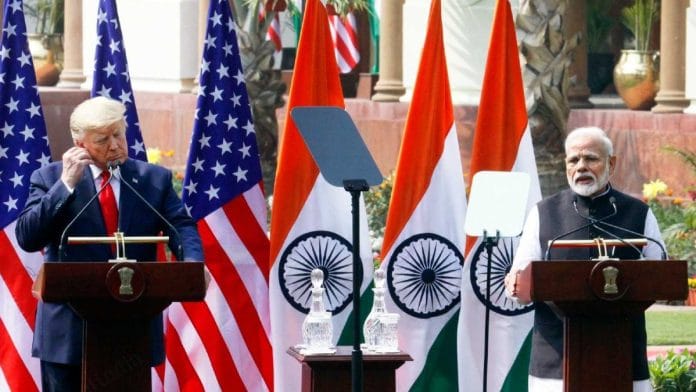



In the hundreds of thousands of words I have read about the new India-US trade deal, here’s one parallel I have not seen cited: the deal and its power dynamics represent nothing that we in India haven’t seen before.
Basically, it’s the same dynamic that prevails at a domestic level between the Indian government and our businessmen and industrialists.
We saw it most recently in responses to the Union Budget. These responses have now assumed a certain dull predictability. Each year, the Finance Minister presents a budget. Sometimes it’s a good budget. Sometimes it’s a bad budget. Sometimes it works to the advantage of the Indian industry. Sometimes it doesn’t.
But here’s the thing: if you believed the responses of Indian businesses, you would never be able to tell whether the budget was good or bad. What’s more, you would never even be able to guess whether it worked to the benefit of the industrialists commenting on it—or whether it hurt them.
No matter what the budget says and no matter what it does to their businesses, the captains of industry will declare that it is the best budget ever. That the Finance Minister is a genius. That India is set to become an economic superpower. And when they are asked to rate the budget out of ten, they will all give it 12 out of ten.
This televised post-budget chorus of the chamchas has become such a joke that journalists wonder why these programmes are even aired live. They might as well record them a week or two earlier, because no matter what the budget says, the industrialists—most of them powerful billionaires in their own worlds—will, like junior artistes in a Bollywood movie, still dance to the same tune.
In moments of exasperation, I asked a few businesspeople why they need to do this. Off the record, they all say much the same things: “We have no choice. The government is so powerful that we have to sing praises of the budget. Even when the budget’s provisions hurt us, we have to pretend that we have benefited. If we complain, the government’s response will be to hurt us even more.”
Politicians, they argue, are thin-skilled creatures who have no hesitation in responding irrationally. “So what you dismiss as ‘chamchagiri’ is actually our survival instinct. Even if we get a bad deal, we have to pretend to be the happiest people in the world. This is the inequality of the power relationship.”
I have a certain sympathy, if not much respect, for the industrialists who offer these explanations. Even in the post-liberalisation era, the government has enormous power. And if it unleashes its agencies on you, then you might as well kiss your business goodbye. So the stakes are high, and the options are very limited.
Truth of India-US trade deal
Now consider the power dynamic between the US and India. There are many obvious parallels. Our industrialists can pretend to be friends with politicians, but the relationship is always transactional. Politicians want things from businesspeople. And if they don’t get them, then photo ops and huggy-kissies make no difference.
So it is with US President Donald Trump. Every relationship is transactional. If you don’t give him what he wants, then he may still call you his best friend—but he will cut you dead.
In this case, Trump wants at least three different things.
One: He wants to show the world that America is powerful enough to choke Russia’s revenue streams. That means he wants to stop everyone from buying Russian oil. He has no interest in India’s claims about its sovereign right to decide who to buy its oil from. Nor does he give a damn about the argument that cheap oil helps India’s economy and therefore its poor.
Two: He believes in tariffs both as a weapon and as an end in themselves. Not only will he use access to the massive US market to reward and punish those who advance or hinder US interests, but he also believes in tariffs as a means of generating revenue. Such is his obsession with the US balance of payments situation and with American exports and imports that he is ready to impose punitive tariffs while demanding that other countries buy massive quantities of US exports.
Three: Trump is boastful and, as he himself admits, extremely thin-skinned. When he makes extravagant claims about deserving the Nobel Peace Prize and ending seven wars, including the one between India and Pakistan, he expects other countries to accept these claims and cheer him on.
When it became clear over the last few months that Trump would not compromise on any of these three demands in the case of the India-US relationship, New Delhi could either go it alone by ignoring Trump or give in.
It’s not practical in today’s world to ignore America or Trump. Though we waited and hoped that he might change his mind, we have had to eventually accept that if we want to do business with America, it has be on Trump’s terms.
And so, one by one, India has agreed to every US demand. We have accepted that we will not buy Russian oil. We have agreed to buy a staggering $ 5 billion worth of US goods over the next few years. We have accepted an 18 per cent tariff on most of our exports to the US—less than the absurd rate that was being thrown around until we caved in and stopped buying Russian oil, but still much higher than the very low rates ( around zeroon many exports) we were paying before Trump took office. India has been instructed to reduce or eliminate our duties on many US goods, and we have agreed.
Also read: Why Indian liberals respect Mamata—she’s a politician challenging their defeatist consensus
Letting Trump win
Trump continues to claim he stopped the war between India and Pakistan, and after initially saying that there was no third-party involvement in the ceasefire, New Delhi has stopped challenging Trump’s claims in the hope of keeping him happy.
It’s easy to say that we have been humiliated. But it’s also pointless to go on and on about it. The dynamic here is the same unequal equation that we see between our industrialists and the Finance Minister at budget time—the same ‘what choice do we have?’ position.
And indeed, that same chorus of the chamchas that follows the budget has begun again, with India’s trade negotiators being hailed for their so-called bargaining skills while the tough decisions they have had to make are being obscured.
We are too scared of Trump to lie about stopping the purchase of Russian oil, but too
embarrassed to admit it to our own people, so ministers give evasive answers when asked. Buck-passing (“I don’t know, so ask such and such minister” )is the order of the day. Minor tariff concessions generously granted by America are hailed as major victories for our negotiators.
Nearly every excuse being offered by the government and its supporters for giving in to Trump’s demands is essentially bogus. Yes, maybe we should not rely so much on Russian oil, but what stopped us from coming to this conclusion before Trump forced us to look for alternatives? Yes, it may be a good idea to dismantle India’s tariff regime, but why didn’t we do it until Trump stamped on our feet?
It’s time now for our leaders to admit the truth. We live in a world dominated by America, which is currently run by a President determined to tear up the rules of the world order. He operates in an atmosphere of threats and chaos, making extravagant demands of other countries and organisations (such as NATO). When he scales down his demands from totally unreasonable to merely outrageous (‘okay, we won’t conquer Greenland; we will just take control of it’) the world acts as though good sense has prevailed.
And while there is some evidence that Trump’s domestic policies are losing popularity with his electorate, there is no real pushback in America against his foreign policy. So there is little to restrain him.
Every country has had difficulties in coping with the Trump World Order, including traditional allies of the US in the West. And he doesn’t intend to stop pushing for more.
India cannot be an exception to this global trend. We have to learn to cope with Trump and his vision. So, there is no shame in admitting that we have conceded most of his demands. We must play the long game here; Trump has only three more years in office, and it seems unlikely that any successor will be as extreme.
Let’s be honest with our people and concede that we are operating with limited options and are doing the best we can to get India-US relations on an even keel with an eye on the long-term partnership.
Nothing is achieved by lying and being evasive. People have seen through the march of the sycophants after each budget. And no matter how many falsehoods you tell them about the alleged triumph of this India-US deal, they will see through them as well.
This is the world we live in. And it’s time to admit it and to treat the Indian people as adults and not as children who will be taken with tales of false victories and imaginary triumphs. It’s always a good idea to tell the truth.
Vir Sanghvi is a print and television journalist and talk show host. He tweets @virsanghvi. Views are personal.
(Edited by Ratan Priya)
The reality is India is balancing old friends with business interests on a high bargain table. easy to write opinions .. very difficult to move things on the ground
Shri N K Singh has praised the “ panache “ with which the deal was secured.
US asked for $500B purchases not $5B as written in the column. Editor needs to be more diligent.
Sycophants exist in only one party, Me Sanghvi.
Only the clown peince, who has nothing to lose, can show fake bravado, and make a fool of himself.
Hypocrites, who oppose reforms, would want to peddle more protectionism, and keep our farmers, deprived of access to better markets and more investments.
Stop defending Congress, who can’t think beyond winning the next election, because they are too desperate after losing so many elections.