




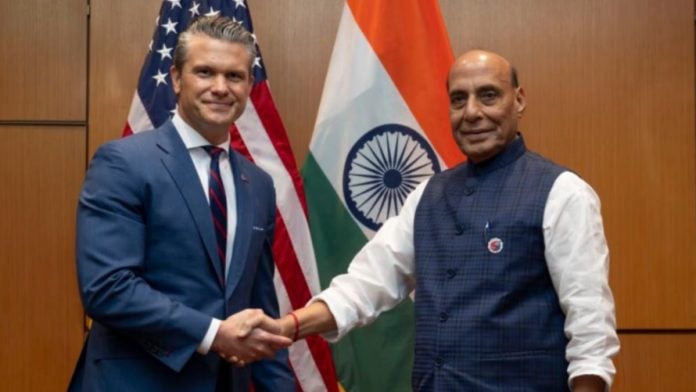

India-US defence cooperation faces the test of turning commitments into capabilities. Meeting in Cebu, Philippines, on 28 October, on the sidelines of the ASEAN Defence Ministers’ Meeting-Plus, Defence Minister Rajnath Singh and his American counterpart Pete Hegseth reviewed progress under the ten-year defence framework, focusing on operational readiness, technology sharing and defence industrial integration. Hegseth also reaffirmed American support against cross-border terrorism. Nearly a year after the framework’s signing in Kuala Lumpur, the task is to translate its ambition into workable arrangements and tangible outcomes.
Just a week earlier, US Secretary of State Marco Rubio was in Mumbai for talks with External Affairs Minister (EAM) S Jaishankar. Their discussions covered trade, defence, technology and energy security, with both sides welcoming progress toward a bilateral trade agreement. His October 20-21 visit, the second to India this year, placed defence cooperation within the broader effort to sustain the Comprehensive Global Strategic Partnership. The diplomatic momentum carries a clear message: New Delhi and Washington continue to invest in the partnership even as they bargain over its terms.
Energy security gives this engagement added urgency. The Iran war and disrupted supply routes have carried the costs of instability into households and businesses across the Indo-Pacific. For India, affordable energy and secure sea lanes are immediate priorities, making economic vulnerabilities integral to cooperation with Washington. The central test is whether strategic convergence delivers military capability and strengthens India’s capacity for independent action. The recent meetings must be assessed against that measure.
Power and the price of partnership
The Quad’s foreign ministers’ meetings trace the widening scope of this agenda. In Washington in January 2025, the four countries reaffirmed their opposition to coercion and identified maritime, economic and technology security as shared priorities. Their July meeting structured cooperation around four pillars: maritime and transnational security, economic prosperity and security, critical technologies, and emergency response. Together, these meetings gave the Quad a more concrete programme of cooperation, broadening its purpose beyond the familiar prism of competition with China.
At its 26 May meeting in New Delhi, the Quad advanced a critical minerals framework and issued a separate statement on Indo-Pacific energy security. It addressed disruptions to oil, gas, petrochemicals and fertilisers, while stressing safe navigation, including through the Strait of Hormuz. These concerns connect regional security directly to industrial capacity and livelihoods. Cooperation on supplies and infrastructure gives the Quad a practical stake in keeping maritime commerce flowing and a purpose beyond diplomatic signalling.
Meeting again in Manila on 22 July, the ministers reaffirmed support for ASEAN unity and centrality and cooperation with the ASEAN Outlook on the Indo-Pacific. Their statement linked maritime security with technology, economic cooperation and emergency response. This regional setting matters for the Cebu meeting. India and the US must advance cooperation in a region whose governments seek stronger capabilities while retaining the freedom to engage competing powers.
Hegseth’s Southeast Asian outreach is part of Washington’s continuing effort to reassure regional partners, but reassurance increasingly comes with an expectation of greater burden sharing. The 2026 US National Defense Strategy prioritises homeland defence and deterring China, while calling for stronger allied contributions and a revitalised defence industrial base. Its approach combines military preparedness with strategic communication to manage escalation, reflecting an American effort to sustain deterrence without allowing competition with China to spiral into conflict.
This sharper hierarchy of American commitments creates both opportunity and uncertainty for India. Washington’s search for stronger regional partners gives it a stake in building Indian capabilities. Yet the transactional impulse of “America First” exposes cooperation to friction over trade and ties with Indo-Pacific partners. Strategic convergence must therefore deliver predictability: costly defence purchases and long-term industrial partnerships require confidence in technology access, timely delivery and sustained support.
India must sustain engagement while preparing for disruption. Its market, geography and Indian Ocean presence confer strategic weight, but cannot substitute for manufacturing strength, robust infrastructure and technological competence. Diversifying partnerships delivers lasting gains only when India can absorb technology, sustain acquired capabilities and build on them at home. The debate over American reliability must therefore sharpen India’s focus on the material foundations of its own autonomy.
Also read: Israel must now decide what kind of democracy it wants to be
Strategic intent to military capability
The ten-year framework provides the foundation for military exchanges, maritime cooperation, logistics and industrial collaboration. The Cebu discussions returned to these priorities, including information sharing and co-production. The test now is implementation: securing approvals, concluding commercial agreements and putting service-level arrangements in place to turn the framework’s commitments into capabilities the armed forces can use.
Maritime cooperation offers a natural starting point. India and the US share an interest in tracking threats and securing sea routes across the Indian Ocean. Better surveillance, anti-submarine warfare capabilities, secure communications and logistical support can strengthen India’s maritime presence. Joint exercises must translate these capabilities into operational readiness, exposing gaps and sharpening coordination before a crisis puts them to the test.
Such cooperation can strengthen deterrence without requiring identical commitments. India’s security concerns include its continental borders and cross-border terrorism, alongside competition at sea. Washington’s Indo-Pacific strategy has a different geographical emphasis. A stronger India can help maintain a favourable balance of power in the region while protecting its own security interests. The challenge is to turn shared strategic interests into concrete cooperation without assuming that both sides have the same priorities or commitments.
Industrial cooperation is equally consequential. The February 2025 India-US leaders’ statement envisaged reviewing arms transfer regulations, strengthening maintenance and repair arrangements, and pursuing reciprocal defence procurement negotiations. Progress requires tackling familiar bottlenecks: licensing delays, contractual uncertainty, access to spare parts and the terms of technology sharing. These issues demand sustained attention between summits, where strategic intent must translate into industrial capability. Private firms can help widen cooperation, but commercial viability and predictable procurement will determine its reach. Existing India-US partnerships point toward opportunities in maritime systems, aircraft support and emerging technologies. For India, the industrial gains must extend to stronger domestic suppliers, deeper engineering skills and the capacity to maintain and upgrade equipment at home.
The political relationship will shape how far this agenda advances. Rubio’s Mumbai discussions brought trade, energy and defence together because progress across these areas rests on a wider foundation of trust. Commercial breakthroughs can strengthen that foundation; unresolved disputes can turn routine military or industrial delays into political irritants.
Regular institutional engagement must keep practical cooperation moving when political differences intervene. American support against cross-border terrorism in Cebu also carries weight. It acknowledges a concern central to India’s security calculus and its assessment of partners. A durable partnership requires both countries to take each other’s priorities seriously and speak candidly about what they can deliver.
India’s strategic autonomy will draw strength from reliable supplies, a stronger domestic industrial base and forces prepared to act. The Quad meetings, Rubio’s visit and the Cebu review signal sustained political investment. That investment must now deliver through timely decisions and sustained implementation. The ultimate test of the ten-year India-US defence framework is clear: can India field the capabilities it needs, sustain them under pressure and exercise greater freedom of choice? Strategic autonomy gains weight when India has the means to act.
Monish Tourangbam is a Fellow at the Chintan Research Foundation (CRF), New Delhi. Views are personal.
(Edited by Saptak Datta)