






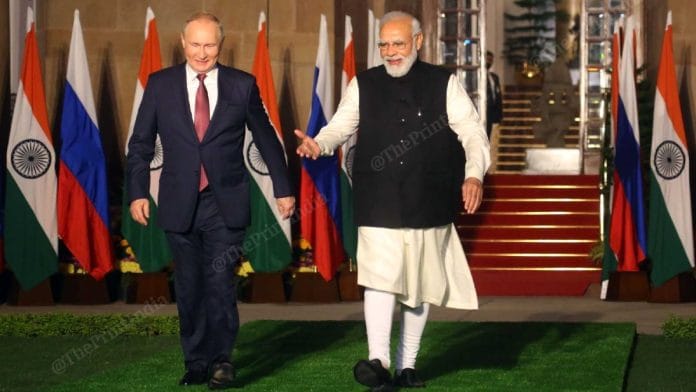



For all intents and purposes, The India-US trade agreement comes at strong cost to India-Russia energy trade in terms of oil purchases by India. If trade restoration with the US is conditioned on India’s energy trade disruption with Russia, then could it not greatly harm India’s historic ties with Russia?
Some have argued that such a feature violates India’s strategic autonomy and defies the historical India-Russia strategic partnership (see here, here, here and here). However, there are at least five reasons why the case above is overstated. India’s relations with Russia are greater than the fortuitous trade in oil (for commercial reasons) since 2022, and is far more pragmatic and transactional than the rhetoric of a historic friend and partner suggests. Moreover, as the Ukraine war appears to be ‘near the finish line’ (at least in Trump’s mind) we are witnessing a policy of maximum pressure on Russian oil revenues—objectively limiting India’s room for manoeuvre. This makes the present zeitgeist very different from ‘business as usual’, and heightening the salience of short-term measures over longer-term oriented foreign policy doctrines.
I have previously argued that India was likely (and sensibly so) to reduce Russian oil purchases by the end of last year. This was driven by a decline in global oil prices, EU sanctions on Russian-crude derived products as well as US secondary tariffs. Recent announcements and developments indicate that India is likely to further cut purchases of Russian oil, even if it doesn’t hit nil (more likely in the range of 2,00,00 to 4,00,000 bpd).
Is it then time to worry about India-Russia ties and perhaps Russian retaliation in some form? I argue that while caution is always welcome, there are reasons to not be pessimistic.
Ties sans oil
It indeed cannot be the case that the India-Russia historic strategic relationship is both great and also so contingent on the short-term purchase of oil. Relations were, after all, ‘great’ prior to February 2022—when Russian crude constituted merely 1-2 per cent of India’s total oil imports per year. Hence, ties are likely to remain mutually constructive even after India stops importing vast amounts of Russian crude. As the Russia-Ukraine war may be winding down (or mutating), we are likely to see a return to more normal times. This, after all, also means less to no discounts on Russian oil—the whole raison d’être of increased purchases.
Also read: India’s strategic future tied to easing Russia-Europe standoff
Reality of ‘strategic autonomy’
Since 2022, India has adopted a strident narrative on the linkage between strategic autonomy and its substantive purchases of Russian oil. This was required in the normative landscape as the west laid moral opprobrium on India for ‘opportunistic’ benefit from war, even as it directly and indirectly encouraged such purchases to stabilise global oil prices. However, India purchased Russian oil because it was economic and not because Delhi was fulfilling any form of strategic obligation towards a ‘historic ally’. It had more to do with cheaper oil than it had to do with Russia. To defend large increases in purchase amount, the language of ‘strategic autonomy’ was frontloaded. It served its purpose as a form of ‘fig leaf’ to signal a somewhat non-negotiable stance and bargain from a position of strength. For economic and commercial reasons again (as well as strategic), Russian crude has been much less attractive since last year. Hence, its linkage with ‘strategic autonomy’ is also that much weaker.
The same could be said for India’s position on ‘energy security’. Russian oil was more intricately tied to energy security in the aftermath of the war in February 2022, when prices shot up to $130 per barrel and there was a scramble for finite oil resources. As the world is witnessing an oil glut and declining oil prices, the connecting tissue between Russian oil and energy security is much weaker if not entirely abstract. However, by the same token, if global oil prices increase in the future there will be strong incentive in Delhi to scale up energy purchases from Russia— perhaps with some degree of consultation with the US.
Also read: India-Russia persist with ties not due to Soviet-era nostalgia. They see a new strategic logic
Rhetoric of India-Russia friendship
The account of the India-US trade deal being a threat to India-Russia ties relies on a historically fixed and emotional understanding of India-Soviet/Russian ties based on loyalty, friendship and cultural affinity. In the real world, however, the relationship has been based on interests (self and mutual) and convenience. It has been, in other words, almost entirely transactional. It is this very aspect that has made India understand and accept growing ties between Moscow and India’s adversaries—Pakistan and China. Moscow’s growing drift towards neutralism between India and Pakistan is also well recognised in Delhi. In recent months, it was reported that Russia applied pressure on Tajikistan to eject Indian presence from the Ayni airbase in 2020-21. And yet, Delhi did not let it affect ties in any way given that Russian interests in the Central Asian country are much more salient than India’s in that region.
Sensitivities and emotive familiarity are not entirely absent, but they are supporting elements rather than causal drivers. In this context, Russia fully understands that India’s economic and strategic future is more tied to the West than it is to Russia. Hence, recent Russian statements have struck a sensible balance in criticising Trump’s coercion rather than India’s adjustments.
Even as the oil partnership winds down, Delhi and Moscow have pivoted towards a mobility agreement that facilitates Indian workers entry into labour-starved Russia. This is of significant value to Russia given that Central Asian workers are now less welcome and are themselves less keen on working in Russia. Such an expedient and timely pivot, after all, is itself a testimony to the pragmatic flexibility built into the relationship.
The war on oil tankers and higher stakes
Trump’s approach toward Russia in recent months has acquired a ‘close to the finish line’ approach. This has involved unprecedented forms of both conciliation (through promises of economic cooperation and integration into the western society of nations) as well as economic/military pressure on oil revenues. The latter has involved (since January) the seizing, stalking and harassment of ‘shadow fleet’, as well as sanctioned oil tankers in international waters from the Atlantic to the Indian Ocean and involves contributions from France, UK, Ukraine itself and a growing host of countries. The EU is also at present considering a blanket ban on EU companies from providing maritime services to vessels carrying Russian crude oil.
Such measures are gradually increasing the risks of a naval confrontation between Russian and western forces. The West’s actions are also yielding significant results, leading to a halving of oil revenues for Russia in recent months, while also causing significant domestic economic strain. In this context, the suggestion that India simply needs to assert its strategic autonomy and continue buying large amounts of Russian oil (given increasing discounts) disregards ongoing acute international trends. It also disregards the salience of long-term ties with the EU and the US. At the same time, however, worries about over-accommodation toward the US are real and legitimate.
Perhaps relatedly, the Indian Coast Guard also recently seized three ‘shadow’ oil tankers ‘linked’ to Iran on 6 February. This was a significant move arguably marking India’s contribution to the global enforcement against ‘shadow fleets’ that operate outside of the rules based order. The Coast Guard itself characterised the action as an act ‘strengthening the rules based international order’ and reenforcing India’s position as a ‘net security provide’ in the region. These moves are unprecedented in many ways and underscores that these are not ‘business as usual’ times. Russia itself, after all, has sought to entice Trump by offering cooperation in energy investments, critical minerals and suggesting Russia’s return to the dollar settlement system.
There is also the shadow of the future. All wars eventually end, there is the obvious prospect of a Russia that has made peace and is focused on economic reconstruction, growth and internal stability. It will need India for investments, workers, and as a partner in various international organisations. Both defence and energy ties continue to hold great potential, especially in a world where there is a modus vivendi between Russia and the West.
It will be unwise for Russia to recover relatively meagre profits by selling ‘sanctioned’ oil to a less than willing India and thereby complicating a stronger economic as well as defence partnership in the future.
More recently, China had stopped imports of Russian electricity based on economic reasons. Given that India’s recent oil decisions are themselves entirely economic in nature, it will be somewhat odd for Russia to curtail ties with India and not with its closer strategic partner to its south.
Also read: Putin’s India visit a lesson for Europe on how to maintain foreign ties when Trump is against it
A loss foretold? Not really
India-Russia relations are much more resilient and adaptive than more pessimistic accounts suggest. Being students of diplomacy par excellence, Russian experts and officials have often shown a more sympathetic understanding of India’s foreign policy constraints than well-wishers on the Indian side. By fearing a degradation in India-Russia ties, India inadvertently conveys the message that commercial agreements with Russia have been obligations rather than freely arrived at transactions. This meaning oddly contradicts ‘strategic autonomy’ itself.
The world of India-Russia ties goes much beyond crude oil and has never been defined by singular events and episodes. Meanwhile, global politics has changed significantly over the last few years. This has undeniably posed new constraints and challenges to India’s pursuit of ‘strategic autonomy’. India’s hard to shake off dependence on critical minerals from China is just one example of newer challenges that older frameworks struggle to recognise. Trump’s hyper-distinct policy-making style is arguably another challenge. Strategic autonomy has undoubtedly needed to adapt—and so has India-Russia relations in recent years. The present flux has after all required greater nimbleness than fixed post-cold war doctrines generally allow for.
Sidharth Raimedhi is a Fellow at the Council for Strategic and Defense Research (CSDR), a New Delhi-based think tank. He tweets @SidharthRaimed1. Views are personal.
(Edited by Theres Sudeep)