



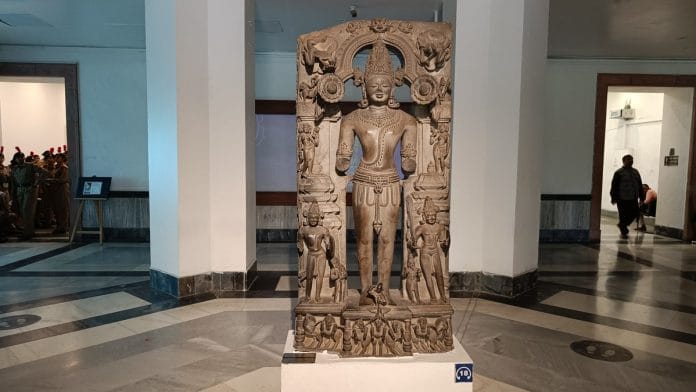
When my daughter was nine, I took her to the Ephesus Archaeological Museum in Turkey. That day, we saw the magnificent statuette of Artemis together. She had many questions: What does fertility mean? Do we also have a goddess of fertility in India? Why does she have so many breasts? Who carved this statue? When information on the museum plaques, the museum guide’s explanations, and my subject knowledge wasn’t enough to satiate her curiosity, I did something that comes naturally to me as an architect: I took her to the actual site of the ancient Temple of Artemis. As we stood in front of the ruins, we spoke of how mythology was a significant part of Greek culture, how Greeks personified nature in the form of gods, what could happen if someone disagreed with this belief system in that era.
This, right here, is why I can never agree to accept museums as mere repositories of objects. Or as a checklist on a tourist’s itinerary. Because at their best, museums can be catalysts for true learning by generating and nurturing curiosity.
The upcoming Yuge Yugeen Bharat Museum in New Delhi, which will be the world’s largest museum upon completion, is expected to host more than 80,000 artefacts in 950 rooms across 30 thematic galleries over a sprawling 1,55,000 square metres. If a single artefact could deepen my daughter’s understanding across topics as diverse as mythology, fertility, history, nature, religion, architecture, and the role of women in society, one need only imagine what 80,000 artefacts can do!
Across the country, new cultural institutions are being planned, expanded, and refurbished. The Union Budget 2026 proposed developing 15 archaeological sites, including Lothal, Dholavira, and Sarnath, into “experiential cultural destinations.” Under the Ministry of Culture’s Museum Grant Scheme, individual projects can receive up to Rs 15 crore for Category 1 museums and Rs 8 crore for modernisation of an existing Category 2 museum. There is immense potential. But scale, or the number of museum-worthy objects, has never been a problem for Indian museums. The problem is that scale alone cannot guarantee the transformative impact a museum can have on a person, and most importantly, on our kids. In fact, scale has almost nothing to do with it. In my opinion, whether a museum succeeds as a cultural institution depends on how powerfully it can generate, deepen, and sustain curiosity among its audiences. And that, in turn, depends on how good a museum is at telling stories.
Having visited and studied numerous museums across the country and having had the opportunity to design a few, I think the biggest hurdle that keeps India’s museums from reaching their true potential is the lack of focus on storytelling. So many magnificent artefacts in our museums repeatedly fail to attract audience interest because there is no story built around them to contextualise them in relation to other artefacts in the museum. To turn this around, we need to change the very processes by which our museums are planned, programmed, and maintained in the long run.
Storytelling and accessibility
The first step is to involve interpretive planners at the early stages of museum design. A lack of interpretive planning is the reason for disjointed or poor-quality storytelling across numerous museums in India. These specialists are responsible for taking stock of all objects in a collection and creating a plan that defines the museum’s overall story as well as gallery-wise and object-wise narratives for visitors. Curators, conservators, and exhibition designers should work collaboratively with interpretive planners to ensure each artefact is displayed and communicated effectively, with its appropriate context.
Once the interpretive plan is in place, the next step must be to carry the defined stories into the physical architecture and exhibition design of the museum. Every element of the space, from various types of displays, the lighting, colours, textures, and audio-visual integrations, needs to be thought through at this stage to shape a cohesive story for the diverse range of audiences a museum caters to. For instance, at the Samrat Samprati Museum of Jain Heritage we designed in Gujarat, one of the permanent galleries displaying Akbar’s farmaan to a Jain acharya (monastic leader), Heer Suri, recreates the Mughal court at Fatehpur Sikri through red sandstone arches with white borders, the setting where Heer Suri had imparted teachings of ahimsa to the emperor. Be a child or an adult, a Jain practitioner or not, anyone who steps into this gallery will be transported viscerally into the context in which the displayed artefact is to be experienced and understood.
Prioritising physical and language accessibility for all is another important aspect that needs consideration at this stage, if the stories inside a museum are to reach a wide audience. This layer, too, is missing in many Indian museums today. There are some practical reasons for this, and as an architect working in this space, I do understand them. For instance: ideally, inclusive gallery design should accommodate both adults and children. But how does one place all the labels and exhibits at eye level for children (under 3.5 ft) while also serving the 75 per cent adult audience?
However, if learning is treated not as a programme to be inserted later, but as a condition embedded into the museum from the outset, simple solutions can be devised to overcome these hurdles. Movable chairs or step-up stairs could be provided for little ones to view exhibits placed at an adult’s height; story-based labels instead of technical-sounding notes can encourage more curiosity; multilingual interpretation (visual and auditory) can help bridge gaps not only of attention but also of literacy and access. Another idea is to include interactive exhibits where kids and adults alike can learn through physical play, something that the Museum of Solutions (MuSo) in Mumbai has done really well. Well-curated, multilingual sound and light shows, such as those at Amer Fort in Rajasthan and Orchha in Madhya Pradesh, are also great tools to engage wider audiences without being prescriptive.
But permanent exhibitions can only do so much. Anyone who has worked in or with museums understands that even the most extensive permanent exhibits can only attract strong footfall for the first few years. Which is why a robust public programming and outreach strategy becomes crucial if a museum is to fulfil its transformative public purpose in the long run.
This strategy needs to be threefold. First, museums should bring newer people in by organising well-curated temporary exhibitions at regular intervals; running interactive, art-history-class-style workshops using select pieces from the collection; and conducting independent workshops, like pottery or miniature painting or cyanotype printing, which can attract and engage niche audiences.
Second, museums should go out and reach people where they are. This means that enough budgets must be allocated to creating and maintaining accessible digital archives of the collection on a museum’s website, for social media outreach, and whenever possible, for high-visibility advertising in public areas such as parks, streets, bus stops, airports, and railway stations. MAP in Bengaluru has done a really good job at all of these — I was in the city the other weekend for a site visit, and their adverts in the airport were successful in nudging me to make a small trip to the museum, even when I had only 20 minutes to spare. I was heartened to see the ground floor activated with a temporary exhibition, Living Botanicals.
There was a constant buzz of youngsters moving into the space and interacting with the exhibit on their own terms. The exhibit was designed to promote gathering and interaction, and that day, the space was hosting a pottery workshop led by deaf facilitators as part of the museum’s programming for the International Week of Deaf People. It was truly heartwarming to be part of this lively atmosphere, it was yet another reminder that a museum cannot thrive without relevant, sustained programming.
Beyond digital and on-ground outreach, initiatives like Chhatrapati Shivaji Maharaj Vastu Sangrahalaya’s Citi-CSMVS Museum on Wheels demonstrate that it is possible to literally take museums to people for whom it might be difficult to access the museum and its offerings. Over ten years, their free-of-charge exhibitions have travelled on bus wheels to rural and urban areas in six Indian states already. Education facilitators are present at each travelling exhibition, ensuring that all visitors get guided tours and interactive talks that can support deeper understanding of the themes; they are also available for specialised workshops for students and educators upon request.
Also read: Troubled kings, distorted faces and vivid shades — Inside Delhi’s UTSAV’26 art exhibition
Moving beyond guided tours
The third part of the strategy is to embed a museum’s programming within existing institutional structures such as schools and universities. To achieve this, museum directors, curators, and government officials must work together. Beyond the usual guided tours, museum curators or subject matter experts could conduct in-person sessions in educational institutes, leveraging the institute’s auditoriums, classrooms, and other possible venues; if that’s not possible, online classes or weekend workshops could also be explored and kept open to all. Museums could also be planned to become active venues themselves, hosting artists, craftspeople, performers, and storytellers regularly.
In addition, policy initiatives like Bihar government’s pioneering scheme, which funded primary schools for museum visits and enabled 33,000 students from 1,000 schools to visit the Bihar Museum in 2019-20 alone, demonstrates that funding is essential to drive participation. Aligning museum funding frameworks more explicitly with local governments’ educational goals would similarly encourage institutions to prioritise access, school partnerships, and sustained programming.
And lastly, every museum must have an associated conservation lab within its premises to preserve historical artefacts for posterity and to provide an environment-controlled space for conducting research.
If we can bring these changes about, we can truly expand the role of museums from a static repository of objects or a tourist’s checklist item on an itinerary to a dynamic, living, evolving entity where knowledge continues to not only be experienced, but also produced. If we can bring these changes about, every single museum, big or small, can help a young kid discover a story that could change their lives forever.
Sarika Shetty is a partner at SJK Architects, a Mumbai-based architecture, interior design, and masterplanning practice founded in 1990. Most recently, she led the design and development of the Samrat Samprati Museum of Jain Heritage in Koba, Gujarat. Views are personal.
(Edited by Aamaan Alam Khan)