






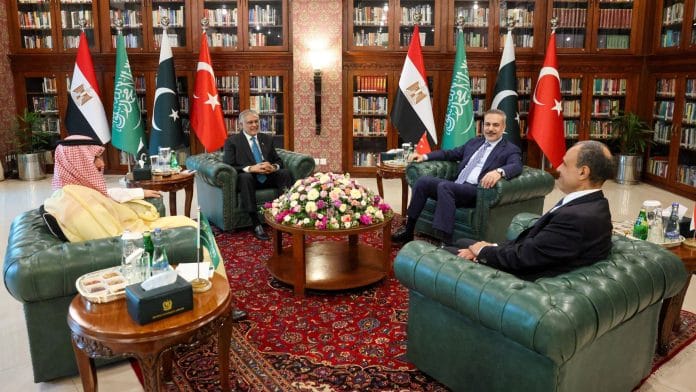



Only two years ago, Iran and Pakistan were firing drones and missiles at each other. Pakistan signed a mutual defence treaty with Iran’s archrival Saudi Arabia last year. And yet Pakistan, along with Egypt, Saudi Arabia and Turkey, is at the centre of talks over a ceasefire between the US and Iran. There is no guarantee that the talks will succeed, but Pakistan, for now, appears to have a seat at the “global high table”.
However, External Affairs Minister S Jaishankar ended up looking like sour grapes when he labelled Pakistan a “dalal” nation for attempting to mediate between the US and Iran. It wasn’t so long ago that Jaishankar himself had presented India as a potential go-between in the Russia-Ukraine war. Given how urgently India needs the Middle East war to end to contain serious harm to the economy, silence may have served the national interest better.
Prime Minister Narendra Modi’s poorly timed tilt to Israel on the eve of the war had already damaged Iranian trust in India. The Modi government subsequently course-corrected to protect Indian energy security. However, 18 Indian vessels carrying crude oil and LPG remain stuck in the Persian Gulf (as of 30 March) while Iran has reportedly given blanket permission for 20 Pakistan-flagged vessels to gradually transit the Strait of Hormuz.
This is an undeniable setback to India’s goal of isolating Pakistan. How did it come to pass?
The reliable ally
First, Pakistan’s involvement in the US-Iran relationship isn’t new. Pakistan’s army chief Field Marshal Asim Munir has had direct contacts with the Iranian military for some time, including meetings with the Chief of General Staff of the Iranian Armed Forces and the commander of the Islamic Revolutionary Guards Corps (IRGC) in early 2025. Both of these individuals were killed in June 2025, but the institutional links remained. For this reason, Pakistan facilitated talks between the US and Iran in July 2025, just after the June 2025 Israeli attack on Iran’s nuclear facilities, which US Secretary of State Marco Rubio acknowledged. And with the IRGC running the show in Iran at the moment, that channel is useful to the Americans.
Second, as the weaker party in its contest with India, Pakistan has always been nimble in its search for allies. It’s common knowledge how Pakistan recommended US President Donald Trump for a Nobel prize for “stopping” the India-Pakistan conflict and invested in a crypto venture linked to Trump’s family. These gestures led Trump to invite Munir, the presumed architect of the Pahalgam terror attack, to a friendly lunch in the White House only one month after India and Pakistan had been shooting at each other.
Despite its ‘all-weather’ alliance with China, Pakistan is hedging its bets by continuing to engage the US and attempting to neutralise India’s material advantages. Like India, Pakistan is trying to expand its strategic space in an increasingly polarising world. And the children of the Pakistani elite still prefer New York or London to Shanghai.
This pattern of Pakistan trying to make itself indispensable goes back decades. The country wooed the US in the 1950s by posing as a reliable anti-Communist ally, as a go-between in the US-China rapprochement in the 1970s, a bulwark against Soviet expansionism in the 1980s, and an ally in the “war on terror” in the 2000s. These efforts always ended poorly and at high cost for Pakistan, be it the flow of refugees, weapons and drugs from Afghanistan or the spread of jihadism and sectarianism domestically. But they inevitably complicated India’s strategic environment. And this time it seems like we are stuck in a replay.
Also read: India isn’t shaping the West Asia crisis—it pays the price for caution
Where does this leave India?
Remember, whichever country can claim “war rukwa di“, an end to the conflict clearly serves India’s interests. If Pakistan and others are to facilitate that for us, so be it. Looking ahead, the trust deficit between the Gulf kingdoms and the US that this war has created could present an opportunity for India. This depends, of course, on how the war ends, but any decline in US influence could create a security vacuum that India will need to fill, given our energy dependency and a one-crore-strong diaspora in the region.
But strategic influence is built on economic heft, and the China-Pakistan combination will be an obvious alternative. There are many moving parts and many miles to go, but India must prepare for a future in which it leverages relationships around the Persian Gulf to build a future security architecture. And a compromised Prime Minister beholden to Israel’s Benjamin Netanyahu will be unable to do that.
Amitabh Dubey is a Congress member. He tweets @dubeyamitabh. Views are personal.
(Edited by Ratan Priya)