




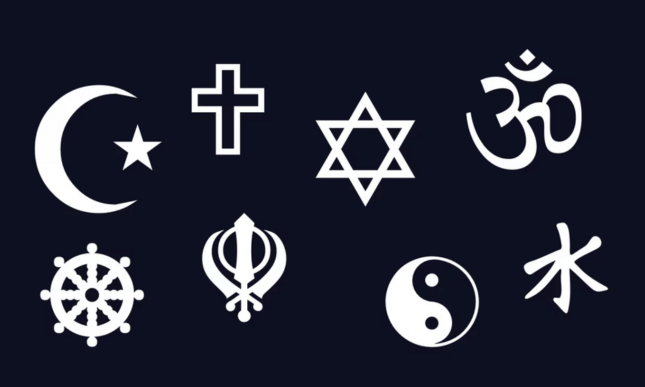

India regularly gets listed as a country a country of “particular concern” by the US Council for International Religious Freedom (USCIRF). This institution is highly irrelevant and also has no business commenting on other countries’ religious freedoms, especially when it can’t do so in its own home country, the USA.
We must ignore all USCIRF reports as motivated, but we must discuss the core definition of what religious freedom should really mean, and what it has become.
The current idea of religious freedom comes from the European experience with religious persecution – where Catholics and Protestants fought bloody battles in the past – and, more recently, from the American Protestant idea of religious freedom, which is largely about the right to proselytise. America, which was initially colonised by Protestant groups fleeing the increasing secularisation of Europe, is a particular believer in the innate evil of pagan groups, and that their liberation from their beliefs is part of freeing the human soul.
According to Dr Jakob De Roover, Professor at Ghent University, Belgium, for American Protestants, “heathen religions like that of India always tyrannise the human spirit. Inspired by the devil, they are characterised by their violation of Christian religious freedom. Therefore, the story continues, ‘Hinduism’ aims to stifle the soul and subordinate the conscience to human authority (through its caste system, for instance). Stripped of their overtly theological elements, such beliefs entered American common sense and popular discourse about India and her traditions. This story about ‘Hinduism’ makes it all the more obvious to the Americans (and to others who accept this story, such as the Indian secularists) that the freedom to escape from this religion should be safeguarded at all cost.” (Quoted from an article in Firstpost.com)
While not all Protestant groups may hold such extreme views, they do believe that the right to convert Hindus is their fundamental right. The Protestant groups operating in India are often the ones most aggressive in seeking conversions.
In an earlier article, I have argued that the right to propagate and convert cannot be a fundamental right for many reasons, including the fact that it results in a lack of theological diversity, and robs the world of philosophical ideas from the eastern religions of Hinduism, Buddhism, Jainism, Sikhism and Shintoism, among others.
As a general rule, the right to religious freedom ought to be an individual right, and an individual right only, and not the right of heavily funded church or mosque organisations to unleash mass conversions through inducements and fraud. These can also be socially destabilising. No one will object if one person feels the need to convert; when this becomes a mass obsession, it can cause social havoc.
There is also a bigger argument against conversions in the Abrahamic mould. Here if you convert, you have to give up all ideas linked to the previous religion. How can you call this religious freedom, when the new convert is expected to give up all his old beliefs in toto. How is it religious freedom if accepting Jesus means you have to give up Ganesha or Rama? Can religious freedom be a mutually exclusive affair?
Mahatma Gandhi, during the time he was leader of the Indian freedom movement, was repeatedly nudged by evangelical persons to convert to Christianity because his ideas were apparently close to that religion. But Gandhi could happily draw inspiration from Christ’s Sermon on The Mount and from the idea of Sri Rama and Ram Rajya. In both Christianity and Islam, you have to make a clear choice: you are either with us or just a target for conversion.
Religious freedom should ideally mean that the individual can choose to adopt any religious or spiritual idea from any religion, in part or in full, and not be forced to choose a binary – either you are with me or against me. The Meos of Mewat had become Muslims but retained many of their Hindu practices. This gave rise to the Tablighi Jamaat, which wanted to rid them of “shirk”, or practices not approved by Islam.
“Religious freedom” that forces the individual to choose between ideas that are essentially non-binary in nature is not religious freedom at all.
It is time the world accepted the Indian idea of religious freedom and junked the one that suits the political purposes of Abrahamic faiths.
R Jagannathan is an editor and the former editorial director at Swarajya magazine. He tweets @TheJaggi. Views are personal.
This article has been republished from the author’s personal blog. Read the original article here.
Would request the author to define what he means by religious freedom?
Does he mean that social upliftment should only be done adherents of one class of religion as is currently happening in India by choking all NGOs of other religions?
Does he mean that Government should be the ultimate authority in deciding who has the permission to convert as is currently happening?
If US or Europe or Russia passes an anti conversion law similar to India , would be support it where Govt notification is required for any conversion to another religion? And anyone trying to convert is put in prison by government.
By religious freedom does he mean that all people should believe that all religions lead to the same path? And if anyone does not believe in it and believes that there is only one way then that belief is not covered under religious freedom?
Propagation of religion is a fundamental right. It includes the right to make your own theology. And it includes the right to have your theology exclude other theologies. That is true religious freedom. Anything else is just an eyewash in hypocrisy.
Two commenters here fail to distinguish between individual conscience and institutional behavior—a distinction that destroys their entire defense.
Radizzz claims “religious freedom already means individual conscience” and points to Western eclecticism as proof. But the author never argued against individual choice. He argued against organized, funded, systematic conversion campaigns. These are different animals. A person privately converting to Christianity is one thing. A missionary organization with millions in funding targeting vulnerable populations is another. Radizz conflates them to avoid the actual critique.
John Rambo dismisses the author as “historically inaccurate” and “a bigot” without explaining why. No counter-evidence. No clarification. Just character assassination. If the Protestant history is wrong, say how. If the theological analysis is flawed, show where. Instead, Rambo opts for name-calling—which is what people do when they can’t argue the substance.
Here’s what actually matters: The author identifies a real asymmetry. Abrahamic faiths have institutional machinery to convert. Hinduism doesn’t. That’s not bigotry; that’s observation. The presence of individual eclectic believers in the West doesn’t negate this. It just means some people, despite their religion’s exclusivity doctrine, choose pluralism anyway. That’s them resisting their own theology, not proof that the theology permits it.
Radizz then pivots to “but what about Christians in Chhattisgarh?”…classic deflection. Two wrongs don’t make the author right or wrong. If Hindu mobs are persecuting Christians, that’s a separate crime. But it doesn’t rebut the argument that organized conversion campaigns are structurally different from individual faith choice. She’s throwing a stone at a glass house while standing in one herself.
The real question neither commenter addresses… If your religious freedom requires others to give up theirs, is it actually freedom? Or is it just power dressed in the language of liberation? They don’t answer because they can’t
Evangelism in Bharat is colonialism. Conversions must stop.
Westernn evangelical organizations have weaponized billions into systematic assault: hospitals, schools, NGOs, trained indigenous missionaries targeting the broken places—caste oppression, poverty, illness. They offer false salvation. Convert and you erase your lineage. Your children inherit a foreign god and lose the Mahabharata as lived memory. Your ancestors’ rituals stop. The chain breaks.
This is calculated destruction. Evangelicism demands binary choice: my god or damnation. It permits no coexistence. Where Bharat says “Krishna and Jesus can both be honored,” evangelicism says “choose or be damned.” It poisons Bharatiya philosophy at its core and replaces it with exclusivity and domination.
The corruption is complete: Indian courts, Indian secularists, Indian NGOs have weaponized the colonizer’s framework and enforce it as universal truth. “Religious freedom” has become the legal instrument for civilizational erasure.
The plague isn’t foreign missionaries. It’s that Bharat’s own institutions have become agents of its dissolution.
Enough. Conversions driven by institutional machinery, funded by foreign money, targeting communities for erasure—these are not expressions of individual conscience. They are weapons of civilizational destruction. Bharat must recognize this and end them.
The right to convert under the charade of “individual religious freedom” is the right to dissolve your own civilization. Bharat does not have to grant this right. Civilizations that survive refuse to subsidize their own extinction.
Stop the conversions. Defend Bharat.
Excellent article. Monotheism has no freedom to choose gods.
Religions that impose one god, and destroy other cultures are hypocrites in talking about religious freedom.
Monotheism is the epitome of religious imperialism and fascism.
Hinduism doesn’t say, you should not worship any other gods, but Abrahamic religions have this as their core principle.
Who the hell is Jesus trying to save people from? Himself? As if they have the monopoly on “salvation”.
Historically inaccurate as well. Protestants did not flee secularisation of Europe. Author is a bigot – nothing more.
What a contradictory article, religious freedom already means thst one should be able to form religious beleifs as per their own conscience. The presence of eclectic beliefs in the west already proves that there is nothing in the idea of religious freedom that prevents such a thing from happening.
If people who share religious beliefs come together to form an organization then thst is their prerogative as is their prerogative to congregate and create their own theology
If people want to mix and match then that is their prerogative. The state should not interfere in either case whether nor support one. This person ahould see what is happening in Chhatisgah to christians or the numerous gathering where muslims are called to be socially boycotted till they leave islam before attempting to lecture anyone.