









If there was still any doubt that we live in an age of strongmen, it was snuffed out on the night of Jan. 4, when one strongman seized another, in his Venezuelan lair, and flew him to the US. Donald Trump has declared that he is now “ultimately” in charge of Venezuela, and his deputy chief of staff, Stephen Miller, poured scorn on idle talk about “international niceties,” proclaiming that we live in a world “that is governed by strength, that is governed by force, that is governed by power.”
Which raises another question: How long will this new world last? Will the strongmen burn themselves out and the rules-based global order reassert itself? Or are we in for the long haul? Liberals like to approach this problem with the help of a paradox: Strongman regimes are much weaker than they appear, and democratic regimes much stronger. Strongmen may take history by the scruff of the neck, but their regimes are “brittle.” Liberal leaders may dither and dawdle, but they have hidden strengths. Strong is weak and weak is strong: We just need to wait until this underlying logic plays itself out.
This view of the world is uplifting, to be sure. Who does not love stories of Goliaths felled by Davids, or oversized school bullies humbled by pipsqueaks? It can also claim the support of serious intellectuals: The current issue of Foreign Affairs contains a cover essay on the “The Weakness of the Strong Men” by a leading historian of the Soviet Union, Stephen Kotkin. But with every passing week this line of argument becomes less convincing.
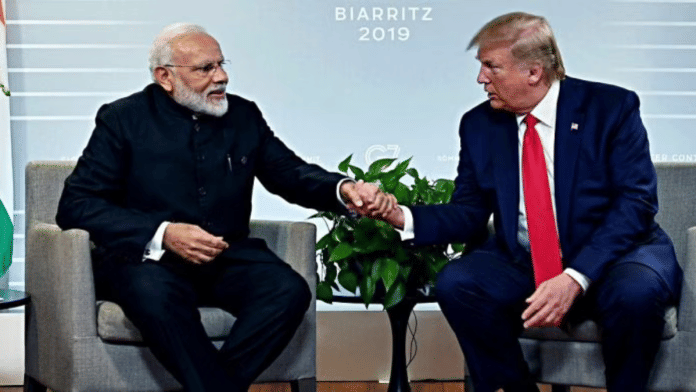
Strongmen have been on the march since Vladimir Putin breathed new life into the form in 1999-2000. Putin and Xi Jinping have consolidated strongman rule across the vast Eurasian landmass. President Recep Tayyip Erdogan has been tightening his grip over Turkey for the last two decades, and now brazenly jails his democratic challengers with seeming impunity. Mohammed bin Salman (MBS) has extended strongman rule to the family monarchies of the Arabian Peninsula. Most remarkably of all, Donald Trump and Narendra Modi have introduced the strongman principle to the world’s oldest democracy and its most populous. They have also been remaking the global landscape, whether it is Putin expanding into his near abroad, Benjamin Netanyahu rolling back Iran’s axis of evil or MBS building a nine-runway airport in Riyadh.
Advocates of the strong-weak hypothesis point to the number of strongman regimes, from Nazi Germany to Soviet Russia, that have collapsed in flames. Yet Francisco Franco ruled Spain for 36 years (1939-75), the same length of time as Antonio Salazar ruled Portugal (1932-65). The Soviet regime lasted for almost 70 years only to be replaced, after an interregnum of chaos, with another strongman regime. A 2023 paper in the American Economic Review, drawing on global data going back to 1900, demonstrates that, on average, populist leaders (who tend to be strongmen) have longer spells in power than non-populists (six years versus three) and a higher chance of being re-elected (36% versus 16%).
Advocates of the strong-weak hypothesis also point out that strongmen regimes tend to dysfunction. Strongmen are so paranoid that they employ guards to guard the guards, so cut off from reality that they overestimate their relative strengths (as Putin did in Ukraine), and so weak that they surround themselves with homunculi.
Yet today’s liberal regimes suffer from a mounting range of their own dysfunctions. Veto groups have become so powerful that routine planning decisions can take years. Lobby groups have captured government departments. Much democratic government is inertia qualified by giveaways to vested interests. Democratic feedback loops have become so clogged that the establishment ignored democratic complaints about immigration for decades. As for cronies, mediocrities and timeservers, the democratic world is awash with them.
During the high days of neoliberalism, pundits insisted that strongmen were doomed by the three great forces of our time: democracy, globalization and information technology. But these days the opposite is the case. Would-be Trumps are on the march across Europe, determined to repeat the tricks of Modi and Trump. In the most recent European parliamentary elections, in June 2025, populists came first in five countries, including Italy and France. A big new poll predicts that Nigel Farage’s Reform Party would win 381 seats, giving him a majority of 112 in a political system which a Tory grandee, Lord Hailsham, described as an “elective dictatorship.” A 2025 Ipsos poll of 31 countries found that 47% of respondents believe their country is in decline and needs a “strong leader who breaks the rules” to fix it.
Globalization is more likely to favor strongmen than free markets, partly because it spreads discontent, particularly among the traditional working class, and partly because it allows the likes of Xi and Putin to interfere in open societies. And a growing number of tech barons have thrown in their lot with strongmen, abandoning tech libertarianism for national greatness and transforming their flabby flesh into toned muscle.
Strongman regimes are more likely to prove self-reinforcing rather than, as liberals would like to think, self-undermining, a principle that applies both at home and abroad. Harvard’s Steven Levitsky warns that the US may be descending into a system of competitive authoritarianism, in which parties continue to compete in elections but incumbents routinely abuse their power to punish their critics and tilt the playing field against the opposition. Globally, despite their furious rivalries, strongmen tend to reinforce each other, chatting on the phone, meeting at summits, even basking in each other’s reflected glories. Billboards for Israel’s Likud party show Netanyahu shaking hands with Trump, Putin and Modi next to the headline “in a class of his own.”
Being a strong man during the era of the rules-based global order may have been a disadvantage, as Iraq’s Saddam Hussein discovered. But once strongmen have achieved a certain mass, they gain not just an advantage but an entry ticket for global politics. The European Union, with its obsession with process, predilection for weak leaders and addiction to collective decision-making, is consigned to the children’s table, an object rather than the subject of history.
The problem with the liberal paradox is not that it is completely wrong or empty. Lord Acton was right that power corrupts and the only way to limit that corruption is to limit power; Cassandras are right to warn that strongmen regimes frequently end in calamity; and Trump’s critics are equally right to warn that controlling Venezuela will be a lot harder than extracting Nicolas Maduro. The problem is that such beliefs can feed complacency when what we need is vigilance.
Liberals need to start off by fixing the dysfunctions within their own systems rather than waiting for the dysfunctions within authoritarian systems to play themselves out. Stop ignoring the people when they tell you that immigration is not working. Get rid of the timeservers who clog up national civil services. Stop letting yourselves be fleeced by nongovernmental organizations. This is the key to revitalizing a moribund EU and snuffing out strongman tendencies in the US. They also need to become active shapers of history again rather than mere observers. Devote serious resources to defense. Take a more judicious approach to the remit of international law; in particular, rethink the concepts of asylum and refugee status established in quite different circumstances in the aftermath of the Second World War. Push back more firmly against authoritarian attempts to spread misinformation or dirty money.
It is no longer enough to assume that strong is weak and weak is strong. We must prove it by rigorous self-criticism and vigorous action.
This report is auto-generated from Bloomberg news service. ThePrint holds no responsibility for its content.