



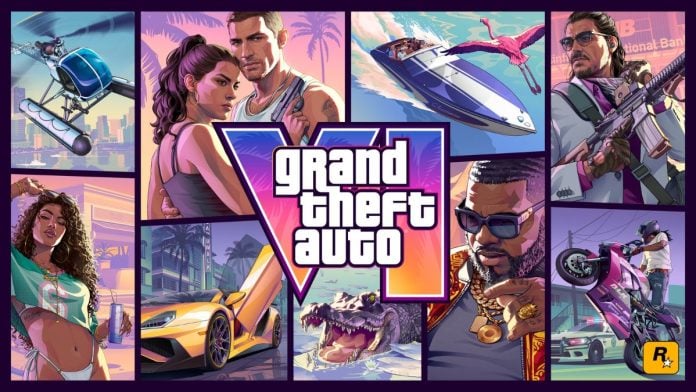
After 13 long years since GTA V, the new Grand Theft Auto is finally here. It’s a bit of a cultural moment for millions across the world—32.5 million individual units sold across PlayStation and Xbox before launch.
But something is amiss in the Florida-inspired fictional in-game state of Leonida in GTA VI. It isn’t the jaw-dropping game graphics or the gratuitous violence, nor is it the sandbox model of doing anything and everything imaginable.
This time, Rockstar, the developer studio behind the video game, wants players to invest in the relationship between its two protagonists, Jason Duval and Lucia Caminos. Their shared life includes the ordinary business of being together: checking in, spending time at home and undertaking small domestic activities that can strengthen their bond. And, according to the online conversation, this was finally a step too far. The franchise that has long allowed players to steal cars, rob banks and pursue almost any impulse now asks them to consider another person’s needs. A step too far, Rockstar?
I have dedicated many hundreds of hours to the GTA franchise since Vice City. I have loved toying around with its evolving game and physics mechanics, peculiar gameplay conventions and sandbox environments. Like many equally frustrated souls, I strongly despised the ‘Demolition Man’ helicopter mission from Vice City, could never ‘get gud’ enough to complete it, proceeded to download a virus-infected save file from the internet and conked the family computer.
It has taken a lot of self-soothing—and constant mindfulness about my impulses—not to dive headfirst into the newest instalment.
Why are men angry?
Social media has been abuzz with reactions to the new game. Complaints about chores, maintaining a relationship and remaining faithful to a partner have become an unexpectedly revealing part of the conversation. GTA is almost 30 years old, making it much older than a significant part of its player base.
Across its mainline 3D games, the player has generally inhabited a male protagonist whose freedom is expressed through mobility, acquisition, violence and sexual access. He can steal, kill, rob, pursue women and abandon responsibilities, often with little lasting accountability. I could keep trying to steal military jets, die as I was about to take off, respawn and try again.
GTA VI introduces a different proposition through Jason and Lucia: a relationship in which decisions, money and survival are shared, or at least negotiated. The question is whether Rockstar is asking the heterosexual male player to confront the privileges of the masculine fantasy that has historically underpinned the franchise.
This is not an argument that Rockstar has become a moral authority, or that a video game can reform men. It is an examination of whether the game’s changing mechanics and relationships expose the limits of the traditional male fantasy. Its most interesting provocation may not be its violence, sexual content or political satire, but its suggestion that the male protagonist is no longer the only person whose interests matter.
The response deserves scrutiny without being caricatured. Not every player who dislikes domestic gameplay is expressing misogyny; some may simply prefer the series’ established pace or resent mechanics that feel like chores. But the disproportionate attention paid to the idea of a male protagonist doing ordinary domestic work is revealing.
Why should fixing up a home, checking in with a partner or sharing responsibility feel more disruptive to the GTA fantasy than murder, theft or spectacular violence?
Also read: GTA VI isn’t just for gamers anymore. Modi, MAGA, sports & startups are in on the action
The American Dream, a satire
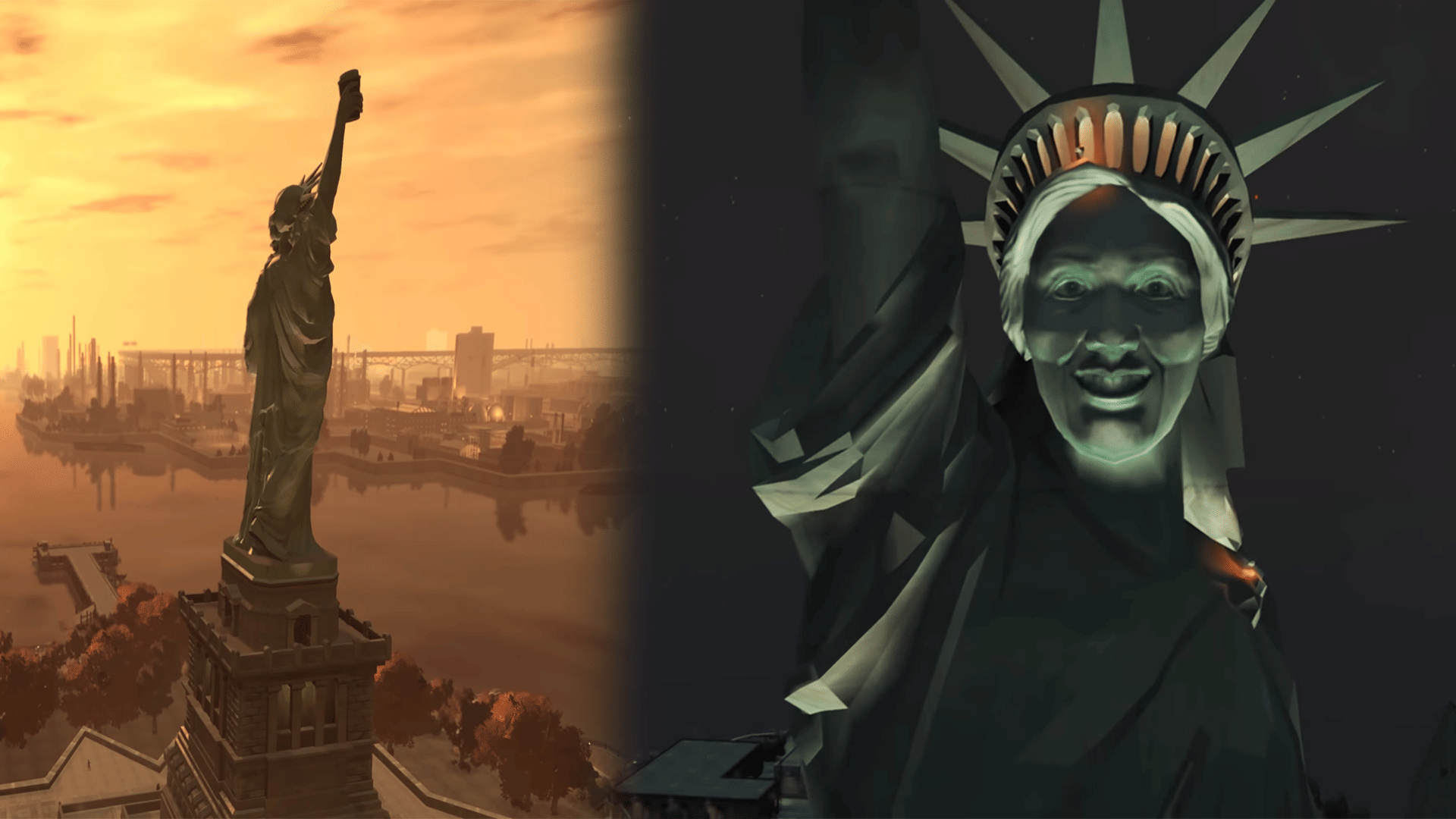
GTA’s political commentary comes from taking American stereotypes and dialling them up to eleven, showcasing the highest possible tension between the idealised American Dream and the lived-in reality. The players see, for example, the Hot Coffee scandal monumentalised in GTA IV, with Liberty City hosting the Statue of Happiness (the in-game iteration of the Statue of Liberty) holding a coffee cup instead of the torch. Many fans have argued that the statue’s facial features resemble Hillary Clinton, the lead proposer of the Family Entertainment Protection Act (FEPA).
GTA III’s (2001) Claude is a near-anonymous criminal. Tommy Vercetti from Vice City (2002) is an aspirational gangster. GTA IV’s (2008) Niko Bellic is an Eastern European immigrant who arrives in the US to live out the American dream and is disillusioned.
In the 2013 GTA V, players can switch between three protagonists: Michael De Santa, a White American; Franklin Clinton, an African-American; and, the most controversial of the three, Trevor Philips, a White Canadian.
Each showed a different relationship with wealth, ambition, family and social status. Michael, an erstwhile bank robber at the beginning of the game, dealt with a midlife crisis, where his wife appears to be unfaithful, and his children despise him. Franklin, like Carl ‘CJ’ Johnson from San Andreas (2004), aspires to upward mobility. Trevor, the most reckless and aggressive of the three, seems to be developed as an antithesis to the stereotype of the kind and polite Canadian citizen.
Yet despite the damage they cause, the men face strikingly little in the way of meaningful consequences. The game also gives limited space to queer male identity, and male relationships are largely framed through competition, aggression, friendship or criminal enterprise. GTA Online then extends the sandbox into a space where players construct and perform their own fantasies of wealth and power.
Media within the GTA worlds is highly inflammatory in its contents. GTA VI includes an anti-Furry, ‘open hunting season’ advertisement. It uses a fictional campaign to manufacture a threat around a marginalised subculture, packaging prejudice as humour, entertainment and a public-interest message.
The parallel with contemporary political communication in the US is hard to miss. US President Donald Trump’s use of social media, AI-generated imagery and inflammatory messaging shows how misinformation and manufactured threats can turn marginalised groups into political targets, particularly in the run-up to midterm elections. The difference is that Rockstar deploys propaganda as satire, while real political propaganda can legitimise prejudice.
Also read: I played GTA VI for the chaos, stayed for Jason and Lucia’s love story
A history of culpability
The question of who is culpable for what happens in a GTA game is not new. One of the more notorious early test cases dates back to 7 June 2003 in Alabama, US, when 18-year-old Devin Moore, arrested in connection to a stolen vehicle, lethally opened gunfire at a police station, and fled the facility in a police vehicle.

At the time of his arrest, Moore was quoted comparing life to a video game, saying, “Life is like a video game. Everybody’s got to die sometime.” He had reportedly played GTA.
On 14 February 2005, the victims’ families filed Strickland v. Sony, a wrongful-death suit against the game publisher Sony, game developers Take-Two and Rockstar, as well as American chains GameStop and Walmart, who sold the games, alleging that the games had contributed to Moore’s actions.
In August 2005, Moore was convicted of capital murder and sentenced to death. In November 2005, the defendants’ motion to dismiss the civil suit was heard and denied, and in March 2006 the Alabama Supreme Court refused the defendants’ application challenging that denial. That was a procedural decision. The court did not establish that GTA caused the murders.
This was an instance where cultural controversy had mired GTA’s reputation as a violent game, and raised questions about whether in-game actions reflected real-world decisions. Now, the questions should evolve to also include issues of destabilised mental acuity, especially undiagnosed underlying psychological ailments that could potentially worsen through cultural consumables like video games, cinema and social media.
Also read: GTA VI enters the chat: Modi takes dig at UPA, says ‘India is playing a whole new game!’
The fantasy of the unaccountable man
The franchise began at DMA Design, where a project named Race’n’Chase was being developed in 1995 about cops and robbers. A coding error in the game made the cops unintentionally aggressive toward the players playing as robbers and became the foundational tool that made the project evolve into the first GTA in 1997. As gaming consoles and development tools improved, we moved from simpler top-down games to third-person open worlds in GTA III, then Vice City, San Andreas and GTA IV, a premise that matured into a template in which the male protagonist becomes an instrument of unstoppable nature and unrestricted agency.
Violence, theft, sex, money and social mobility become activities available within a world that rarely demands lasting moral accountability. Death is a temporary interruption: the player is arrested or killed, loses some resources, respawns and carries on. There is a revealing gap between the consequences experienced by characters in the fictional world and those experienced by the person holding the controller.
Hot Coffee and the American Congress
The original developer of the first GTA game, DMA Design, was later absorbed into Rockstar Games. An apt name, as the games this studio produced have been riddled with fame and controversy. In 2005, a couple of years after the Devin Moore shooting, we got the Hot Coffee scandal, which was a third-party downloadable mod that could unlock access to disabled sexual content in the San Andreas video game. This led to the game’s change in classification from Mature to Adults Only.
In the US, the Federal Trade Commission investigated and later reached a settlement, and consumer and shareholder lawsuits followed. On 16 December 2005, Hillary Clinton introduced the proposed Family Entertainment Protection Act, which was never enacted, and on 14 June 2006 the US House of Representatives held a hearing on violent and explicit video games. Rockstar’s controversies became part of its commercial identity.
Rockstar has regularly come under legal and public scrutiny for promoting violence. In 2003, teenage stepbrothers William and Joshua Buckner, who reportedly claimed inspiration from GTA III, shot at vehicles, killing Aaron Hamel and seriously injuring Kimberly Bede; a $246 million lawsuit against Rockstar, Take-Two and others was voluntarily dismissed four days after filing.
In 2006, representatives of the victims of the New Mexico family killings sued over 14-year-old Cody Posey’s alleged exposure to GTA: Vice City, seeking $600 million; the case was dismissed in December 2007. The controversy extended to Thailand in 2008, when an 18-year-old murdered taxi driver Khuan Phokaeng, reportedly claiming he wanted to imitate a GTA carjacking.
The GTA games and the male fantasy gameplay of unaccountable actions are embroiled within each other. Provocation, one may argue, is not incidental to the GTA brand, but is at the core of its identity and self-awareness.
Also read: Singer Rupa Biswas’s GTA VI moment—a 6 am call, a secret deal and a 44-year-old song
GTA VI: a new chapter in heterosexual culpability?
The move from GTA V’s three playable protagonists to a central male-female partnership—Jason and Lucia—is significant. Their relationship is not simply a narrative device; it potentially changes the player’s relationship with the world. Shared decisions, mutual dependence and the possibility that one protagonist’s actions affect the other all complicate the traditional fantasy of the solitary man who moves through the world without being answerable to anyone.
Two mechanics carry much of this argument. The first is physical cash. Money carried by the protagonist is vulnerable: dying or being arrested can mean losing it, so the player must weigh how much to carry against how much risk to take. The second is family savings. Money placed into this shared mechanism is set aside for the protagonists’ common future rather than remaining available for immediate, individual spending.
Together they separate acquiring wealth from protecting it, and they move the game from individual accumulation toward shared financial responsibility. There is symbolic weight in a male protagonist having to consider not only what he wants to buy or do, but what his decisions mean for someone with whom he shares a future.
These mechanics introduce a different kind of friction into the GTA experience. The player is asked to think beyond immediate gratification and consider the consequences of his choices for another person. Culpability here is not a legal concept. It is the recognition that freedom without responsibility is a privilege, and that the traditional GTA protagonist has largely been allowed to enjoy it.
Also read: Your child wants to play GTA VI. What should parents know before handing over the controller?
The business of selling virtual freedom
Numbers show that the GTA franchise is not a niche cultural phenomenon. Before GTA VI’s launch, the franchise was worth well above $10 billion. In 2013, opening day sales for GTA V were approximately $800 million. In comparison, GTA VI earned approximately $3.79 billion in Day one retail sales, and presold 32.5 million units before launch.
The scale of GTA V’s afterlife is equally important. Its success did not end with a one-time purchase. GTA Online, initially included with GTA V, became a persistent environment in which players could build crews, undertake heists, buy property and vehicles, and compete over status. Shark Cards allowed players to purchase in-game currency with real money. Premium content, subscriptions and recurring purchases extended the commercial relationship beyond the original sale. The game world mocks conspicuous consumption while giving players an ongoing set of reasons to consume.
In India, the game retails for Rs 5,999 for the standard edition and Rs 7,499 for the ultimate edition, which includes some add-on in-game items. Rising memory and storage costs, alongside increased demand from AI infrastructure, have added to pressure on console hardware prices. The PlayStation 5, launched in India for Rs 49,990 in 2021, has increased to Rs 69,990 in 2026—which ideally should not be the case in normal times. We’re nearly looking at a cost of Rs 80,000, just to play a video game. This is truly an item of luxury when one considers the average wage structures across the Indian subcontinent.
This is not simply about gaming becoming expensive. It shows how access to a global cultural phenomenon is increasingly determined by disposable income. The player pays to enter GTA’s fictional capitalist society, where almost everything is for sale and wealth determines access, status and power, and then returns to an increasingly expensive consumer economy outside it. GTA Online makes the contradiction especially visible, with virtual currency, premium content, recurring purchases and a continual pressure to accumulate more. Rockstar’s fictional world mocks consumerism while its commercial ecosystem profits from the desire to participate in it.
‘Pay to play’ is no longer just a description of a video-game business model. It is an increasingly useful description of contemporary culture itself. We pay to access entertainment, to join cultural conversations, to experience spectacle and to signal belonging. The player is not merely watching capitalism being criticised; he is paying to participate in that criticism.
Also read: The Bengaluru team behind GTA VI and the studio that started with one PC
The player, and the person outside the game
The GTA series has tested technological boundaries of its game systems and the social ramifications of its stories in the real world. This newest iteration introduces the first female protagonist in a mainline GTA narrative, who is also a woman of colour. Alongside her male partner, both of whom value their relationship, has the world up in arms, or tweets in the least.
As you spend time within the game apart from your partner, they will send you memes and messages on social media, like in real life. Jason has a to-do list of fixing up his apartment to keep Lucia happy. They work, steal and murder together.
GTA VI may still offer violence, wealth, criminality and excess, but its relationship mechanics and shared responsibilities suggest a more complicated form of agency. The question is no longer simply whether Rockstar can make players uncomfortable with its fictional world. It is whether Rockstar can make them uncomfortable with the assumptions they bring into it.
Shatadeep Maitra is a fine-arts professional, curator and author of books and exhibitions like The Babu & the Bazaar: Art from 19th and 20th-Century Bengal and Indian Blue.
Views are personal.
(Edited by Saptak Datta)