



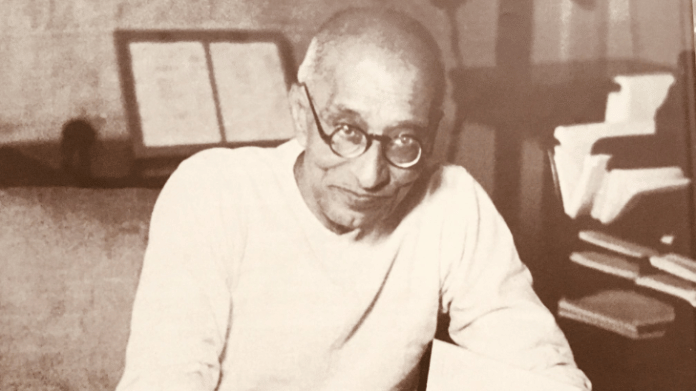

I have been asked to inaugurate this convention of the Swatantra Party. I do it with great pleasure as well as with a due sense of responsibility. I am not inaugurating merely a party. I think we are inaugurating a movement of freedom. Forty years ago, when I was forty years old, after twenty years’ practice at the Bar, and twelve years of political life in connection with the Congress and the Nationalist Party of that time and the Home Rule Movement, I joined the Non-cooperation Movement in close collaboration with and under the leadership of Mahatma Gandhi.
Now when I am twice that age, I am leading a revolt against what I have come to believe to be a fatally wrong direction taken by the Indian National Congress in the governance of this great country. I have come to the conclusion that a movement for freedom, as important and as serious as the movement for independence against British rule, has now to be inaugurated against this misconceived progress of the Congress towards what will finally end in the suppression of individual liberty and the development of the State into a true Leviathan.
The State is becoming a giant entity by itself menacingly poised against the citizen, interfering with his life at all points, mistrusting the people, imposing restrictions, introducing a series of controls and regulations, stepping into the fields of agriculture, industry and trade, creating an army of officials, tremendously increasing the cost of administration and therefore the taxes paid by the nation, hypnotising the people with slogans that are mistaken for thought and wisdom, a scheme of Government in which it is taken for granted that the citizen is ignorant of what is his own interest. My criticism of the Congress policies and tendencies and their inevitable consequences is strong but not exaggerated.
My criticism of the ruling party’s present policy is this: You begin with a false conception and make promises on that basis which are necessarily incapable of performance; then your sympathetic critics want you to be more efficient than you are and to do the impossible and you are led to make more promises in place of the old promises. The whole business which is faulty at the base and in the superstructure leads to the people being made victims of one deception after another.
For example, you promise to put ceilings on land holdings in the hope of making by compulsion what bhoodan is trying to make by willing surrender. Then it is pointed out that you cannot have sufficient land to meet the land hunger of the landless peasants. You give up the idea of making gifts and in view of the criticism of agricultural experts you propose to substitute co-operative farming for individual cultivation. Then you meet objections to compulsory collectivisation by announcing that it will all be voluntary and will not be enforced collectivisation. In order to overcome popular objections you plan subsidies and other inducements at, the cost of the nation in order to build up a case for successful co-operative farming. I have illustrated what I said first in strong and general terms. There is no morality in creating an impression that the landless will get land as a result of the policy of land ceilings and yet that deception is the basis of whatever hold the Congress has now in the rural area.
The Attorney General’s recent speech at Bombay is a scathing indictment clothed in the language of a trained lawyer and gentleman, addressed to an enlightened audience, in an atmosphere charged with gentleness. He has exposed the fatal weakness in the present regime and has made out an unanswerable case for an opposition party such as ours to come into being. He has not expressly welcomed the emergence of this party but what he has said amounts to it.
He finds fault with the public and the professions for their apathy and silence. He could have gone deeper down and explained the reasons for this silence and absence of opposition. The secret lies in the octopus-hold which the ruling party has secured on men and their lives and occupations in the name of Socialism and a march towards the socialistic goal. He said that the officials are not doing their duties properly. Why? For the same cause. We should remove the cause and not hope to achieve anything by treating the symptoms.
We all know how power corrupts. It is a cliche but it is true. There are two types of this corrupting power in action. At the top the ruling party and its chiefs have secured position and power to make or attempt to make basic changes in the structure of society, imagining that they can achieve revolution without revolution. Illusion and megalomania are the consequences of this corruption produced by power at the top. They attempt to change the personal laws as to succession making fundamental changes which must totally dislocate the structure of life at the very base.
At one stroke, for instance, they have made laws to double fragmentation of real property and scatter the fragments by offering to the daughter an equal position with the son without taking into account the social and economic and family changes involved in a woman’s life by reason of marriage which is still a universally prevailing institution in our country. This is a capital example of exhibitionism and thoughtlessness.
They desire to banish religion and God from Indian life. They seek to regulate life in fields where regulation was unknown. They seek to disturb the fundamental agricultural economy of our country.
The party system and the totalitarian position of the ruling party deprive the Government of all effective checks in the implementation of these unwise programmes. I attribute the unwisdom to the corrupting influence of power and want of faith in the people, the assumption that they are ignorant and are not likely to do the right thing unless compelled.
The second type of corruption by reason of power is at the lower levels of the party, where bosses and important elements in the political machine interfere with justice in the executive administration. Officials have lost their old courage in standing up to political pressure. I need not expatiate on this. It is one of the most widely felt evils and if there is one reason more than another which has brought the Congress into disfavour, it is this.
The ruling party must be replaced by a party that will respect the freedom of the individual. The Swatantra Party stands for this freedom. It stands for individual initiative and enterprise. State initiative, except where it is conceded to be necessary, amounts to compulsion. Compulsion kills initiative, and regulation kills interest and responsibility. We want our policies to be based on faith in the people as the moral foundation of government, discarding compulsion. Taxation is not, as some persons wrongly imagine, ruled out by our doctrine of freedom. Taxation may be high, though not excessive, according to the amount of the welfare activities taken up by the state. What we object to is taxation that cripples private initiative and kills the goose which we expect to lay eggs of gold. There is a wide spectrum between absolute freedom and socialist regulations or state capitalism. We stand for a pull towards private initiative and the liberty of the citizen to live a free life. We are against any form of deception intended to deceive the poorer sections of the people. There is no morality in promising the people what cannot be performed, just to strengthen your party.
In the recent past the press had lapsed into an uncritical mood and if I may say so, into an attitude of even adulation of the ruling party. It has, however, now begun to be critical. It has thrown away the reserve that prevailed till very recently. We are very grateful for this. But for that very reason, the ruling party is now angry with the Press. This is yet another proof of the unfitness of the party to continue in that position.
The new party and its adumbrated programmes are criticised from two different angles. One class of critics display an incorrigible faith in state compulsion as necessary for progress and an equally incorrigible want of faith in the people. Their desire for compulsion and regulation is incompatible with faith in the people, with faith in democracy. It is incompatible with the principles of freedom for which we stand. In fact, these critics should hope for the reform of the Congress Party from within, which hope I have lost.
The other angle of criticism is from all those whose ambition is for a place in the sun. They enquire and reflect whether this new party will succeed. They wish to know what its chances of strength and victory are. It is needless for me to tackle this type of criticism. The only question that we should put to ourselves is this: Is a new party, a party standing up for Swatantra necessary? If it is necessary, we must work for it steadily and bravely. If there is moral and political justification for the party, the nation will not allow it to fail. Satyameva Jayate. It does not matter how old I am. It will grow irrespective of me from strength to strength.
We cannot fight oppression if we continue to be afraid of oppression. We cannot fight and remove the cause of fear if we do not throw off fear. To be afraid is to be more and more victimised.
The convention will presently consider and settle the programme of the Party. But I can say even at this stage that the Swatantra Party is pledged to social justice and equality of opportunity for all people without distinction not only of religion, caste or occupation but even of political affiliations. The Party is based on the truth that the progress, welfare, and the true happiness of the people of our country, as in other countries, depend on individual incentive, enterprise and energy. The state is merely an aggregation. We hold that state interference and state management destroy individual incentive, individual freedom and energy. We therefore stand for the great principle enunciated by Gandhiji and constantly emphasised by him, of maximum freedom for the individual and minimum interference by the State.
We hold, as I have said before, that our fundamental article of faith for the policies of government should be founded on faith in the people and not on state compulsion and certainly not on the encouragement of hatred and conflict between class and class or on expropriation of lawfully held property, repudiation of obligations and on the conferment of more and more powers on the officials of government at the expense of the freedom of the citizen.
We hold that the state should foster and utilise the sense of moral obligation felt by individuals to serve others and the pride and satisfaction such service gives, which are inherent in our tradition rather than adopting legislative or executive compulsion. We hold that every effort should be made to foster and maintain spiritual values. We hold that the present policies and trends of the ruling party lead to the increasing dominance of a purely materialistic philosophy.
There is a pervading sense of uncertainty in the country. We hold that this is fatal to progress. The Swatantra Party should keep as its immediate goal the aim and the sense of stability and incentive for individual effort. This can only be done by strict adherence to the fundamental rights and guarantees specified in the Constitution as originally adopted in respect of freedom of property, trade and occupation and that if any property is to be compulsorily acquired by the State for public purposes, just compensation should be given.
Whatever principles are laid down as a result of deliberations at this convention I feel that we should make it clear that on any matter not covered by those principles every member of the party should be completely free to hold his own views and to express them and to organise for carrying them into effect without being deterred or restricted by the party whips. This is not intended to rope in all kinds of people but it is intended to create a sense of freedom instead of the present prevailing sense of suppression in the atmosphere of political parties.
Just as we desire to have minimum government and maximum freedom for the citizen we ought to have minimum party restrictions and maximum freedom so that if and when we get into a position of responsibility we shall not be interfering with the essential principle of democracy that, on all issues, outside the fundamentals of the Party, the real majority view of Parliament on those matters should prevail and not what is really a minority opinion happening to be the majority view of the ruling party.
These restrictions and whips and rules of discipline that are deemed so sacred in the present climate of political parties, really convert the parties into mere cliques. In the fundamentals of the Party, there should be no swerving from accepted principles. In all other matters, we should be free and we should feel free. Otherwise, there can be no progress through the Parliamentary system.
We should definitely turn our eyes away from the temptations of dictatorial governance. We may be relieved of a great deal of burden if we transfer all responsibilities to a dictator. But that is not the way to true happiness either for the citizen or for the people as a whole.
I shall be failing in my duty if I do not say how grateful we are to the Agricultural Federation of India for the inspiration they gave us for the formation of this Party and to the Forum of Free Enterprise that helped us so greatly in the preliminary work. Prince and peasant, captains of industry and the toilers in the factories, the small shopkeepers as well as the wholesalers, all who prize the liberty of the individual and in particular the poor who are losing their occupations, all those who wish to resist the inroads of the State and its machinery on liberty we welcome in this our Party of Swatantra.
With these words, I conclude, invoking the blessings of Providence and of the rishis on our deliberations.
This is part of ThePrint’s Great Speeches series. It features speeches and debates that shaped modern India.
So, Khangress did oppress ineividual freedom for decades. Oh My ashok!!