



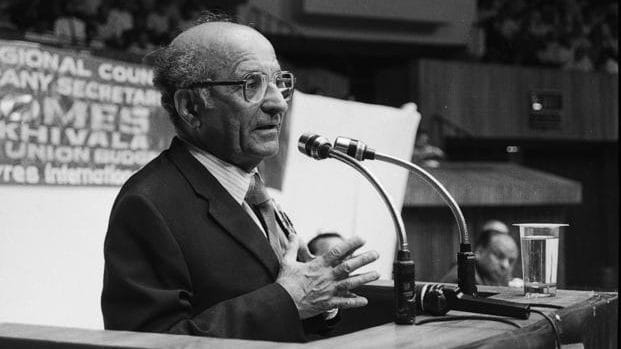

India has never known true democratic freedom in its entire history except during the last 23 years. If Plato’s dictum regarding political evolution is correct, our newly won freedom will have to be zealously guarded if it is not to be supplanted by dictatorship. In a nascent republic where freedom is not bred in the bones of the people, the danger of dictatorship is always vastly greater than in democracies which are centuries old.
Political freedom and civil liberty are the keystone of the Indian Constitution. Our Constitution is primarily shaped and moulded for the common man. The only persons who would be disappointed with our Constitution are those who believe in outdated ideologies which can only result in levelling down and not levelling up. The Constitution believes in the distribution of wealth, and therefore it not only permits but encourages the creation of wealth by enterprising individuals who, with their vision and expertise, are prepared to take risks and develop their country. That is why our Constitution confers on all citizens the fundamental rights to acquire, hold and dispose of property and to carry on any trade, business or profession.
With the growing powers of Governments all over the world, it is eminently desirable for any democracy to have fundamental rights which cannot be curtailed or abrogated. In the words of Mr. Justice Frankfurter, man, being what he is, cannot safely be trusted with complete power in depriving others of their rights. The protection of the citizen against all kinds of men in public affairs, none of whom can be trusted with unlimited power over others, lies not in their forbearance but in limitations on their power. At least such is the conviction underlying our Constitution.
With our varying and widely divergent creeds and ideologies, and a wide variety of religions and languages, our country is pre-eminently a country where inalienable fundamental rights are an absolute necessity. These rights have been called, not without justification, the “conscience of the Constitution” or the “soul of the Constitution”. In material terms, they constitute the anchor of the Constitution and provide it with the dimension of permanence.
No time in India’s history could be more inopportune than the present for amending the Constitution and empowering Parliament to abridge or take away the Fundamental Rights. With the growing sense of insecurity in different States, when fanaticism of all sorts—regional, linguistic, communal and economic—is gathering momentum, it would be not merely a mistake but a betrayal of the fundamental freedoms to enable Parliament to trifle and tinker with them.
The right to property is often derided as the “least defensible” right in a socialist democracy. Yet a little reflection would show that this right is of the essence of a sound body politic and of a democracy which aims at marching forward economically.
Any attempt to abrogate the Fundamental Right to property would be erroneous, because it would run counter to the eternal laws of human nature. Men will sooner, Machiavelli said, forgive the deaths of their relatives than the confiscation of their property. It is a sad reflection on human nature that, generally speaking, a man will work for himself and his family as he will work for no one else. However, until this law of human nature is changed, the abolition of the right to property can meet with nothing but disaster.
There is no democracy anywhere in the world where, as a matter of law and of constitutional practice, the right to property is not respected. The right to property is enshrined in the Constitutions of the States where the rule of law prevails, as, for example, in the Magna Carta, in the American Declaration of Independence, in the French Declaration of the Rights of Man and in the German Constitution. Even in Communist countries like the U.S.S.R., the right to private property in the fruits of personal labour and the right to inherit such property are recognised.
Under our Constitution the right to property is elastic and flexible—the Legislatures and the Executive are entitled to subject it to all such reasonable restrictions as are in the public interest. The right to property cannot be invoked at all against laws relating to zamindari and other estates in lands or against other laws relating to agrarian reforms. Sixty-four Acts passed by Parliament and the State Legislatures are constitutionally declared to be valid although they may directly infringe the right to property. The adequacy of compensation cannot be challenged in our Courts of Law. Far from there being any need to abridge the Fundamental Right to property further, the truth is that perhaps in no free democracy of the world does the right to property exist in such an abridged and attenuated form as it does in India.
Countries where freedom has become a way of life can do without the luxury of a constitutional right to property. But in India, where economic fanaticism has become a way of political life, it is imperative to retain the right to property.
It would not be too much to say that the right to property is, in a sense, the handmaid to the other fundamental rights. Of what avail is the fundamental right to freedom of speech and expression to a newspaper if its property can be taken away without reasonable compensation; or the fundamental right to form associations or to a religious minority is to be held on the sufferance of the party in power?
The myth has been sedulously propagated by wily politicians that it is the Constitution which stands in the way of the nation’s economic progress and the uplift of the masses. This is the greatest fraud ever perpetrated on the people. The truth of the matter is that it is the wooden-headed and disastrous economic policies of the Governments at the Centre and in several States which are truly responsible for the miseries of the seventeen million unemployed and the many more millions who, though employed, are still living below the minimum subsistence level due to the erosion in the value of the rupee. There is not a single sound economic policy or scheme for social development of the masses which is in the slightest degree hampered or hindered by any of the provisions of the Constitution.
The significance of the judgment of the Supreme Court in the Privy Purse case is not so much for the Ruler as for the common man. The basic issues involved in the case were not concerned with Privileges and Privy Purses—with the booming of salute guns or the counting of our devalued currency; the basic issues centred round the sanctity of the Constitution and public morality. Could the Constitution be silenced and its mandate sacrificed at the altar of political expediency? If privy purses could be stopped by executive action, the most valuable investment in the world would be the securities of the Indian Government. The funds of charities and trusts for widows and orphans, and provident funds of millions of workers, are invested in Government securities. If privy purses can be repudiated, so can the Government’s obligation to pay the principal and the interest in respect of Government securities, because the Constitution has used exactly the same words in guaranteeing privy purses as for guaranteeing the Government’s obligation in respect of securities. What was at stake was nothing less than the nation’s honour and its reputation for financial integrity in the eyes of the world.
The importance of the Privy Purse judgment from the point of view of the common man can be well gauged from the following passage in the judgments:
“Breach of any of the constitutional provisions even if made to further a popular cause is bound to be a dangerous precedent. Disrespect to the Constitution is bound to be broadened from precedent to precedent and before long the entire Constitution may be treated with contempt and held up to ridicule. That is what happened to the Weimar Constitution……The basic issue arising for decision in these cases is of far greater significance than it appears at first sight. The question whether the Rulers can be de-recognised by the President is of secondary importance. What is of utmost importance for the future of our democracy is whether the executive in this country can flout the mandates of the Constitution and set at naught legislative enactments at its discretion. If it is held that it can, then our hitherto held assumption that in this country we are ruled by laws and not by men and women must be given up as erroneous.”
(Per Hegde J.)
There is no doubt that the overwhelming majority of thinking men strongly believe in the Fundamental Rights and are deeply conscious of the outstanding role played by the Courts in preserving our cherished values. But unfortunately they constitute the silent majority. There are times in a country’s history when inaction and silence can be a culpable wrong, and we are living in such times. It is not enough that we believe in our national motto that truth will ultimately prevail. We must take active steps to see to it that falsehood does not have a very long innings before the ultimate moment of truth arrives.
This is part of ThePrint’s Great Speeches series. It features speeches and debates that shaped modern India.