




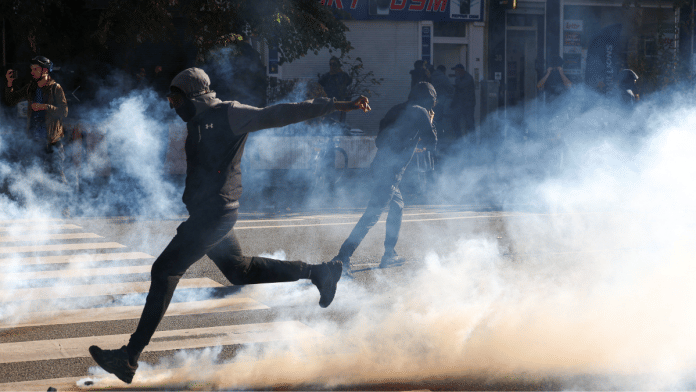

Something unusual is stirring on the streets of the world.
The immediate causes are different. In Bangladesh, a student protest over quotas in public employment grew into something much bigger. In Nepal, restrictions on social media provided the spark, but behind them lay accumulated anger over corruption, economic stagnation, and the conspicuous lifestyles of a privileged political class. Both countries endured extended periods of chaos that resulted in a reset of the political landscape.
India has seen its own manifestations of youth anger, first around entrance examinations and paper leaks, and subsequently about the revision of electoral rolls. Even though the protesters in India have remained steadfastly non-violent and do not advocate larger political changes, the government views them with unease. More recently, young people have been prominent in demonstrations, often violent, across France, Belgium, Italy, and Albania.
There is ostensibly no common organisation linking these movements, no shared manifesto, and certainly no single ideology. Their political circumstances are very different. It would be simplistic to describe them as one global movement. But it would be equally unwise to ignore the common undertow.
Those left behind by the ‘new economy’
Much of the anger stems from a generation beginning to doubt the economic bargain offered to it. For several decades, the legitimacy of market capitalism rested on a relatively simple proposition: Economic growth would create opportunities; education would enable social mobility; and hard work would be rewarded. Each generation could reasonably expect to live somewhat better than the previous one. The state, meanwhile, would provide a reasonable floor of schools, universities, healthcare, transport, and social protection.
That bargain looks increasingly uncertain. Global youth unemployment remains high, with the college-educated cohort disproportionately impacted. But statistics tell only part of the story. Many traditional entry points into secure middle-class employment are shrinking. Young people increasingly encounter temporary work, stagnant incomes, expensive housing, and intense competition for a limited number of secure jobs. They are invited to celebrate the “new economy” and its gig-like character, which many are understandably reluctant to do.
For an educated young person, unemployment is not merely the absence of income. It represents a broken expectation. Families invest heavily in education because they see it as the route to economic mobility. When degrees no longer lead reliably to employment and competitive examinations become lotteries involving millions of applicants, frustration inevitably acquires a political dimension.
This helps explain why education and employment have repeatedly become flashpoints. The youth-led upheaval in Bangladesh began with access to government jobs. The protests in India against paper leaks reflected the enormous stakes attached to a limited number of opportunities. Across parts of Europe, students, teachers, and workers have protested over education funding, wages, and deteriorating public services.
These are different grievances, certainly, but behind them lurks a single question: what future does society offer its young? This question has become more urgent as economic insecurity coincides with pressures on the public services on which citizens depend.
Governments everywhere face genuine fiscal constraints. Populations are ageing. Public debt has risen. Healthcare costs are growing. Defence and security expenditure is increasing. In countries such as India, an enormous buildout of economic and social infrastructure is still needed, much of it to be undertaken by the government. These pressures cannot simply be wished away.
Yet, there are political consequences when fiscal adjustment translates into poorer schools, more expensive universities, unaffordable housing, weaker social protection, and increasingly strained healthcare. What appears in a government budget as expenditure rationalisation can seem vastly different to a young citizen struggling to establish an independent life.
Also read: What H&M’s decline and Zara’s growth mean for India’s apparel industry
Time to renew the social contract
Parallel to this crisis, another, potentially more unsettling development is taking place: the extraordinary visibility of concentrated wealth. Capitalism has always produced inequality. What has changed is both its scale in some societies and its visibility everywhere. Young people facing insecure employment and uncertain prospects simultaneously inhabit a digital world in which enormous private fortunes and extravagant lifestyles are displayed and lauded continuously. Nepal offers an unusually vivid illustration, where the lifestyles associated with the families of powerful people became a lightning rod for a wider resentment.
But the issue goes beyond conspicuous consumption. Across countries, enormously wealthy individuals and corporations possess growing influence over technology, media, political campaigns, and public debate. Successful enterprise, innovation, and risk-taking remain essential engines of prosperity. Wealth in itself is hardly the problem. The difficulty begins when citizens believe that wealth can purchase disproportionate political influence—or that the rules governing ordinary people do not apply equally to those at the top. Inequality ceases to be a distant economic statistic then, and becomes injustice deeply felt by young people.
An uncomfortable relationship is emerging between economic discontent and populist politics. In several democracies, sections of the wealthy have found common cause with Right-wing populist movements promising lower taxes, deregulation, or protection from institutional constraints. Populist leaders have often proved adept at redirecting economic anxiety toward immigration, cultural identity, minorities, or established institutions.
The paradox is striking. Citizens frustrated by economic insecurity can end up supporting political movements whose economic programmes do relatively little to alter the underlying distribution of wealth and opportunity. This is why viewing the current global unrest simply through the familiar prism of ‘Left versus Right’ misses something important. Many young protesters do not speak the language of traditional ideology. They speak about jobs, examinations, rent, schools, corruption, dignity, and fairness. They organise through social media rather than political parties or trade unions. Their mobilisation can therefore be sudden, decentralised, and unpredictable.
The fact remains that every street protest can’t be romanticised. Protest movements can appear to be incoherent. Legitimate demonstrations can descend into violence. Social media can amplify misinformation as readily as genuine grievances. Governments have a mandate and responsibility to maintain public order. But maintaining order and understanding discontent are different tasks.
The larger message from the streets may be that the balance between market efficiency and social security has shifted too far. Capitalism has demonstrated an extraordinary ability to generate wealth, innovation, and technological progress. But its political legitimacy ultimately depends on something more: enough people must believe that they have a reasonable opportunity to participate in that prosperity.
The social contract everywhere is in urgent need of renewal. That means restoring opportunity and social mobility; protecting reasonable access to education, healthcare, and housing; ensuring genuine competition rather than entrenched economic power; and maintaining credible boundaries between wealth and political influence. Governments worldwide must recognise that economic growth, while indispensable, cannot be the only measure of a successful society.
Pravesh Sharma is a former IAS officer who served in Madhya Pradesh, the PMO, and the UN. Views are personal.
(Edited by Prasanna Bachchhav)