



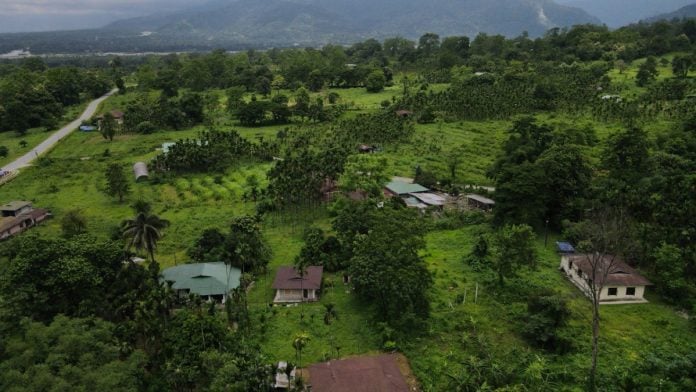
What is the city but the people?” Sicinius poses this timeless question in Shakespeare’s Coriolanus. On 1 November, the banks of Bhutan’s Mau Chhu river offered a remarkable occasion to revisit that question. Following months of preparation, around 40,000 volunteers came together to raise the outer structures of 108 Buddhist chortens along an 11.7-kilometre stretch of riverbank near the Indian border.
Sacred to Bhutan’s Buddhist tradition, these shrines are among the earliest landmarks of Gelephu Mindfulness City, an ambitious Special Administrative Region conceived by King Jigme Khesar Namgyel Wangchuck. By mobilising citizens through zhabto, the Bhutanese practice of voluntary service for the common good, the kingdom has anchored a futuristic urban enterprise in a custom with centuries-old roots.
At the United Nations General Assembly in September, Prime Minister Tshering Tobgay introduced himself, with unusual candour, as a “salesman” for Gelephu. He had come to invite governments, entrepreneurs and investors to help build it. The appeal was unapologetically commercial. Facing a sobering exodus of educated youth to Australia and Western countries in search of higher wages, Bhutan urgently requires capital investment, modern enterprise, and high-value employment to retain its talent.
Yet what makes Gelephu particularly intriguing is the thought being given to the civic life that will unfold alongside its economic ambitions.
Outside observers have often treated Gross National Happiness (GNH) as a quaint national slogan, a piece of Himalayan exceptionalism. In truth, GNH functions as a rigorous policy framework that gives importance to community vitality, cultural participation, environmental stewardship and the balanced use of time, alongside conventional economic measures such as GDP.
Gelephu seeks to translate this philosophy directly into spatial form while its master plan is still taking shape. Designed around the geometry of the sacred mandala, the proposed layout envisions eleven distinct neighbourhoods linked by habitable infrastructure. Most notably, its multi-tiered bridges are being designed not merely to facilitate quicker movement across the rivers, but also as active civic nodes hosting markets, universities, healthcare centres and spiritual sanctuaries. A journey across the city is thus transformed from a mundane commute into an invitation to linger and gather.
By weaving shared public life into the blueprints before the city takes shape, Gelephu poses a compelling question to older, established cities across the world: how might existing urban landscapes be approached with a similar imagination to reclaim shared spaces?
Also read: How digital currency can lift gross national happiness in Bhutan
Reclaiming the public life of cities
In Bengaluru’s Cubbon Park, what began in 2023 with two people reading together has become a regular gathering: Cubbon Reads, which has since grown into a movement. The idea has found counterparts in Delhi’s Lodhi Gardens, as well as in Ahmedabad, Gandhinagar, Jaipur and many other cities. Participants bring their own books and read as they please. There is no need for introductions or obligatory conversation, though nothing prevents them from enjoying a conversation with a fellow reader. A familiar public garden has acquired a new role in the city’s cultural life through a habit freely adopted by its visitors.
In Gurugram, the street itself has become an occasional gathering place. Raahgiri, fostered by civic groups, schools and local authorities, temporarily opens roads to walkers, cyclists and performers. A road built for the weekday rush briefly becomes a place to linger on a Sunday morning.
Often, that is all it takes: ordinary residents looking at a familiar corner of their city and imagining what else it might hold. The value of such initiatives lies in the invitation to participate and in leaving room for different ways of doing so.
Gelephu’s attempt to align sacred geometry with everyday public life resonates with India’s urban past. Long before modern zoning separated commerce from leisure, older Indian towns built this civic inclination directly into their physical layout. When Sawai Jai Singh II laid out eighteenth-century Jaipur on a nine-square grid, its commercial avenues opened into great chaupars, where trade, gossip and public assembly shared the same ground. In Bundi, Raniji ki Baori, commissioned by Rani Nathavati Ji in 1699, turned the daily necessity of drawing water into an occasion for townspeople to gather in its cool subterranean arcades. Ahmedabad’s old pols, too, grew around shared chowks, wells and chabutras. These places brought people together through the ordinary necessities of living.
The Danish urbanist Jan Gehl’s celebrated maxim, “First life, then spaces, then buildings,” seems particularly apt. Gelephu is attempting to honour that order from the outset. Our older cities have a different advantage and opportunity: inherited spaces that need only fresh imagination to be renewed. Reading circles, heritage walks and neighbourhood initiatives can give them new cultural purposes, just as earlier generations found their own uses for the squares and courtyards they inherited. The stone and mortar may remain the same, even as the lives and habits of those who gather there evolve.
That is perhaps the most enduring promise of Gelephu’s experiment. A master plan can lay down bridges and avenues, just as history can bequeath stepwells and chaupars. Neither can prescribe the customs, friendships and shared experiences that will eventually give a city its character. Concrete and capital may build a city, but as Sicinius knew in Rome, and as thousands demonstrated along the Mau Chhu, it is the everyday generosity of its people that makes it worth living in.
Maitridevi Sisodia is an author, columnist, and civil servant. She is currently serving as a Deputy Collector in Ahmedabad. She tweets @MaitriSisodia. Views are personal.
(Edited by Prashant Dixit)