




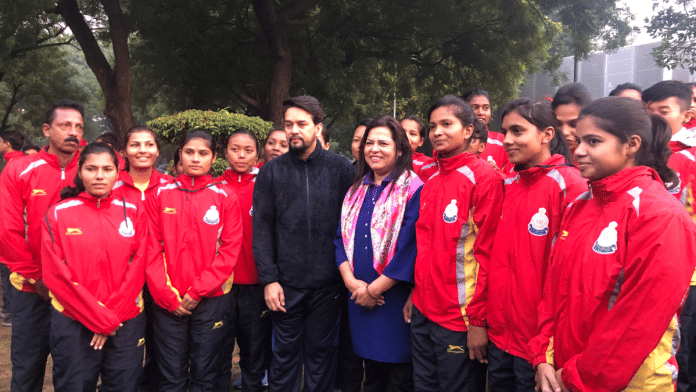

So far, India has had a decent showing at the Aichi-Nagoya Asian Games 2026, with 37 medals in total: four gold, 16 silver and 17 bronze. India has once again proved we have it in us to produce athletes of an international calibre. Our athletes have performed and wowed even in less renowned sports, opening up new frontiers for Indian sportspersons. Jay Meena garnered a bronze in men’s softball, India’s first-ever in this sport. Suchika Tariyal also won a bronze for India in Mixed Martial Arts in the under-50 kg category. Since MMA made its Asian Games debut at Aichi-Nagoya, this is also India’s first-ever medal in the sport.
Other notable breakthroughs in Japan include Mirabai Chanu’s first-ever podium finish at an Asian Games. The 32-year-old weightlifter brought home the silver in the 49kg category. Shooting star Elavenil Valarivan nabbed a silver in the 10 m air rifle category. And of course, the women’s cricket gold is a singularly awesome achievement. Quimcy D’Souza’s valiant bid at the semifinals in teqball further cemented India’s position as a sports powerhouse.
Running is a sport that India is picking up. I am often called upon to flag off marathons, and despite my inability to finish one myself, I am quite enthusiastic about it and am often cheering the runners who dash the marathons. And it is, therefore, no surprise that India returned to the podium after 44 years with Sawan Barwal’s silver in the marathon. Marathon running is gaining popularity in India. I hope we will soon be seeing a lot more medals for India on the international marathon circuit.
As I congratulated these winners for their wonderful achievements, I found myself once again the target of trolls who, from the comforts of their couches, as usual, were happy to downplay any achievements of their hard-working brethren, who toiled relentlessly to first qualify in a sport and then to actually reach the podium. This is by no means a small feat. But a nation that notches up a medal tally must give clear and unconditional support to its athletes.
One of the trolls questioned what the BJP government, of which I am treated as an inherent part, has done to promote a sports culture in the nation, and that prompted me to address the critics: Since 2014, there has been a rather substantial shift in the way sport is treated, not just as an elite competition but also as mass participation.
Taking sports beyond the metros
The introduction of Khelo India has probably been the most substantive structural change brought by the Modi government. Launched in its present form in 2017, the program has created a national framework around sports infrastructure and talent identification at the grassroots level. Seventeen and under athletes and players are identified through competitions and promoted via Khelo India centres. As of September 2026, the scheme has entered a massive, revamped third phase, which is aligned with the Khelo Bharat Niti 2025. The Union Cabinet has further approved an unprecedented budget extension for the 2026-27 to 2030-31 cycle, earmarking a combined financial layout of Rs 36,441 crores.
The government has also structurally changed how it handles sports facilities by merging public, state and private entities under the new Khelo India training facilities. Under the Khelo India umbrella, these centres focus heavily on modernising sports, science and tech. Almost 349 new sports infrastructure projects have been approved nationwide, carrying a total investment of Rs 3,176 crore. Out of these 349, 274 are fully completed, 58 are actively under progress, and 17 are finalising plans. There are 1067 Khelo India centres that have been made operational across districts to identify youth talent at the entry level. For the five-year modernisation of infrastructure, sports technology and athlete welfare facilities, Rs 10,568 crore has been dedicated.
Decentralisation of sports facilities is another effort that Prime Minister Narendra Modi’s government has made to promote sports at a grassroots level. Instead of concentrating facilities and coaching institutes only in metros like Delhi, Bengaluru, Hyderabad, etc., the government has been establishing Khelo India centres at district levels, often using existing sports infrastructure and former athletes as coaches.
The aim is to identify a talented child in a smaller town and bring the coach, ground and pathway to competition to their doorstep.
Recently, a video of 47-year-old Ramabai Ramveer running barefoot in a saree went viral. In a country of 1.3 billion people, there would be hundreds of Ramabai Ramveers who would benefit from training and facilities in order to compete at a competitive level.
Also Read: At Asian Games in Japan, women step into the ring as referees in men’s boxing. It’s not a first
Searching for talent
The Ministry of Youth Affairs and Sports’ flagship Target Olympic Podium Scheme (TOPS) is a serious investment in elite athletes. Though in existence prior to 2014, it has been expanded considerably under PM Modi’s direction. It provides identified elite athletes, who have a shot at competing at the Olympic level, with financial support, as well as international training, foreign exposure, equipment, specialist coaches, sports science and also covers their competition expenses. Prominent athletes who have benefited from this scheme are the javelin king Neeraj Chopra, shooting star Manu Bhaker, shuttler PV Sindhu, and Mirabai Chanu. This support has resulted in stellar podium finishes at the Olympic Games over the years and also at the ongoing Asian Games. Mansukh Mandaviya has informed the Lok Sabha in July 2026 that 369 elite athletes are being supported under the government’s TOPS scheme in preparation for the upcoming LA Summer Olympics.
Apart from a wider talent pool, there has also been a wider allocation and increased investment in sports medicine, physiotherapy, rehabilitation, performance analysis and sports psychology. Bringing areas which were often overlooked in sports to the limelight.
A recent example is the Integrated Sports Science Centre and Conditioning Hall at NS NIS Patiala, inaugurated in 2026 as part of a Rs 38 crore athlete support investment. I have also observed an increasing trend toward sports-related professions. Sports injury specialists, sports managers and sport psychologists are professions that are quite popular today and also increasingly commercially viable. In my own field, many young lawyers are opting to specialise in sports law, which is a developing multi-disciplinary field.
Sports Authority of India’s high performance centres are even beginning to rely on AI and advanced data analytics to track cardio-vascular, endurance and speed and movement mechanics.
The National Centre of Sports Sciences and Research is expanding its network of district science centres to provide elite biometric monitoring, recovery protocols, and injury prevention to grassroots and podium-bound athletes.
A mass movement of national importance
In 2019, the government launched the Fit India Movement, trying to change the conversation from “sport is something that professional athletes do” to “physical activity and fitness is something that ordinary Indians should take up”. Fit India became a national movement under the leadership of PM Modi, involving schools, workplaces, fitness campaigns and community activities. As an MP, I sanctioned multiple open-air gyms all over my constituency of New Delhi. My favourite of which is the open-air exercise space in Chanakyapuri’s Nehru Park. The Fit India Sports Carnival organised by my team in 2019 involved the entire constituency and included a plethora of different sports.
What this government has done differently from previous administrations is that greater formal recognition has been given to sports such as kabaddi, kho kho, yoga, mallakhamb and other indigenous games. We have seen how both the men’s and women’s kabaddi teams have brought home accolades and medals in the 2026 Asian Games.
“Ask not what your country can do for you, ask what you can do for your country,” US President John F Kennedy’s famous words resonate deeply with me. If we want to see India on the podium at the 2028 Los Angeles Olympics, we really cannot leave the job to our athletes and the government alone. We, as citizens, have a role to play. Watch the competitions, support our athletes. Buy tickets to local matches and competitions. Cheer for our teams. Most importantly, get our children off the couches and into sports gear.
Cricket will always be dear to us, but we must learn to celebrate and support athletics, shooting, wrestling, boxing, badminton, hockey, swimming, gymnastics and every other sport where an Indian is striving to compete. We are home to the Himalayas, skiing is a winter Olympic sport that could be taken up, as could luge, which is represented solely by the efforts of Manali-born Shiva Keshavan.
Every time we watch, participate, encourage and support a sport, we help create demand, opportunity and a sporting culture. If we want more Indians at the podium at LA 2028, let us start by becoming a nation that not only watches cricket, but watches, plays and backs its athletes.
Our athletes are showing that India’s sporting ambitions cannot be confined to one or two disciplines. Every medal represents years of discipline, sacrifice and determination, and every new sporting success inspires another young Indian to pick up a racket, step onto a track, enter a pool or walk onto a field.
Let’s watch, cheer, support, and nurture these talents. Because a sporting nation is built not just by the government but by its athletes and citizens who have faith in their capabilities.
Meenakshi Lekhi is a BJP leader and lawyer. Her X handle is @M_Lekhi. Views are personal.
(Edited by Insha Jalil Waziri)