






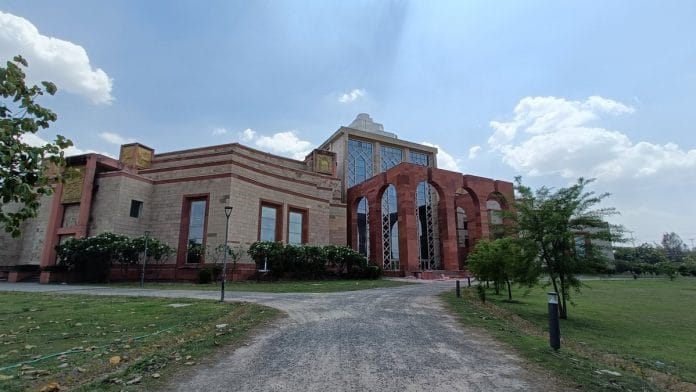


With a recent report on the state of the Pandit Deendayal Upadhyaya Institute of Archaeology in Greater Noida making headlines, all eyes are now on the Archaeological Survey of India. The report, published in ThePrint, highlighted the shortcomings of the ghost campus — vacant classrooms, no faculty or research infrastructure, and limited exposure for the students. To the report, the Ministry of Culture responded by highlighting the official student strength at the institute and the array of classes and workshops conducted at its new premise.
It is true that this 289-crore campus, spread across 25 acres, was built with a lot of promises by the government. It was meant to become an updated version of the existing Institute of Archaeology, the ‘Nalanda’ of Indian archaeology. It was meant to provide students with a supportive, enthusiastic, and challenging academic atmosphere that enables them to achieve their full potential in the field of archaeology.
Yet, despite these ambitions, many of the promises remain unfulfilled. Institutional neglect, inadequate academic expansion, and the declining quality of training have steadily weakened the diploma course. A programme that had evolved continuously with changing archaeological methods and academic demands was expected to enter a new phase of growth and transformation with the establishment of the new campus. But, rather than emerging as a leading centre for archaeological research and training, the institute today finds itself in the eye of the storm.
Amidst this crisis, what is slowly fading into the background is the story of the institution itself, the legacy it has carried for over 70 years of its existence, the generations it shaped, and the contributions it made to Indian archaeology. The answer to many of the questions surrounding its revival and future lie within its own history, in the vision with which it was conceived, the purpose it was meant to serve, and the immense contribution it has made to Indian archaeology.
For those discovering the institute only now through newspaper headlines, it may appear to be defined by only empty corridors and silent classrooms. But for its alumni, the institute was never merely a physical space. It was a place that shaped minds, nurtured curiosity, and instilled a sense of responsibility toward the preservation of the past. Long before it became a subject of controversy, it was home to archaeologists in the making, a space where history was not just studied but made.
Taxila School of Archaeology
On 25 May 1944, an advertisement in The Statesman announced the opening of a training school at Taxila under Mortimer Wheeler, the newly appointed Director General of the Archaeological Survey of India. Within two months of arriving in India, Wheeler launched an organised training programme to develop a new generation of archaeologists. He appealed to universities across the country and more than 60 graduates, along with ASI officers, joined the camp held between October 1944 and March 1945.
Wheeler had earlier established the Institute of Archaeology in London in 1937 and replicated a similar field-based training model in India, focusing on excavation methods, conservation, and publication of reports. Among the 60 students who joined were BB Lal, BK Thapar, Amalananda Ghosh, Krishna Deva, Ahmad Hasan Dani, and Farid Khan, many of whom later became leading archaeologists in India and Pakistan.
For several students, including BB Lal, the training camp provided their first formal exposure to archaeology. Lal, who was a Sanskrit graduate, developed a deep interest in the discipline during the excavation at Taxila and later emerged as one of Wheeler’s most devoted students and India’s leading archaeologist.
School of Archaeology
Following the Partition of India, Wheeler and the Archaeological Survey of India became deeply engaged in the division of antiquities and institutional resources between the newly formed nations of India and Pakistan. The bifurcation of the ASI and its personnel created an unprecedented disruption in the archaeological initiatives and reforms introduced by Wheeler in 1944.
Before leaving his position in the ASI, Wheeler stressed the need for systematic archaeological training in India and argued that the institute itself should undertake this responsibility. This view was supported by the Central Advisory Board of Archaeology, leading to the establishment of a permanent training school under the ASI.
In 1959, Amalananda Ghosh, the first Director General of the reorganised Archaeological Survey of India and a former trainee at Taxila, inaugurated the School of Archaeology. BB Lal, one of Wheeler’s earliest students, became its first director. The school played a crucial role in the professionalisation of archaeological training in post-independence India and reflected the continuation of Wheeler’s vision for systematic field-based training in archaeology.
It provided practical and theoretical training in excavation and preservation surveying, drawing, photography, conservation of monuments, chemical preservation of objects, art and architecture, iconography, painting, and numismatics and antiquarian laws. Senior ASI officers and distinguished scholars delivered specialised lectures and supervised training there.
Initially, only ten postgraduate students were admitted annually, including candidates from neighbouring countries such as Nepal and Myanmar. The course lasted 15 months and included field training with a small stipend for students.
As archaeological research evolved, reforms became necessary. In 1983, an expert committee headed by RN Mridha, then-Member of Parliament, recommended expanding the school into an institute of archaeology with broader objectives of research and advanced training, Consequently, the 15-month course was upgraded into a two-year postgraduate diploma programme with structured syllabus, workshops, mandatory excavation training, and education tour across India.
The institute later shifted locations from Delhi’s Janpath to Tilak Marg in 1985, then to the Red Fort in 2005, and was eventually renamed the Pandit Deendayal Upadhyaya Institute of Archaeology at its present campus in Greater Noida.
Also read: Jaipur’s havelis, bazaars are disappearing. Even UNESCO tag can’t protect heritage in India
Training archaeologists
One of the important aspects overlooked in the recent public discussion is that the institute offers a specialised diploma programme rather than a conventional university degree. Archaeological training depends on fieldwork, excavation, conservation, documentation, and close interaction with specialists. Therefore, the small batch of students, selected from across the country through interviews and written examination, has been intentional. Unlike large universities, the institute was designed as a professional training centre under the Archaeological Survey of India.
However, the training is not only limited to 15 students of the institute, university students often partake in the excavations and other training programmes. The excavations, which are the most significant contributions of the institute in India archaeology, see participation from multiple institutions and universities, including from SAARC countries.
Over seven decades, the institute has undertaken multiple major excavations across the country. Sites like Dholavira, Rakhigarhi, Thanesar, Sinauli, Barnawa, Binjor (4MSR), were excavated by the Institute of Archaeology. Each season, each site not only trained 15 selected trainees but also participants from across institutions and disciplines. For instance, at Dholavira, an entire generation of archaeologists was trained. The site was excavated throughout the 1990s by students from the institute and other universities, including The Maharaja Sayajirao University of Baroda. Similar is the case with Rakhigarhi, which was excavated by the Institute of Archaeology in 1998 and again in 2021.
This unique model of training was gradually expanded to include allied disciplines within archaeology. Recognising its importance, the Executive Committee recommended greater autonomy for the institute to enable smooth academic and administrative functioning. It proposed the creation of an Advisory Council comprising eminent academics and specialists to guide research, curriculum development, and academic expansion. In the global context, the committee envisioned the institute as a major centre for archaeological training and research in the Indian subcontinent, eventually developing into an autonomous multi-disciplinary National Institute of Archaeology.
When the institute shifted to its 25-acre campus in 2019, it appeared that this long-standing vision might finally be realised. Ironically, the Institute of Archaeology established by Wheeler in London evolved into one of the world’s leading archaeological research institutes. However, India’s Institute of Archaeology is standing at a crossroads.
The concerns regarding inadequate staff, weak course structure, institutional planning, and the lack of a clear long-term academic vision cannot be dismissed entirely. Ironically, many of the shortcomings of the institute, addressed in ThePrint’s report, stand in sharp contrast with the recommendations of the RN Mirdha Committee, which had envisioned the institute as an autonomous centre of archaeological research. The committee recommended extending the diploma programme from one to two years to ensure holistic training — a change that was reduced to one year only a few years ago without careful deliberation about its consequences.
The consequences may not be visible now, but at a time when heritage studies and archaeological sciences are rapidly expanding globally, such steps speak of the inability to nurture ASI’s premier training institute. The challenge today is not merely to preserve the institute, but to reimagine so that its specialised and field–oriented character is retained. It must be allowed to grow and flourish as a premier institute for archaeological training and research — South Asia’s own Nalanda of archaeology.
Disha Ahluwalia is an archaeologist and junior research fellow at the Indian Council of Historical Research. She tweets @ahluwaliadisha. Views are personal
(Edited by Aamaan Alam Khan)