




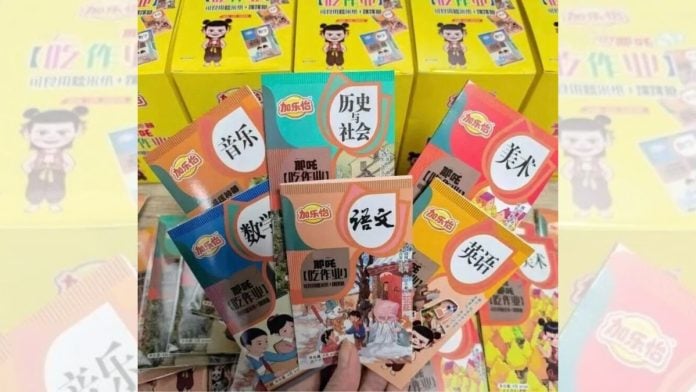

“Today, you’ll eat something you all hate: homework.” So begins a China National Radio commentary on a snack made from sweet glutinous rice paper. As the new school year began in September, snacks resembling textbooks, test papers, and workbooks began trending among primary and secondary school students. Marketed as novelty stress relievers, they offer children a literal way to deal with homework: eat it.
The trend quickly became a hot topic on Chinese social media, with users debating why they want to eat their homework in the first place. Hashtags such as “CCTV exposes the hidden risks of eating homework and eating homework poses health risks” have drawn millions of views on Weibo.
Online reports pointed out that those products labelled as starch products contained excessive synthetic colourants. Others questioned whether sellers were exploiting labelling loopholes or using industrial ink.
Zhu Yi, an associate professor at China Agricultural University, warned that parents should not assume the products are safe simply because their colour does not come off when rubbed or licked. She said long-term consumption of large amounts of colourants and flavourings could place a greater burden on children’s developing livers and kidneys. But the health concerns may be the least interesting part of the story.
Eating away stress
A WeChat commentary described the trend as an emotional outlet for students under academic pressure. In this reading, businesses have turned children’s frustration with homework into something they can buy and consume. The novelty may offer a moment of relief, the commentary suggested, but it does little to address the pressure underneath it.
Yu Yue, an associate professor of psychology at the China University of Political Science and Law, described the trend as a form of “paying for emotions”. Homework is associated with obligation and seriousness; eating it turns that relationship on its head, giving students a sense of control over something that can shape their mood. It can also become a form of peer currency: one child eats it, another follows.
Most in China do not see the trend as harmless catharsis. Another commentary warned that turning eating homework into a stress-relief activity could have the opposite effect, reinforcing an aversion to studying and encouraging a perfunctory attitude towards schoolwork.
Even when commentators disagree about what the trend means, they are largely discussing the same underlying issue: the relationship Chinese children have with schoolwork, and the pressure attached to it. If children are buying snacks to symbolically eat their homework, what exactly are they trying to escape?
Also read: Chinese commentary on Xi-Trump summit is a cross between flowers and daggers
The pressure behind the homework
For some Chinese commentators, the answer lies in an education system where academic pressure starts early and builds over time. A Baijiahao commentator argued that long school days, evening study sessions, heavy workloads, and frequent exams leave many students little time to rest, with the pressure peaking in high school as they prepare for the Gaokao.
Schools such as Hengshui High School and Maotanchang Middle School, known for their strict routines and intense focus on the Gaokao college entrance exam, have become shorthand for this approach, with days reportedly starting early morning and continuing into the evening. Supporters point to their exam results; critics question the physical and psychological costs.
Commentator Hu Xiabao argued that entrance exams, heavy homework, and the expectation of constantly moving toward a better school can create pressure long before the Gaokao and high school. Parental expectations, competition, and anxiety about future employment add another layer.
A commentary compared Chinese students’ school hours and homework loads with those of students in other countries. It said students in the United States, Germany, Japan, and Russia typically spend six to eight hours a day in class, compared with more than 10 hours for many Chinese students, and cited Shanghai students as spending more time on homework than students elsewhere.
The discussion inevitably turns to mental health. The commentary cited estimates that 15-20 per cent of Chinese teenagers suffer from depression. Peng Kaiping, a professor at Tsinghua University, cited surveys suggesting that about three in 10 middle school students have experienced school aversion. A four-year study by Tsinghua University’s Positive Psychology Center, involving 4,20,000 teenagers, found that about 15 per cent showed some degree of risk of depression.
According to a survey by the Chinese Academy of Educational Sciences, 91.7 per cent of primary and secondary school students lack motivation to learn and often procrastinate. The commentary attributed this to overly controlling parenting and parents doing too much for their children.
These figures have become part of a broader online conversation about where the pressure comes from. One Chinese commentator described students as carrying “nine mountains” on their shoulders: pressure from education authorities, school principals and teachers, long school hours, heavy homework, frequent exams, Gaokao competition, parental expectations, and private tutoring.
That is why some Chinese commentators argue that the answer cannot simply be to give children less homework. A commentator, Zhang Zhiyong, for example, argued that learning itself has become too passive and exam-driven. Cutting homework, he said, will not be enough unless students also have more room for independent learning, practical activities, and interests beyond exam subjects. Another commentator, Zhang Xiliu, made a similar argument in discussions of the double reduction policy. In a commentary, he called for schools to reduce homework and academic burdens, improve homework design, and control the total amount of schoolwork. The objective, in his view, is to address the sources of that pressure.
Other commentators focused on specific aspects of the system. Education influencer Tang Jiafeng argued for reducing the weight given to English in examinations, saying students spend too much time and money studying it from primary school through university, often without using it in the workplace. He also said that children are pushed to learn English before fully mastering their mother tongue, linking this to the Chinese criticism of “worshipping foreign things and fawning on foreigners”.
The ‘eat your homework’ trend has reignited online discussion in China about excessive homework, school-related stress, and the demands placed on children in pursuit of academic success. Trends like these may come and go, but the concerns behind them are likely to keep resurfacing in one form or another.
Sana Hashmi, PhD, is a fellow at the Taiwan-Asia Exchange Foundation and George HW Bush Foundation for US-China Relations. She tweets @sanahashmi1. Views are personal.
(Edited by Aamaan Alam Khan)