






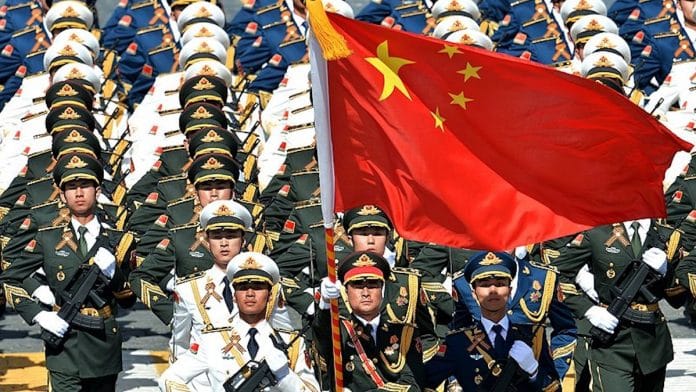



China’s 2026 defence budget will reach 1.91 trillion yuan or approximately $277 billion, Premier Li Qiang announced during the country’s Two Sessions on 5 March, marking another year of steady military expansion amid intensifying regional competition. The figure represents a 7 per cent year-on-year increase compared to 7.2 per cent in 2025. It is the lowest rate in five years.
Across the Chinese internet, this level of spending is widely framed as reasonable, transparent, and economically sustainable. Song Zhongping, a Chinese military affairs expert, argues that Beijing’s defence budget follows a principle of moderation, calibrated to meet national security needs while remaining aligned with broader economic priorities. Commentators on Baijiahao emphasise that China now prioritises quality over quantity, where it is investing in advanced capabilities such as hypersonic weapons and quantum communication to maximise strategic impact without excessive expenditure.
Challenging the ‘China threat’ narrative
Chinese commentators challenge Western portrayals of Beijing as a military threat. Zhang Sinan, a special commentator for Straight News, notes that while China’s defence figures appear large in absolute terms, their growth remains measured, reflecting the need to modernise amid complex regional dynamics and rapidly evolving military technology.
Military spending, he emphasises, is fundamentally defensive, aimed at safeguarding national interests and strengthening deterrence rather than pursuing global hegemony. By contrast, external powers with far larger budgets generate greater concern globally.
Chinese analysts also highlight the efficiency of their military spending and the structural differences of defence posture between China and the US. On paper, China’s military budget is far below the US’s $1.01 trillion allocation. However, higher domestic purchasing power and lower equipment costs narrow the gap in actual capability.
Unlike the US, China focuses on domestic defence and regional security rather than maintaining a global network of overseas bases. Relative to GDP, China allocates roughly 1.26 per cent to defence, compared to 3.5 per cent in the US—a modest share even against historical precedents such as the Soviet Union’s 14 per cent.
Hu Xijin, former editor-in-chief of the Global Times, describes China’s military buildup as a reflection of strategic patience, domestic stability, and calibrated deterrence rather than aggressive expansion. Over the past decade, China’s defence budget has remained consistently below 2 per cent of GDP, allowing the country to achieve major military advancements, from aircraft carriers to strategic missile systems, without destabilising the economy.
Unlike the politically driven expansions associated with US military spending, China’s trajectory, according to this view, follows a deliberate roadmap that balances development with security.
A Chinese commentator stresses that the surrounding security environment is increasingly complex. In the East China Sea, US naval deployments occur regularly; in the South China Sea, some countries are portrayed as challenging maritime norms with US backing; and in the Taiwan Strait, “Taiwan independence” forces are depicted as cooperating with external powers. These dynamics, the commentator argues, make steady military modernisation necessary.
He also highlights how the character of warfare is evolving: advances in artificial intelligence (AI) and algorithmic targeting are reshaping modern conflict, especially in the US-Israel-Iran war. The growing use of AI-assisted operations, he notes, marks the advent of “algorithmic warfare” and underscores the need for rapid technological adaptation by conventional militaries.
Also read: China’s economic model that fuelled its rise is running out of steam
Defence spending and external pressures
Zhou Zheng, a policy analyst at the China Macro Research Group, argues that China’s broader economic policy reflects pragmatic adjustments to domestic pressures and a difficult global trade environment. In such circumstances, maintaining stable defence spending growth itself represents an important achievement.
Within Chinese discourse, Beijing’s defence spending is framed against a rapidly shifting security environment. Intensifying geostrategic competition, persistent regional conflicts, and the re-emergence of bloc politics are cited as key drivers. Steady defence spending is portrayed as both a response to emerging security challenges and a safeguard of national interests.
Zhuo Hua, an expert at the School of International Relations at Beijing Foreign Studies University, observes that China’s military spending is transitioning from earlier compensatory increases to a more restrained, stabilised, and passive trajectory. Public commentary on Weibo echoes in a turbulent world; a credible defence capability ensures that potential adversaries remain at the negotiating table.
Hu Xijin further argues that periods of relative peace provide China with an opportunity to strengthen both its hard and soft power, particularly through advances in strategic technologies and military capabilities. Taiwan remains a central concern. A Baijiahao commentator argues that China’s security considerations are shaped by both external pressures and what Beijing views as internal dynamics, including developments in the Taiwan Strait. The situation, a commentator claims, remains complex, with frequent arms purchases and external engagement from actors in Taiwan, a recurring theme across Chinese commentary.
Chinese discourse frames defence spending as steady, controlled, and well below US levels, presenting it as a measured effort to ensure deterrence and gradual modernisation. Yet even ‘moderate’ investments in advanced capabilities contribute to rising military competition and arms race in the region and beyond.
By portraying growth as somewhat defensive, Chinese commentary downplays how these developments may influence global strategic calculations. As capabilities expand, so too does the risk of reactive modernisation, miscalculation, and confrontation in an already fragile regional environment. What is depicted domestically as prudent modernisation may, beyond China’s borders, accelerate a cycle of insecurity and competitive militarisation.
Sana Hashmi is a fellow at the Taiwan Asia Exchange Foundation. She tweets @sanahahsmi1. Views are personal.
(Edited by Saptak Datta)