





Elephants are never far from the Indian headlines. Over the past year, elephants old and young have been parted from their families, acquired by private zoos and made to serve in temple processions. These are the latest examples of an ancient phenomenon.
For centuries, as gifts and tribute, Indian elephants and their mahouts were among the first Indians to be sent to new frontiers when the subcontinent came into contact with them. Their journeys were arduous, conducted by land and sea, and they often died before the end of their natural lifespans, having suffered greatly.
Simultaneously, they were objects of fascination and wonder, inspiring art and literature. They amazed popes and emperors, marking the extent of ancient diplomatic ties.
The Elephant in China
If an aristocrat from Samarkand wanted textiles from Delhi, a shopkeeper from Chandni Chowk wouldn’t have to walk all the way. But if an elephant was sought, an elephant had to be brought. And it had to travel with specialised support staff—typically Indians trained for years as hereditary professionals.
This made elephants extremely valuable diplomatic gifts. After a military victory over the Khan of Kashgar in 970, the king of Khotan on the Southern Silk Road captured elephants—who must have come from Punjab, or deeper in India. The next year, a letter from the king arrived in Kaifeng, the capital of China’s Song dynasty (960–1279). The Khotanese king offered one of these, a ‘dancing’ elephant, to the Song emperor Taizu, who conveyed his interest. The unfortunate elephant would then have had to travel nearly 4,000 kilometres to reach Kaifeng. We have no idea whether it reached its destination. (Xin Wen, The King’s Road).
Elephants were useful propaganda vehicles for the Song, who had only recently reunified China and needed to make a display of their legitimacy. In 968, a tame individual had found its way to Kaifeng. The Song court officials recorded the event:
“Magnificent, that tamed elephant!… The emperor’s benevolence called upon the giant beast to arrive, the emperor’s virtue placated the distant and the wild,” wrote an official.
Historian Fan Lin discusses this in her edited volume Picturing Animals and Plants in Early Modern China and Japan. She writes that the Song used domesticated elephants to pull their royal carriages and during state ceremonies. Dozens of elephants continued to be presented as gifts to Chinese emperors over the next centuries, though mostly from Southeast Asia.
Increasingly from the 12th century, they were used for display and to entertain crowds, leading processions of dancers and musicians from palace to palace. Their numbers had swelled to several hundred under the Ming dynasty (1368–1644).
In the sixteenth century, palace elephants were bathed in the moats of Beijing on the sixth day of the sixth month every year, drawing admiring crowds of tens of thousands. “After the bathing sluice had been opened,” a book from the time tells us, “the elephants entered the river one by one, like the collapse of a black mountain. After a while, they returned with their heads raised. Their trunks sucked and sprayed water, powerful like a dragon.”
The movement of elephants into China also tells us something else. As objects of such curiosity and fascination, elephants are well-attested in court records, literature and art—much more than the human beings who accompanied them. And the Indian subcontinent was the world’s premier supplier of domesticated elephants—sought after by the richest and most powerful men in the world, though not always for the same reasons. Because of the expense and expertise involved in capturing them, when we trace out the life of a domesticated elephant, we are able to trace out connections, court to court, region to region, between India and places staggeringly far away.
The elephant is an exact index of how far a diplomatic network reached, court to court. The same can be said of other captured animals, such as giraffes, which could only come via the eastern coast of Africa. Several giraffes arrived in Beijing by way of Bengal and the Malabar Coast in the 15th century, brought by the vast treasure fleets of the Ming admiral Cheng He. Also on the fleets were embassies and tribute from kingdoms and traders across the southern rim of Afro-Eurasia.
Arriving in Europe
The soft tread of an elephant’s feet announced two remarkable moments of connection between India and Europe. One such elephant was a lordly specimen called Abu al-Abbas, specifically requested by the Frankish king Charlemagne after he had conquered much of Western Europe in the late 8th century. And as his name suggests, Abu al-Abbas came from the Abbasid Caliphate: from Harun al-Rashid of Baghdad, who himself was in the process of brutally crushing an uprising in Sind—where Abu al-Abbas had most likely been captured. To both rulers, the elephant represented a beast of power and intelligence, a suitable vehicle for an emperor, and a demonstration of his reach. To be able to gift an elephant was no small matter—and equally, to be able to receive one.
The next such moment came around the time the Ming were bathing their elephant cohorts in the great moat of 16th-century Beijing. This time, the arrival of Indian elephants in Europe marked a monumental turning point in world history—the point where Europe, having established its own sea route to India and beyond, would increasingly embark on colonial expansions.
In Portugal, whose adventurers made the first European territorial inroads into the subcontinent, elephant parades helped King Manuel I impress his population and demonstrate God’s approval of Portugal’s actions in Asia. Manuel kept his elephants in a stable beside his Lisbon palace and paraded as many as five at a time from palace to cathedral. In 1514, he sent the best-trained of them, a four-year-old male, to Rome as a gift for the newly elected Pope Leo X. The elephant was most likely bought, as historian Silvio Bedini argues in The Pope’s Elephant, in Cochin by Alfonso da Albuquerque in 1511, before being shipped to Lisbon. Albuquerque ordered him fed 20 litres of rice a day, with butter, and oil rubbed into his skin against the salt air. Two Nair custodians sailed with the shipment. He crossed the ocean shackled between the ship’s masts.
On his way to Rome with Manuel’s embassy in 1514, every port, every town, poured out to see him. The elephant was constantly stressed by large crowds. Despite the embassy’s efforts to keep him concealed, curiosity led people to trample every barrier. Majorcans overran his ship for eleven or twelve days. At Corneto, onlookers crowded an inn’s roof until it caved in. Outside Rome, crowds trampled a cardinal’s walled vineyards. Aristocrats rode out to see him with their retinues, adding to the pandemonium. Despite it all, the elephant’s conduct remained gentle. At Castel Sant’Angelo in Rome, at his mahout’s bidding, the elephant knelt below the papal window, trumpeted three times, then filled his trunk at a trough and drenched the Pope and his party, to Leo X’s great amusement.
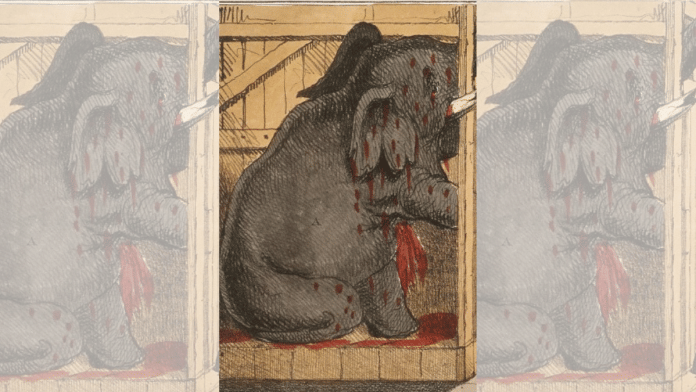
Leo named him Annone—Hanno. But this first elephant to set foot in Rome in a thousand years was not to live much longer. He collapsed in his pen in June 1516, struggling for breath and constipated. The Pope rarely left his side. Doctors dosed him with a purgative laced with gold, which worsened his condition. He died on 8 June, having lived two years, two months and 26 days in Rome. One of his Indian keepers died that same week, but no one recorded his name.
The distraught Pope had the famous artist Raphael’s workshop paint Hanno life-size in a mural at the Vatican entrance. Though this no longer survives, sketches of Hanno went on to shape Europe’s image of the elephant for centuries after, appearing in portraits, carvings, fountains, and frescoes. In 1962, workmen digging under the Vatican Library turned up the jaw of a young male elephant about Hanno’s age. Two tusks fitted with carved bronze, which were found a little later, still hang in St Peter’s chapter archive.
(Edited By Raunaq Lekhi)