





Every autumn, Kolkata transforms. Streets become galleries, temporary temples rise from bamboo and cloth, and millions move through the city in search of the goddess Durga. Today, the festival is celebrated as an expression of collective creativity and Bengali identity. Yet behind the public spectacle lies a more exclusive history, rooted in the mansions, ambitions, and rivalries of colonial Calcutta.
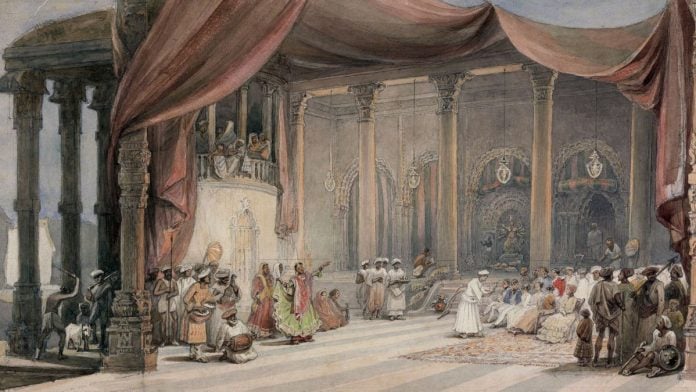
During the 18th and 19th centuries, Durga Puja was one of the most important occasions for the city’s wealthy Hindu families to display their position. Inside expansive residences, worship took place alongside music, dancing, feasting, and calculated hospitality. The festival was certainly an act of devotion, but it was also a theatre of power.
For Calcutta’s emerging Bengali elite, often described as babus, Durga Puja offered an opportunity to demonstrate prosperity, cultivate British patronage, and surpass their social competitors. The grandeur of a family’s celebration could advertise its success more effectively than almost any other event.
Goddess enters the colonial city
Durga Puja commemorates the goddess’s victory over Mahishasura, a powerful demon represented in art as a buffalo. Durga appears as both warrior and mother: 10 arms hold weapons supplied by the gods, while her children Lakshmi, Saraswati, Ganesha, and Kartikeya stand beside her. In Bengal, artisans fashioned this divine assembly as a composite clay image. By the late 18th century, specialist artisans had settled in Kumartuli, the potters’ quarter of north Calcutta. There, they produced images in different sizes and styles to meet the requirements of their elite patrons. The images were installed in a purpose-built section of the Bengali mansion called the thakurdalan. Usually facing an open courtyard and surrounded by columned verandas, the space accommodated both ritual observances and large gatherings. Adjoining halls and performance areas allowed the household to move almost seamlessly from sacred ceremony to secular entertainment.
The mansion therefore became more than a residence. Its architecture organised the festival’s social world. Priests conducted worship before the goddess; male hosts received influential visitors in the courtyard; performers entertained assembled guests; and women of the household participated in rituals while frequently observing evening festivities from screened or shuttered rooms. Sacred and social life coexisted, but they did not necessarily occupy the same spaces.
Also read: L’affaire ECI—what former judges’ open letter gets wrong about SIR
The model established at Sovabazar
No figure better embodies the political possibilities of Durga Puja than Raja Nabakrishna Deb, founder of the Sovabazar Raj family. A prominent intermediary between Bengali society and the East India Company, Deb acquired wealth and influence through his association with British power, including Robert Clive. Following the Battle of Plassey in 1757, Deb’s Durga Puja became renowned for its magnificence. European officials were invited to his residence, where traditional worship was accompanied by elaborate hospitality and entertainment. The celebration projected several identities at once: Deb was a devout Hindu patron, an affluent urban aristocrat, and a valuable ally of the colonial establishment.
He introduced ceremonial practices that asserted his precedence over other families. A cannon reportedly announced the beginning of the important Sandhi Puja at his residence, while other households waited to commence their ceremonies. His family’s immersion procession also enjoyed symbolic priority. The message was unmistakable. Ritual leadership could be converted into social authority. Other prosperous families soon emulated the Sovabazar model. The Debs of Beadon Street, the Dattas of Hathkhola, the Mitras of Dorjeepara, and numerous merchants and landholders constructed impressive mansions and organised increasingly lavish celebrations. Hosting a Durga Puja was no longer solely a declaration of faith. It became evidence that a family had arrived among Calcutta’s influential classes.
Rivalry in the name of the goddess
Competition operated at almost every level. Families attempted to secure the finest musicians, the most admired dancers, and the most fashionable refreshments. They commissioned elaborate images and ornaments, staged extended feasts, and vied to attract prominent European guests. The Tagores and the family of Sibkrishna Daw were remembered for a particularly striking rivalry. The Daws decorated their Durga images with gold and precious stones. The Tagores reportedly immersed the goddess with her valuable ornaments intact. In contrast, the Daws removed theirs for future use, an apparently practical difference that nevertheless became part of the public comparison between the houses.
Other families distinguished themselves through hospitality. Some offered feasts over many days. Invitations were circulated to Europeans, and newspaper notices occasionally welcomed even those who had not received personal cards. Wine, dinner, and entertainment were promised to the “ladies and gentlemen” who attended. This expenditure was not necessarily irrational. In a colonial economy where access depended heavily on relationships, hospitality could function as an investment. Entertaining an administrator, judge, military officer, or merchant might lead to employment, contracts, introductions, or political favour. The festival allowed Bengali elites to approach colonial power in a setting they controlled.
Their celebrations accumulated what sociologist Pierre Bourdieu would call social and cultural capital. Wealth became relationships, reputation, and recognition. The most successful host was not simply the person who spent the most, but the one whose expenditure generated lasting prestige.
Colonial gaze and the nautch
Among the most discussed features of these celebrations were performances by female singers and dancers, whom European observers commonly called nautch girls. Wealthy families competed to engage celebrated artists such as Nikki and Ushuran, whose reputations attracted considerable attention.
These women were accomplished performers who drew on traditions associated with north Indian courts. In colonial accounts, however, their artistry was often filtered through an exoticising gaze. European writers alternately expressed fascination, condescension, and moral discomfort. Performers were described in sensual terms, judged by European expectations, and presented as embodiments of an alluring but supposedly inferior “Orient”.
Nevertheless, Europeans attended their performances in significant numbers. Travel writers described brilliantly illuminated halls, expensive furniture, Indian and European music, perfumed rooms, and richly dressed crowds. Some compared the festivities to a fairy vision. Others found the performances monotonous or indecent, while admitting their popularity among European men.
This contradiction sat at the heart of the colonial encounter. British guests consumed the spectacle while maintaining the authority to disparage it. Bengali hosts, meanwhile, responded to colonial tastes by providing European food, French wines, imported furnishings, Western bands, pantomimes, and even ventriloquists. As a result, Durga Puja became a hybrid environment in which Bengali elites combined ritual tradition, Mughal-influenced performance culture, and European fashions. They adopted the colonisers’ symbols of refinement but placed them within a festival structured around a Hindu goddess and hosted in an Indian domestic space.
Piety, pleasure, philanthropy
The apparent extravagance of elite Durga Pujas should not obscure their religious or charitable dimensions. Worship continued while entertainments took place elsewhere in the mansion. Brahmins were fed, alms were distributed, and poor residents received food, clothing, or money. Some patrons reportedly paid prisoners’ debts to obtain their release. These acts could arise from genuine religious duty and compassion. Yet charity also enhanced the benefactor’s public standing. Just as families competed to employ acclaimed performers, they could compete in generosity. A patron feeding an extraordinary number of people demonstrated both moral virtue and command of substantial resources.
Not every household accepted the combination of worship and spectacle. Families such as the Basumullicks of Pataldanga and the Dattas of Hathkhola cultivated reputations for devotional restraint, restricting or rejecting public entertainment within their sacred courtyards. Piety itself thus became another language of distinction. Whether through opulence or austerity, families sought remembrance.
When the British stopped attending
By the 19th century, the relationship between Europeans and elite Durga Puja began to change. Earlier company officials had participated relatively freely in Indian social and religious occasions. As British rule became more formal and racial ideologies hardened, senior officials increasingly avoided such gatherings.
Missionaries denounced Hindu worship and characterised nautch performances as morally corrupt. Colonial discourse presented Indian customs as evidence of backwardness, strengthening Britain’s claim to a “civilising” mission. Respectable officials feared criticism at home if they appeared too closely involved in local festivities.
European attendance diminished. Lower-ranking officers and sailors might still attend, but the governors, judges, and senior merchants whose presence had once conferred prestige became less visible. Demand for famous performers declined, and fees reportedly fell dramatically. At the same time, excessive spending pressured Bengali families whose fortunes could not always sustain annual displays. The elite mansion puja began to lose its dominance.
Also read: When Bengal was the richest place in the world
From private prestige to public festival
Excluding ordinary people from aristocratic celebrations encouraged a different model. Community-funded pujas were often associated with the early barowari tradition, spread through collective contributions rather than the patronage of a single wealthy household. Over time, these developed into the sarbojanin, or “for everyone”, celebrations familiar today. This transition altered the festival’s centre of gravity. The private mansion’s courtyard gave way to the neighbourhood pandal. Prestige and competition did not disappear; contemporary organisers still compete through artistic themes, scale, and innovation. But the audience became an active public rather than a carefully selected circle of guests.
Modern Durga Puja retains traces of its colonial past. Its spectacular expenditure, artistic rivalry, crowded social calendar, and ability to combine worship with entertainment all have deep histories. However, what a small elite once used to negotiate favour within a colonial hierarchy has become an expansive assertion of collective belonging. The goddess still presides over competition. The crucial difference is that the mansion’s gates have opened, and the city itself has become her courtyard.
Mousumi Roy is a writer and columnist. She writes on politics, culture and economic history. Views are personal.
(Edited by Prasanna Bachchhav)