




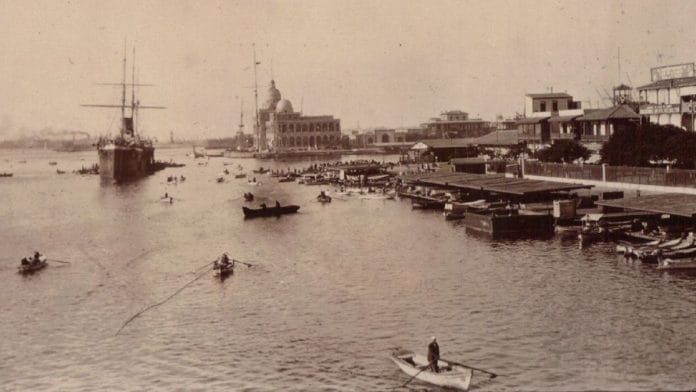

Stand on the banks of the Hooghly today, and it is hard to imagine the tranquil river was once one of the busiest commercial corridors on the planet. Ferries glide between towns, fishermen cast their nets into muddy waters, and faded colonial mansions look out over a river that has long since surrendered its global importance. Yet three centuries ago, this stretch of water was the economic heart of one of the richest regions on earth.
In the early 18th century, Bengal was widely regarded as one of the world’s great centres of wealth. Economic historians estimate that it accounted for around five per cent of global output, an extraordinary figure for a single province. Its fertile floodplains produced abundant harvests, its workshops wove the finest muslins and silks, and its merchants traded across Asia, the Middle East and Europe. Contemporary visitors marvelled at Murshidabad, the provincial capital, describing a city whose wealth rivalled that of Europe’s greatest commercial centres.
For European trading companies, Bengal was not a distant colonial possession waiting to be conquered. It was a prize to be courted. Merchants from across Europe travelled thousands of miles to obtain trading privileges from the Nawabs of Bengal and the region’s influential banking families. Nowhere was this competition more visible than along the Hooghly, where, within little more than forty miles, five European powers established settlements that co-existed, competed and prospered under Bengali rule.
The French built their enclave at Chandannagar—around 50 kilometres from Calcutta (now Kolkata)—whose elegant riverfront, churches and colonial villas still evoke its former prosperity. During the struggle against British rule, the town also became a refuge for Indian revolutionaries, adding another chapter to its remarkable history.
The Dutch settled at Chinsurah, constructing warehouses, churches and stately residences as they exported Bengal’s silk, textiles and saltpetre. Nearby, the Portuguese established themselves at Bandel, where the Basilica of the Holy Rosary, first founded in the 16th century, remains one of the oldest surviving Christian churches in India and a testament to Portugal’s early presence in the region.
Both Bandel and Chinsurah are around 50 kilometres from the main city.
Also read: Andhra meals are great, but Hyderabad’s food scene badly needed a neo-Telugu reboot
Commercial relationship to political domination
The British, of course, founded Calcutta. What began as a modest trading station would eventually become the capital of British India and one of the empire’s greatest cities. Even in its infancy, however, Calcutta had a reputation for extraordinary wealth and excess. Robert Clive famously described it as “one of the most wicked places in the Universe… rapacious and luxurious beyond conception”, capturing both the fortunes to be made there and the corruption that often accompanied them.
Perhaps the most unexpected European settlement was Denmark’s. With Serampore as the base, the Danes came much closer to the city. They created a thriving trading post that later became renowned for scholarship, printing and education. Its Church of St Olav, dedicated to the medieval Norwegian king and saint, remains unique in India and serves as a reminder that even one of Europe’s smallest kingdoms sought a foothold in Bengal’s flourishing economy.
The concentration of so many European settlements along a single river reflected a simple reality: Bengal produced goods the world desperately wanted. Fine cotton textiles clothed European elites, raw silk fed the continent’s luxury industries, and saltpetre, an essential ingredient in gunpowder, was indispensable to the armies of competing empires. Wealth flowed through the Hooghly in astonishing quantities, and for much of the eighteenth century it was European merchants, not Bengali rulers, who found themselves negotiating from a position of relative weakness.
That balance changed dramatically after the Battle of Plassey in 1757. The East India Company evolved from merchant enterprise to territorial power, and Bengal’s immense resources increasingly financed Britain’s imperial expansion. The commercial relationship that had once drawn Europe to Bengal transformed into political domination, with profound consequences for both India and Britain.
However, the earlier world did not entirely disappear. Travelling along the Hooghly today reveals an extraordinary historical landscape where French promenades, Dutch cemeteries, Portuguese churches, Danish institutions and British colonial buildings stand within easy reach of one another. Together they tell the story of an age when Bengal stood at the centre of the global economy and attracted merchants from across the world.
Despite this remarkable heritage, the Hooghly remains one of India’s most overlooked destinations. Visitors flock to Kolkata, while the historic towns upriver receive comparatively little attention. Tourism infrastructure is still developing, heritage buildings often struggle for funding and preservation, and many travellers remain unaware that one of the world’s most cosmopolitan 18th-century landscapes lies just beyond the metropolis.
The Hooghly deserves to be rediscovered, not simply for its colonial architecture but because it tells a larger story about India’s place in the world. Long before Britain ruled India, Europe came to Bengal not as a master but as a customer. The river reminds us that for a remarkable period in history, global commerce flowed not from West to East, but toward one of the richest and most sophisticated regions in the world.
Mousumi Roy is a writer and columnist. She writes on politics, culture and economic history. Views are personal.
(Edited by Saptak Datta)
Wait.. Hasn’t Sagarika Ghose noticed this problem with WB yet? Hasn’t she written out a ton of blogs with policies and recommendations to improve Bengal’s economy? If not, what is she really doing?
Right now, it is the poorest place in the world. All thanks to the 34 year Communist misrule followed by 15 years of utter idiocy.