




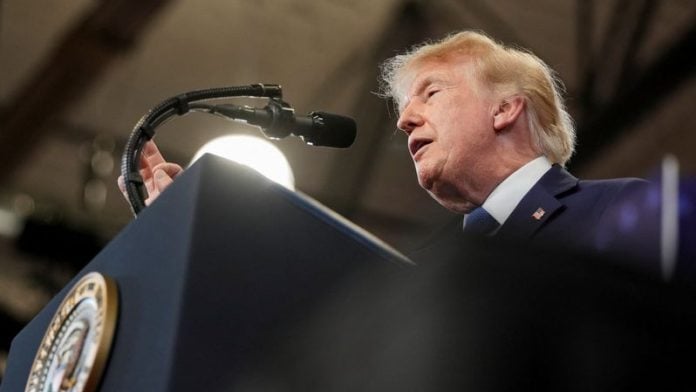

US President Donald Trump finally has his Greenland deal—or, more precisely, an agreement that Greenland, Denmark and the US are expected to sign next week. The full text is not yet public, but Trump’s Truth Social post and later the official communication from Denmark have generated speculation across theatres.
Trump, in his characteristic drama, says Washington will have permanent control over Greenland’s security. Copenhagen’s formulation is more revealing and sobering: the agreement will strengthen Arctic security while recognising both the sovereignty and territorial integrity of the Kingdom of Denmark and the Greenlandic people’s right to self-determination.
For all the Trumpian long-standing rhetoric on invading and annexing Greenland, the 2026 deal once again shows the limits of Trump’s disruptive politics.
In my 23 January column in ThePrint, I argued that Trump would never invade or annex Greenland. His language still had to be taken seriously because presidential threats move allies and negotiations, but that’s not how it turned out literally. Washington already possessed extraordinary military rights on the island, and Denmark and Greenland were open to expanding security cooperation from the get-go.
Eight months later, the distinction is even clearer. The theatrics he created were annexation, but the transaction he got was substantive access.
The thing with Trump is that he remains extraordinarily capable of collapsing the distance between the two. He capitalises on rhetoric and assumes that others are as careless with history as he is confident about his own misreading of it. Greenland was an awkward place for that trick—American access did not begin with Trump, and Danish sovereignty did not disappear with an enlarged American footprint. A renewed American interest in Europe and the Arctic is what Europe would always want.
In the following sections, I have explained the overlooked continuity of US engagement in Greenland, which runs through several legal arrangements—military and commercial—all the way to the latest 2026 deal.
America’s Greenland footprint
Under Franklin D Roosevelt, the US concluded the 1941 wartime arrangement that allowed American defence facilities in Greenland after Nazi Germany occupied Denmark. Under Harry Truman, Denmark became a founding member of NATO in 1949, and Washington and Copenhagen signed the 1951 Defence of Greenland Agreement. To date, that treaty remains the legal foundation of the American military presence.
Article II granted Washington sweeping rights inside agreed defence areas: military construction, communications, storage, personnel, base security, aircraft and maritime movements, harbour improvements and force deployment. US aircraft also received broad overflight and landing rights, while mutual agreement could create new defence areas. Yet all of it was explicitly ‘without prejudice to the sovereignty of the Kingdom of Denmark’. Article XIV tied the agreement to the duration of NATO—which means it’s valid as long as NATO is.
In other words, the bargain was never sovereignty in exchange for security. It was extensive American military freedom inside continuing Danish sovereignty. That distinction has endured every major revision since. Let’s see how!
Under Dwight Eisenhower, the NATO Status of Forces Agreement (SOFA) applied to Greenland from 1955, and a 1958 schedule defined the defence areas. Those areas were later reduced under Lyndon Johnson in 1964-65, Ronald Reagan in 1986 and George HW Bush in 1992. In short, America was willingly reducing Cold War infrastructure it no longer deemed necessary. At its Cold War height, the US had 17 military facilities in Greenland. Today it has one main permanent installation, Pituffik Space Base. That contraction was largely an American choice after the Cold War; some of today’s expansion is rebuilding posture Washington itself dismantled.
Now the more important thing– history shows that American access always had Danish political limits. After a nuclear-armed US B-52 crashed near Thule in January 1968, the Johnson administration and Copenhagen negotiated a supplementary understanding. The US formally assured Denmark that it would neither store nuclear weapons in Greenland nor overfly Greenland with nuclear-armed aircraft without Danish consent. The 1951 framework survived, and the Danish authority over the political terms of US presence was reaffirmed.
Under George HW Bush, a 1991 memorandum reorganised US military activity at Sondrestrom and Kulusuk, and a 2003 agreement further refined it. Each step narrowed or reorganised the American footprint without disturbing the basic bargain: broad US defence rights, Danish sovereignty, negotiated adjustments.
Then came the 2004 Igaliku Agreement under George W Bush, signed by Colin Powell, Danish Foreign Minister Per Stig Moller and Greenland Home Rule Deputy Premier Josef Motzfeldt. It amended the 1951 deal to include Greenland’s changed status, brought the Home Rule Government directly into the defence framework, required Danish, Greenlandic and American flags at Thule, and strengthened consultation before significant changes to US military operations.
It is necessary to be precise here. The 2004 agreement did not itself create or formally codify the right of Greenland’s self-determination. What it did was institutionalise Greenlandic participation inside an agreement still legally anchored in the Kingdom of Denmark. Look at its title—an agreement between the US and ‘the Government of the Kingdom of Denmark, including the Home Rule Government of Greenland’.
The explicit legal recognition of the Greenlandic people as a people with a right to self-determination came five years later, with the 2009 Self-Government Act. The Act says the decision on Greenlandic independence belongs to the people of Greenland and that independence would mean Greenland assuming sovereignty over its territory. Yet it also leaves foreign, defence and security policy among the competences that cannot simply be transferred while Greenland remains within the Danish Realm. In a short while, I will explain why this structure has endured in the latest 2026 deal.
The 2026 deal does not choose between Danish sovereignty and Greenlandic self-determination. It deliberately keeps both in the same sentence. Denmark is sovereign today, and Greenlanders retain the right to decide whether that remains true tomorrow. The 2006 security agreement sits inside that constitutional reality; it does not replace it.
Also read: New India-US trade portal shows India is trying to liberalise and protect at the same time
Beyond security
Igaliku also came with economic, technical and environmental declarations. A 2008 US diplomatic note, accepted by Denmark in January 2009 just after Barack Obama took office, updated procurement rules favouring Danish and Greenlandic suppliers wherever feasible. Strategic hosting had begun to be linked to local economic benefit.
Critical minerals, the crown jewel of Trump’s current rhetoric, also predate the drama. During Trump’s first term, the US and Greenland signed a 2019 minerals MOU and launched a hyperspectral survey. In 2020, Washington reopened its Nuuk consulate, and a Common Plan broadened cooperation across trade, investment, energy, natural resources and education.
So both—the minerals story as well as military-access claims—predate the current theatrics. Trump did not invent either; he intensified and personalised them.
Joe Biden’s administration added another piece in December 2023 by signing a new US-Denmark Defence Cooperation Agreement expanding American military access in Denmark proper. But that agreement did not govern the US presence in Greenland; Washington’s own State Department described Greenland as subject to a separate agreement.
Then Trump returned. By January 2026, annexation rhetoric had created a transatlantic crisis over territory Denmark had never offered to sell, and Greenland had never consented to surrender. European leaders replied that Greenland belonged to its people and Arctic security should be strengthened through NATO and the 1951 framework. In February, NATO launched Arctic Sentry amid Russian military activity and a growing Chinese footprint.
The September deal now appears to complete that turn by reinforcing the US’s security posture. Reuters reports expanded US military presence, permanent access, basing and overflight rights, restrictions on select bases and sensitive investments, and continuity even if Greenland becomes independent. The Financial Times also reports expanded rights while Denmark and Greenland insist sovereignty and self-determination remain intact.
Until the treaty is public, Trump’s ‘permanent control’ will remain his formulation amplified to maximum effect. The 1951 agreement was a US-Denmark bargain. The 2004 amendment gave Greenland an institutional seat inside it. The 2009 Self-Government Act gave Greenlanders an explicit legal route to sovereignty. The 2026 arrangement appears designed to make American security access durable across all three realities.
That is consequential, but it is almost the opposite of annexation. This arrangement preserves the Kingdom’s sovereignty while simultaneously acknowledging that Greenlanders can one day choose independence, and then attempts to future-proof the American military relationship in case of that choice.
Also read: The 2026 midterms will test the political foundations of American power abroad
Reaction and relief
The first readings from the West notice the same mismatch. Le Monde says Trump has abandoned the ambition to extend US sovereignty; the Washington Post says the agreement falls well short of taking any possession.
For Europe, that makes the outcome considerably more relieving than the months of rhetoric preceding it. Denmark retains the red line it set from the beginning—no transfer of sovereignty. Greenland retains the principle that its future belongs to Greenlanders. The US remains—and may become more deeply—embedded in Arctic defence. NATO’s presence strengthens rather than recedes.
In effect, Europe held together and refused to let Trump redraw the map. Trump had to make do with what he could get instead—something that was always on the table.
What about Russia and China? For Russia, a stronger American and NATO presence around Greenland strengthens early warning, surveillance and control of the North Atlantic approaches associated with the Russian Northern Fleet, basically hardening NATO’s western Arctic flank.
Beijing has no Russian-style Arctic geography and claim. Its avenues into Greenland are more likely to run through mining, infrastructure, technology, financing and dual-use investment. Currently, Chinese investments there are far smaller than Trump often imagines and claims. If the final agreement gives Washington and its allies stronger capacity to block sensitive non-NATO investments and bases, it narrows precisely those routes. Again, the direction is not new: Washington’s critical-minerals engagement with Greenland dates at least to 2019.
Trump can still sell the agreement as a personal victory before the midterms, just as his war in Iran remains mired in attrition. He can and will say ‘forever’, ‘control’ and ‘security’ with a few dozen Truth Social posts and absurd maps showing Greenland as American.
But historical records between the US, Denmark and later Greenland are consistent, if one chooses to take history seriously.
The entire exercise also explains why Trump should be taken seriously without treating every piece of his rhetoric as a literal blueprint. His threats create pressure and force allies to move faster. They also impose costs in trust and generate crises that the eventual agreement may spend months repairing.
But the transaction that endures his rhetoric is often much more conventional than the performance around it.
The full 2026 text may still contain surprises, and any definitive legal judgment should wait until it is published. What is already impossible to miss, however, is the principle around which Denmark and Greenland say the agreement has been built: the sovereignty and territorial integrity of the Kingdom remain recognised, while the Greenlandic people’s right to self-determination remains recognised too.
Swasti Rao is a Consulting Editor (International and Strategic Affairs) at ThePrint. She tweets @swasrao. Views are personal.
(Edited by Saptak Datta)
Freshening the make up a little on the 1951 defence agreement between USA and Denmark.
Since a formal agreement dating back to 1951, USA has the right to base military facilities and resources in Greenland. Now down to a single space station in what was earlier called Thule. So there will be enormous relief throughout Europe that it was not forced to choose between NATO and continental solidarity. 2. Greenland has 56,000 residents. Denmark provides it an annual subsidy of $ 600 million, about $ 10,000 per capita. Plus other development assistance. Not quite the colonial loot and plunder Britain carried out on the Indian subcontinent for two centuries.