






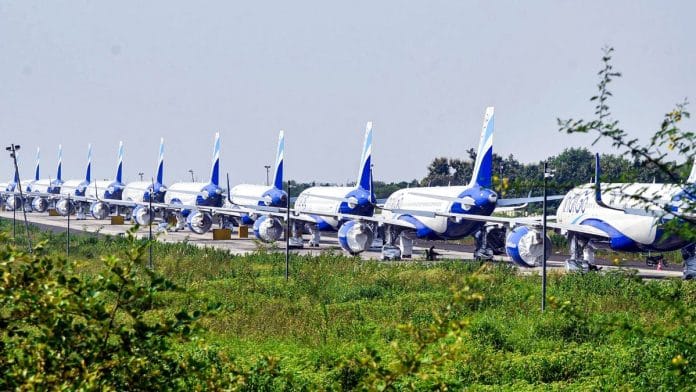



IndiGo’s cancellations and the Directorate General of Civil Aviation’s hasty dilution of newly tightened pilot-rest norms should be treated as a system-failure drill, not a one-off embarrassment. Within days of enforcing stricter Flight Duty Time Limitation rules, the regulator partially rolled them back and granted IndiGo special flexibility on weekly rest and night duties, after cancellations stranded passengers nationwide.
A single private carrier commanding just over 60 per cent of the domestic market could trigger a safety rollback. This tells the real story: India has allowed one airline to become “too big to fail” without building “too rigorous to bend” institutions around it.
This is the moment to ask not just how IndiGo misplanned its crew and schedules, but why policy and regulation allowed one business model to hold regulators, passengers and the exchequer hostage. The answers lie in five overdue policy shifts—safety governance, capacity approvals, market structure, passenger rights and foreign participation—that together can reduce the fragility built into Indian aviation.
Seal safety regulation off from operational panic
The Directorate General of Civil Aviation’s (DGCA) decision to harden Flight Duty Time Limitation (FDTL) norms first by barring substitution of leave for pilots’ weekly rest and tightening night-duty windows, and then to withdraw parts of that regime within days under pressure from cancellations, has badly damaged its credibility. Safety-critical regulations cannot be written in bold one week and in pencil the next simply because one airline under-hired or over-scheduled its crew.
India needs a firewall between safety judgement and operational convenience. Parliament should amend the legal framework to insulate key rules like FDTL from ad-hoc waivers, allowing only time-bound, transparently reasoned exemptions vetted by an independent safety board. Any relaxation must carry a published risk assessment and mitigation plan, so that regulators cannot quietly trade away pilot rest for short-term relief.
Pilots and independent safety experts should also be structurally embedded in this process, through a National Aviation Safety Council that reviews proposed dilutions and records dissents. When cockpit fatigue is the final barrier between routine operations and catastrophe, the people who fly the aircraft cannot remain the weakest voice at the policy table.
Tie routes, slots and schedules
IndiGo expanded its winter schedule while under-investing in pilots, then cited new FDTL norms and crew shortages as grounds for large-scale cancellations. Pilot associations are correct in pointing out that airlines had been given a notice about the revised rules for nearly two years. The real failure was the approval of schedules that could never have been flown safely under the tightened regime.
DGCA must convert “paper scrutiny” into hard gatekeeping. No airline should be granted additional slots or seasonal schedule approvals unless it demonstrates, with auditable data, that it has adequate cockpit and cabin crew to operate the entire programme under the strictest FDTL configuration. Crew-to-capacity ratios should be publicly benchmarked so that competitors are not rewarded for flying closer to the red line.
The regulator should also run periodic “stress tests”—simulating fog, Air Traffic Control (ATC) outages, technical directives or sudden aircraft groundings—to check whether crew buffers and rostering systems can absorb shocks without triggering cascading cancellations.
Also read: IndiGo crisis is a management failure. Don’t blame the pilots
Need for a systemically important framework
Allowing one low-cost carrier to reach more than 60 per cent market share in domestic traffic has created a single point of failure in a sector vital to the economy. When IndiGo’s network seized up, the government found itself simultaneously firefighting passenger outrage, pressure from business lobbies and macro-level connectivity concerns—exactly the profile of a systemically important institution.
India needs a “systemically important airline” framework on the lines of what exists for banks. Crossing defined thresholds of market share, route dominance, or airport dependency should trigger enhanced obligations—higher resilience standards, stricter scrutiny of under-staffing, mandatory contingency capacity and more stringent disclosure of operational and financial risks. Any public intervention—waivers, policy forbearance or fiscal support—must be tied to governance reform, not cash and time.
That could mean independent board-level safety committees with veto powers over schedules, annual fatigue-risk audits in the public domain, whistle-blower protection for crew reporting roster abuse and time-bound plans to de-risk concentration at single hubs. The message should be simple: when the State bends to prevent systemic collapse, it will demand structural change in return.
Enforceable rights to passengers
The political economy of this crisis tilted towards rescuing operations quickly because the legal and financial cost of mass cancellations remains modest in India. Passengers faced ruined plans, financial losses and days-long uncertainty, with limited automatic compensation and weak rebooking obligations.
India’s passenger-rights framework must move from a feel-good charter to an enforceable contract. There should be automatic compensation bands linked to delay and cancellation causes, with a presumption in favour of the passenger unless the airline can demonstrate extraordinary circumstances. Airlines that cancel flights for reasons within their control must be required to rebook affected passengers on rival carriers where seats are available, at the original fare bucket rather than whatever last-minute price the market throws up.
Care obligations—meals, accommodation where appropriate and timely information—should be backed by penalties on both airlines and airports that fail to provide them. When every cancelled flight creates a predictable, non-negotiable liability, boardrooms will invest more in resilience than in lobbying for quiet regulatory U-turns.
Use of foreign capital
On paper, India allows up to 100 per cent foreign direct investment in scheduled domestic airlines. In practice, foreign airlines remain capped at 49 per cent ownership, and “substantial ownership and effective control” must rest with Indian nationals, which keeps strategic foreign control off the table. The result is a capital-hungry market in which domestic promoters still call the shots, sometimes with limited appetite to invest in resilience.
The IndiGo episode strengthens the case for using foreign capital and foreign airlines more intelligently as tools of safety and resilience. Raising the cap for foreign-airline shareholding in Indian carriers to 74 per cent to 76 per cent—while still enforcing Indian “effective control” through board composition and voting-rights design could attract deep-pocketed partners with stronger safety cultures and better systems.
In parallel, India should open a review of limited domestic access for foreign carriers on select trunk routes, tied to strict reciprocity and robust safety and labour conditions. Properly designed, this cabotage-like access would not replace Indian airlines, but it would reduce the “too big to fail” problem by creating alternative capacity on routes now dominated by one or two players.
The IndiGo-DGCA episode is not just a story of one airline’s miscalculation or one regulator’s weak knees. It previews what happens when rapid growth, concentrated market power and ad-hoc regulation collide in a sector where the margin for error is measured in lives. Whether India chooses bolder foreign participation or a more conservative path, the minimum agenda is clear: Independent safety regulation, honest capacity planning, passenger rights and governance structures that treat aviation as critical infrastructure, not another business vertical.
KBS Sidhu is a former IAS officer who retired as Special Chief Secretary, Punjab. He tweets @kbssidhu1961. Views are personal.
(Edited by Saptak Datta)
Agree that the agency that approves additional routes/schedules should be monitoring the new guidelines. Needing more staff and pilots is not something that can be bought in a super market. IndiGo should have alerted the authorities. Authorities did not fulfil their responsibility in monitoring and alerting to possible issues from their regulations. Press is at fault as well, that no one analyzed the potential disruptions. Indian Press needs more watchful staff, rather than just the morning-after analyses.
This is a very outrageous take on regulator “allowing” an airline to grow disproportionately ! In fact, a fallacious take ! There are too big to fail enterprises in every sector in India and more so in several other capitalist economies ! The day a regulator starts to poke its nose to “ensure” firms do not grow beyond a certain point is the day when we start causing nervousness in the business environment of a country. This episode speaks more about mismanagement than about too big to fail. Was there any mechanism in place to regularly track how airlines were handling their roster scheduling after Nov 1 directive is the question to be asked. If not, there should be one in future to ensure these kinds of firms do not make a mess of their dominant position. One must also keep in mind that this is the same airline which has consistently shown great on time performance across a decade. There are lessons to be learnt here but surely not the one the writer of this article propounds. Do not use a sledgehammer to crack the nut.