





To move to Goa, you have to be a little in love. When the metropolis loosens its chokehold on you, and you need somewhere to lose – or find – yourself, you come here. It obliges: slower mornings, the gift of green, and the rare freedom of being nobody’s business. Falling in love with Goa is the easy part, but falling in love in Goa? That’s where things get a little complicated.
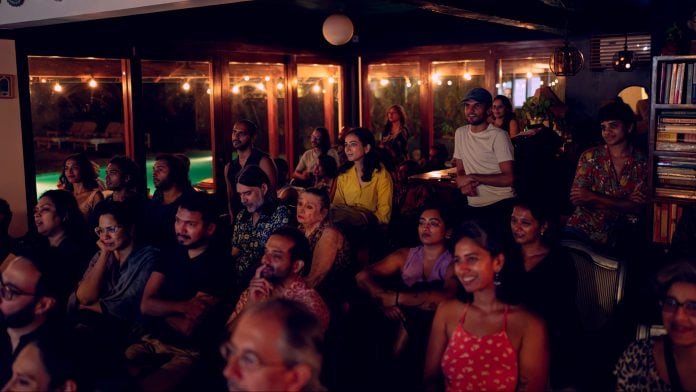
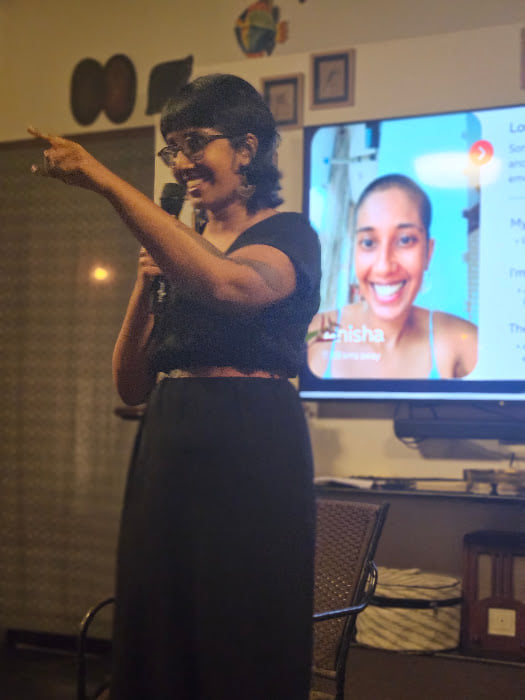
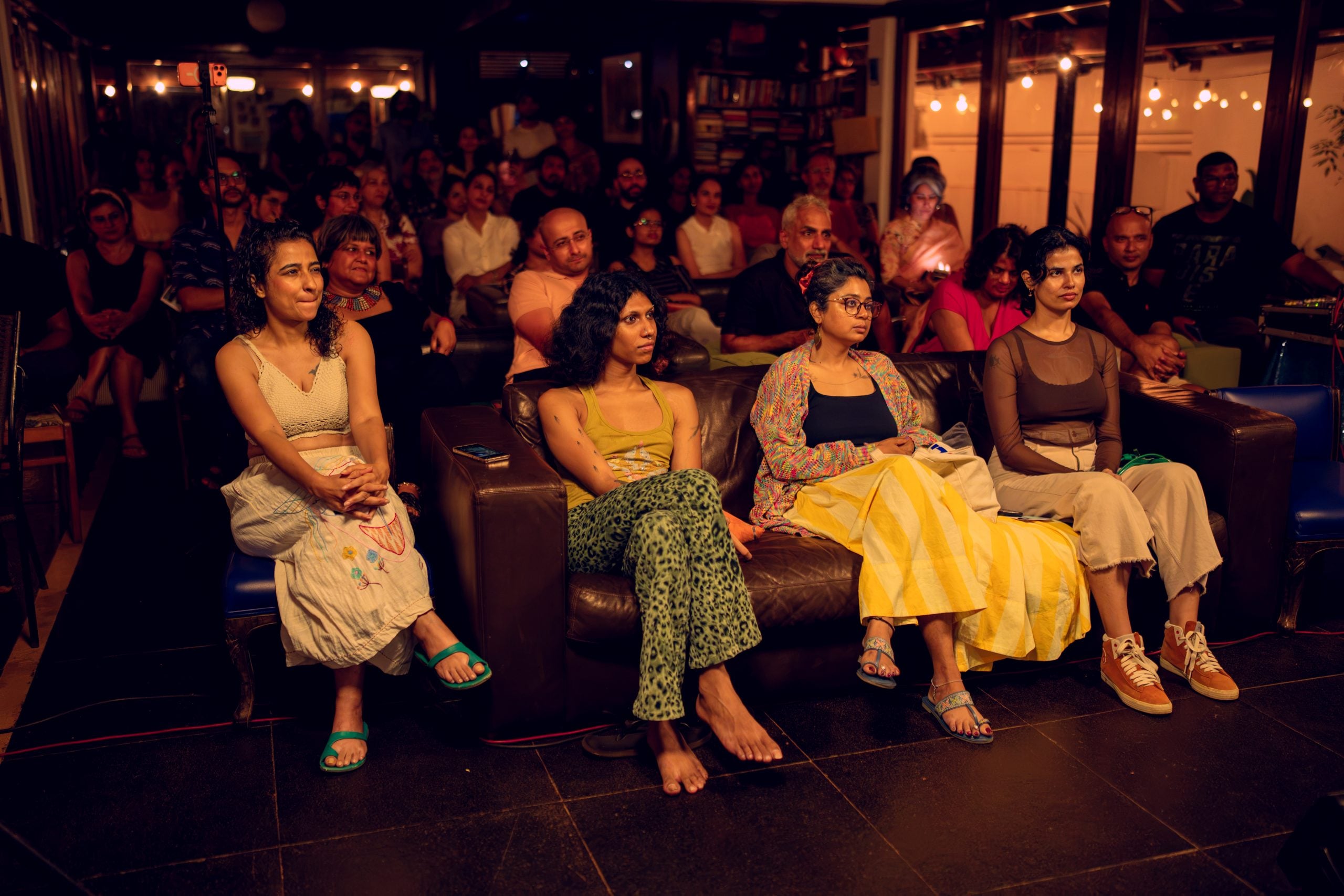
Dating in Goa was the theme of “Into-Me-See”, an event organised by the collective Creative Sangha, featuring poetry, prose, and even a PowerPoint performance by six of its members. The title is a pun on “intimacy” and the performers held themselves to it. It was a lively evening – after all, everyone’s dating history has the potential to turn into stand-up material.
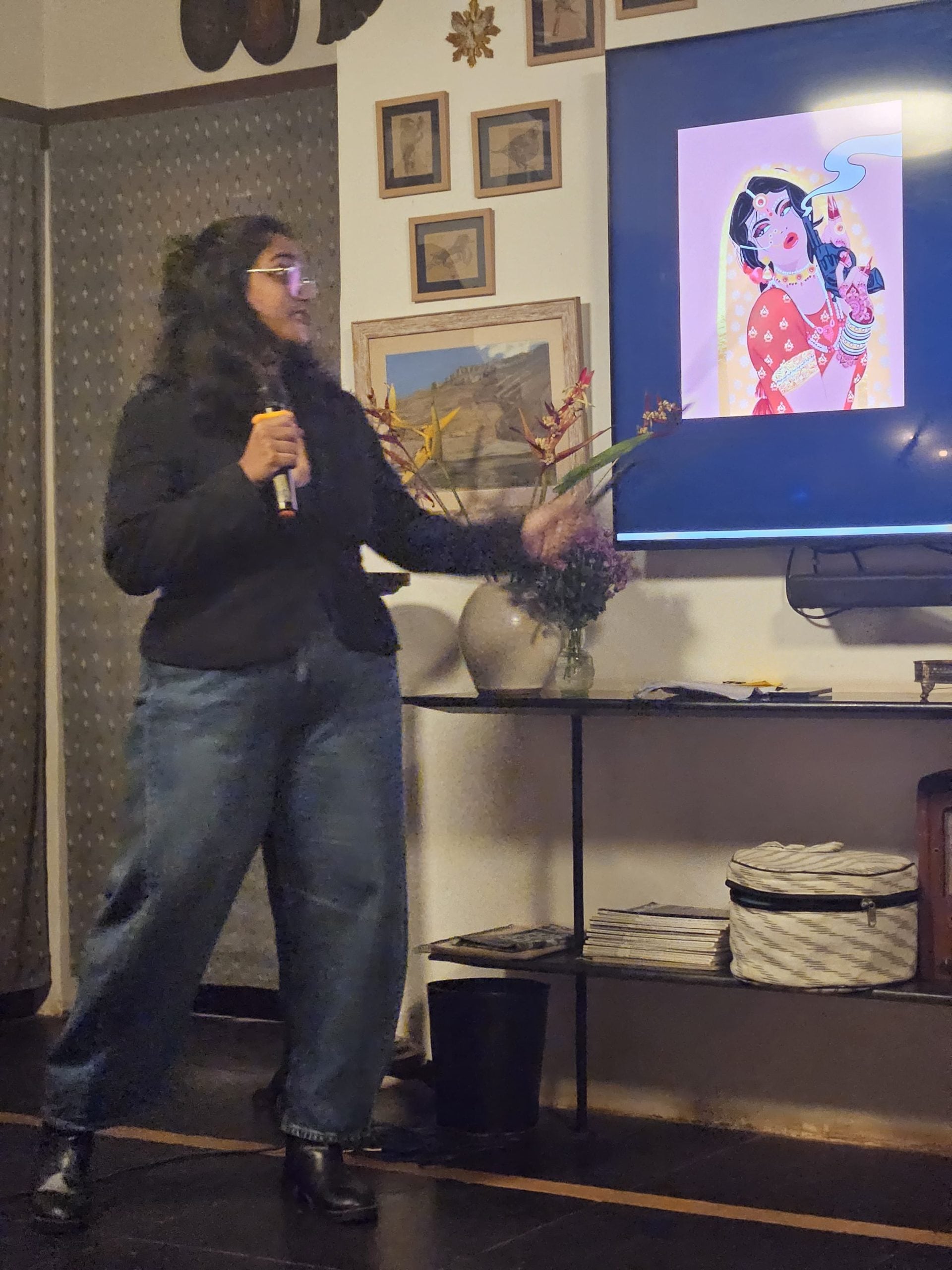
Who among us hasn’t been on one or the other side of breadcrumbing, love-bombing, kittenfishing, or grey-rocking? Surabhi Chatterjee’s PowerPoint presentation, in particular, drew the loudest laughs. She focused on the differences between men’s and women’s dating experiences, and how the gender gap that shadows women’s work and home lives shows up uninvited on their dates, too.
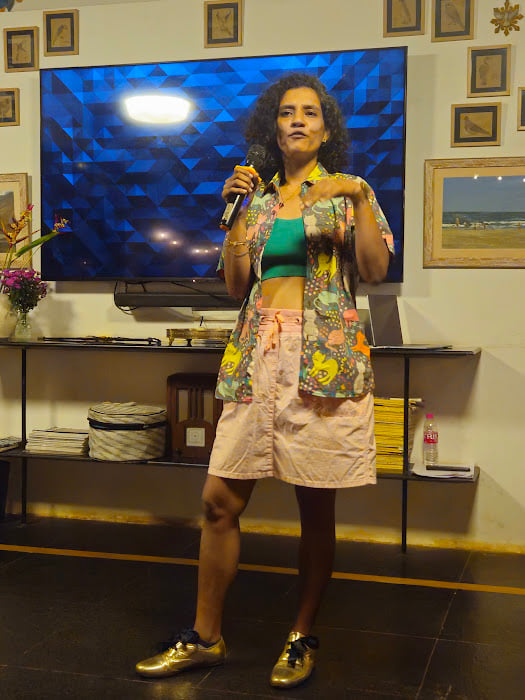
Some of the performances were unexpectedly tender, even as they were hilarious. Vrujen Andhare, the reigning Mr Gay World India, spoke about how being in Goa gives rise to transient connections.
“How many people have watched the sunset from my favourite beach point and called it theirs after four days,” Vrujen said. That line comes from his experience of taking dates to a beautiful, secluded spot in Mandrem, from where the entire Arambol-Morjim stretch is visible on a clear day.
After a while, Vrujen felt he had fallen into a pattern: hike up to the spot, draw the skyline, and make out with his date.
“It became such a choreographed thing that it stopped being meaningful,” he told me in a later interview. “I felt like I was chasing the idea.”
Like many other Covid migrants, Vrujen moved to Goa from Delhi about six years ago with his former partner and cat. After his relationship ended, he didn’t seek out permanent connections.
“The more I have explored myself, the more I realise I’m not really made for a conventional love story,” he said. He identifies as polyamorous and says he has realised that even a little bit of intimacy is enough for him to get by.
“It’s unrealistic to find that one person who can fulfil all your needs. I much prefer to mix all the masalas to create a beautiful butter chicken.”
Vrujen attributes part of the churn to gay dating culture. The rest comes from the place. The Goa of tourists moves at a frenetic pace, compressing several experiences into a brief period—and that includes hooking up or “speed-dating” with others who have made the state their home. Those connections tend to evaporate when the visitor leaves.
But while they are around, the “local settler” often slips into the role of tour guide, in a slow slide from romantic prospect to concierge. Vrujen told me that he felt some of these prospects treated him as a means of getting to the cool places.
“I mean, I can get you into a cool club, but you don’t have to pretend to be my plus one,” he said. He allows that some of them were nice people who simply wanted to see Goa through the eyes of someone who lived there. Others figured they could depend on him in a place with patchy mobility.
Those of us who arrived in Goa already partnered up tend to forget how small and scattered the dating pool really is. Poet Pragya Bhagat, who contributed an essay on app dating in Goa to the anthology Appetite, has often watched friends spot their app matches across the room—a rare coincidence in the city.
By comparison, dating apps in metros line up a buffet of potential long- and short-term partners for single men and women, no matter the varying quality of the offerings. Vrujen said that in Bengaluru, where he studied, Grindr surfaces hundreds of matches within a kilometre’s radius. But here, even within a 10-km radius, barely 10 matches show up. “In Bangalore, it’s an ego boost,” he said. “Here, I feel, am I not worth the effort?”
Also read: The price to breathe: Why Goa’s women are paying with their lungs
In Goa, finding your person is complicated
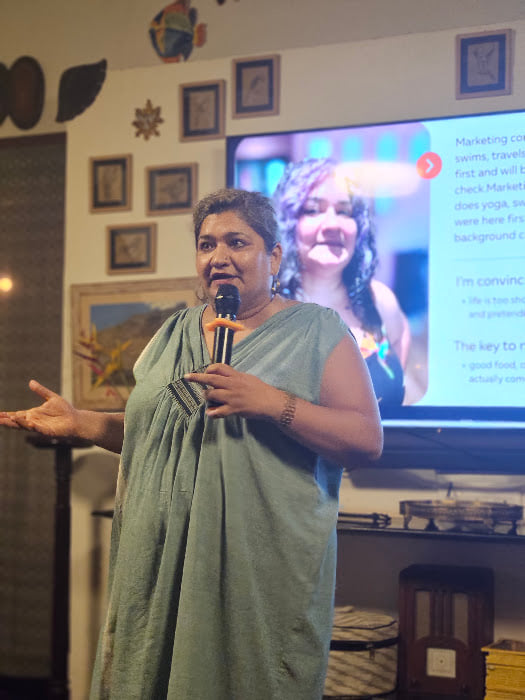
Sapna Shahani and her female friends often ask similar existential questions. Shahani is one of the founders of Creative Sangha and performed a bittersweet monologue about recovering from an anxious attachment style. She moved to Goa 15 years ago, after a decade in the US. Like many women who settle here, Shahani moved for a freedom that is hard to find elsewhere in India. She tells me that at a housewarming party she hosted, she found herself looking around at a roomful of 20-odd women friends, most of whom were single. “They are all beautiful, intelligent, sophisticated, independent women,” she said.
It’s a common thread, Shahani says: independent women everywhere struggle to find partners. “But somehow, it gets harder in Goa.” The state attracts women who can feel safe and live without asking for permission. “The compromise most of us make is that we don’t find men who are equally compatible,” she said.
Part of it is plain economics. Goa offers few ways to earn a decent living, so those who stay tend to have generational wealth or a remote job. Romance in Goa—just like real estate—favours people with money from somewhere else.
Shahani says Goa also attracts a certain type of straight man. “If a man can pay his bills, he’s possibly divorced and unwilling to commit,” she said. The rest are young men burnt out on the city, ready to sow their wild oats. You can find plenty of people to fool around with, but most women in their 40s who never married would prefer commitment. “Then there are several people who are ethically non-monogamous,” Shahani told me. “It sounds like a fun idea at first, and you try and explore every option that would help you reach your eventual goal of experiencing a healthy or mutually satisfying relationship. But when your connection with a person grows deeper, it doesn’t work in my experience.”
What Goa loses in variety, it more than makes up for in other kinds of connections. Bhagat tells me that each neighbourhood in North Goa has a “local ecosystem of social interaction”. North Goa has a steady supply of creative stimulation, from calisthenics and pottery classes to rock climbing, plays and festivals. In Bhagat’s observation, many women in their 30s and 40s become comfortable going to these places on their own.
“Everyone wants to be witnessed. So much of a romantic pursuit is about finding your person that it can become difficult to be with yourself. But this cultural vibrancy enables you to be alone,” Bhagat said.
Even the transience, Bhagat points out, has its uses. Many people who don’t match romantically end up as friends. “Just because you are pursuing romance doesn’t mean the individual can’t offer another kind of meaningful connection. There’s a lovely lesson in this,” she said.
Andhare found out how far that goes last year, when he had a heart attack. He informed two people, but 25 people turned up at the hospital. People kept showing up long after his hospital stay, and keeping him safe became a community project. “The day I really belonged,” he said, “was the day I got a heart attack.”
In a place where everyone comes and goes, love can also mean the people who stay when it really matters.
This article is part of the Goa Life series, which explores the new and the old of Goan culture.
Karanjeet Kaur is a journalist and a partner at TWO Design. She tweets @Kaju_Katri. Views are personal.
(Edited by Prashant Dixit)