



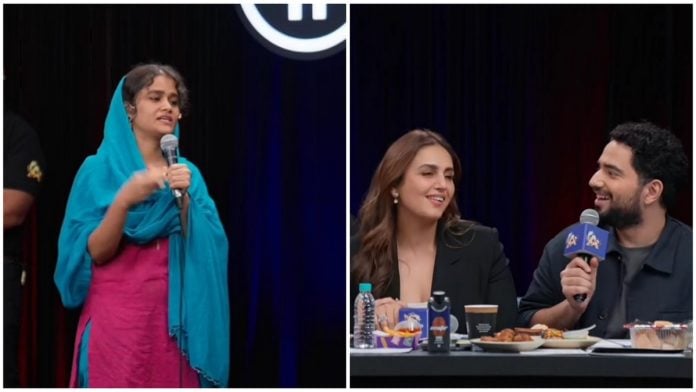
Surma, namaz cap, bomb-making, raising a cricket team of children—Muslims in India just can’t escape the stereotypes. These caricatures are often passed off as jokes, which is what we saw in a recent episode of Samay Raina’s India’s Got Latent. This time, cousin marriage was the punchline.
In a clip that has gone viral, the Muslim character Salma Deewani, played by actor Bhagyashree Tarke, banters with the panel and says she’s come with her cousin. When panellist Huma Qureshi asks, “Kaun cousin?”, Samay Raina replies, “Husband honge.” The audience bursts into laughter, cheering and hooting along. It’s really not that funny.
Cousin marriage has a long history in several Indian communities. So why is it constantly mocked as a Muslim oddity? These portrayals might seem harmless or funny to some, but they contribute to a very narrow understanding of an entire culture. As a Muslim woman, I have to keep fending off ill-informed assumptions.
Many of my non-Muslim friends have asked me whether I have ever considered marrying one of my cousins. And I am certainly not alone in this. My Muslim friends have also faced the exact same question repeatedly.
Let me just put it out there: I am a Muslim and I am not married to a cousin. Neither my sister nor anyone in my family has married their cousin. I have not witnessed a single instance of cousin marriage in my own family in the last three decades. Even my parents have never seen cousin marriages being practised in their generation.
Yes, Islam permits cousin marriage, and that is one reason the practice may be more prevalent in certain Muslim communities. But cousin marriage also exists in other societies and countries around the world.
Also Read: Hijab is a choice. Why are we so uncomfortable when Muslim women freely choose it?
Who is marrying their cousin in India?
The casual mocking of cousin marriage exposes how little people know about others outside their immediate echo chamber.
Even within Hindu communities in India, cousin marriages have existed as part of certain regional and cultural traditions. In South Indian states like Andhra Pradesh, Telangana, Tamil Nadu and Karnataka, cross-cousin marriages have historically been quite common in several communities.
The 2019-21 National Family Health Survey found that 7.3 per cent of ever-married Hindu women aged 15-49 had married a first cousin, while the share was 12.1 per cent for their Muslim counterparts. So yes, the prevalence is a bit higher— but nearly nine in 10 Muslim women in the survey married someone other than a first cousin. So, what’s the factual basis for the generalisation?
There are wide regional variations as well, with marriages between blood relatives at 28 per cent in Tamil Nadu, 27 per cent in Karnataka and 26 per cent in Andhra Pradesh and, at the lowest end, 0.5 per cent in Sikkim.
There is a cultural taboo in many communities about marrying cousins, as they are considered a step away from siblings, and there is a greater risk of children born to first cousins inheriting certain genetic conditions. Other communities, however, have traditionally practised such marriages to make kinship ties stronger and keep property within the family. It’s hardly something to make nudge-nudge, wink-wink remarks about. We need to understand that cultural differences are not invitations to ridicule.
People take one practice, associate it with a religion, and begin treating it as the defining feature of every household in that community. Bollywood has been doing this for decades, giving us predictable portrayals of Muslims as the kohl-eyed villain, the over-the-top nawab, the comic sidekick with a stereotypical Urdu accent, the religious fanatic and the ruthless terrorist.
It’s time we moved beyond these lazy generalisations of Muslims. And if you think every Muslim household revolves around cousin marriages, perhaps you need to meet more Muslims, make more Muslim friends and step outside the limited social circles that shape your understanding of the community.
Views are personal.
(Edited by Asavari Singh)