







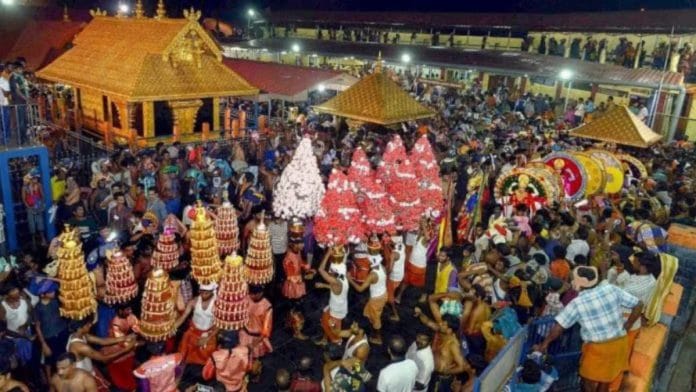


How should a constitutional court deal with religious practices? The Sabarimala reference hearing in the Supreme Court has reignited the enquiry.
For decades, Indian courts have dealt with the Essential Religious Practices (ERP) test. Under this doctrine, a practice receives constitutional protection only if the court finds it essential to a religion. What began as a way of protecting religious autonomy has slowly become a method of judicial certification. Courts are asked to say which rituals, customs, disciplines and forms of worship are central to a faith, and which are peripheral enough for the State to regulate.
That is an uncomfortable role for any court. Law must enter religion when a practice produces legal consequences. But it need not begin by asking whether a ritual is central to salvation, worship or divine command. A court can ask a simpler and more judicially manageable question: what legal consequence does this practice produce?
That shift changes the nature of the enquiry. A court looking for consequences has to identify an injury, a right, a burden and a remedy. This is legal work. A court looking for essentiality has to enter the internal life of a faith, which is theology by another name.
This matters especially in India, where religious life rarely resembles a single church with a fixed catechism or final authority. Sampradayas split. Reformers argue. Sects emerge. Communities leave, return, hybridise and reinterpret. Local practices acquire sacred force. New forms of devotion arise without waiting for official permission.
A person dissatisfied with a religious order may argue within it, defy its gatekeepers, leave it, or build another path. BR Ambedkar’s Navayana Buddhism, the Brahmo Samaj, Arya Samaj, Lingayat traditions, Kabir’s devotional challenge, the Ramnami Samaj and many dera traditions show how often Indian religious reform has travelled through voice, exit, rupture and creation. This is not marginal to Indian religious history. It is one of its recurring forms.
The ERP test fits this world badly. It assumes that religion works like a code of compulsory commandments. The enquiry often becomes: would a believer cease to belong to the faith if this practice disappeared? But many Indian traditions do not operate in that binary fashion. They move through discipline, choice, lineage, memory, custom, fasting, worship, renunciation, household life and multiple paths to the sacred. Difference is not always apostasy.
The test, therefore, does more than judge faith. It thins it. Courts begin to peel religion layer by layer: this ritual is not essential, that custom is only social, this discipline is optional, that observance is merely cultural. What remains may be an abstract core, but not necessarily the religion that people actually live. A faith is not only its irreducible minimum. It is also its accumulated layers.
Judges are not especially well placed to perform this exercise. They are trained in constitutional interpretation, evidence and legal reasoning, not theology. Even a careful judge brings assumptions about reason, superstition, equality, modernity, tradition and reform. In ordinary disputes, legal materials help discipline those assumptions. Religion is different. It rests on faith, memory, ritual, revelation, discipline, fear, hope and belonging. There is no neutral scale on which spiritual necessity can be measured.
One judge may see devotion, another may see oppression. One may see discipline; another may see superstition. That is not a charge against judges. It is a limitation of the judicial function. Courts can decide legality. They should not have to certify theology.
When law can step in
The State faces the same limitation. Parliament and State legislatures represent people politically. They do not, by that fact alone, represent every faith doctrinally. A legislature may include members of a religious community, but that does not mean it reflects the community’s internal plurality: monks and lay followers, women and men, reformers and traditionalists, urban elites and local practitioners, textual authorities and oral communities. Democratic power is not enough to justify deep entry into matters of belief.
None of these places religion beyond law. That would be naïve and dangerous. Religion as a conscience deserves strong protection. Religion as a community deserves substantial autonomy. Religious institutions may be regulated in their secular administration. And where religion becomes coercive power, it must answer to constitutional and criminal law.
The constitutional enquiry should therefore be on the harm caused, not the essence of religion.
Does the practice involve coercion, fraud, violence or public disorder? Does it deny access to a public or legally regulated space? Does it affect bodily integrity, civil status, property, participation, dignity, health or legal capacity? Does it create caste disability, gendered legal harm, exploitation or institutional abuse? If it does, the law can step in. If it does not, courts and governments should be slower to intervene.
Harm must also be understood carefully. It cannot mean mere discomfort, embarrassment or disagreement with a religious practice. It must be legally serious. Sometimes the harm is to third parties: violence, coercion, exclusion, fraud or public disorder. Sometimes it is civil or dignitary: denial of access, property, participation, status or legal capacity. Sometimes it concerns the practitioner herself, as in fasting, vows, bodily risk or end-of-life discipline. These situations cannot be treated alike. A competent adult’s voluntary discipline is not the same as an act imposed by family, clergy or community.
Sabarimala verdict shows why this approach is cleaner. The dispute need not turn on whether the exclusion of women was essential to the worship of Lord Ayyappa. The real constitutional issue is whether a public religious institution can deny access in a way that produces consequences for equality, dignity and civil status, and whether those consequences justify intervention despite claims of denominational autonomy. A court may still intervene. But it can do so without announcing what the deity, tradition or faith truly requires.
The same approach works in other conflicts. Religious freedom often collides with equality, dignity, liberty, privacy, access, freedom of expression and the abolition of caste disability. Courts must then identify the legal injury, the affected right, the degree of burden and the least intrusive remedy. They can decide whether a practice produces unconstitutional consequences. They need not decide whether it is essential to worship or doctrine. Constitutional courts should harmonise rights, not rank scriptures.
The familiar objection is that, without the ERP test, anything can be claimed as religion. That fear is overstated. Sincerity can open the door, but it need not decide the case. A claim may be sincerely religious and still be regulated if it produces coercion, fraud, violence, public disorder, civil injury, caste or gender-based disability, exploitation, exclusion from legally regulated spaces or demonstrable constitutional harm. Voluntariness, third-party impact, proportionality and legally cognisable injury can do the real work.
Also read: How budgets made investing in India unaffordable for middle-class savers
A more defensible role for courts
This approach does not weaken social reform. It simply removes an unnecessary detour. Courts don’t need to declare that a practice is bad theology before deciding whether it causes legal harm.
The nine-judge Supreme Court bench, which has reserved judgment in the Sabarimala reference case, now has a rare opportunity to lower the temperature of Indian religious-freedom law. It can move the doctrine away from theological certification and toward legally cognisable harm. It can begin with a religion’s own understanding of itself, without treating that understanding as immune from law. It can preserve State intervention for coercion, violence, fraud, exploitation, civil disability, public disorder, direct bodily harm, institutional mismanagement and genuine conflict with other fundamental rights.
That would give the judiciary a smaller role. It would also give it a more defensible one.
Religious freedom should remain a shield against interference, not a licence granted after theological cross-examination. India does not need courts or governments to reorganise faith. It needs a constitutional framework that protects the space in which religions can be argued with, left, defied, reformed and remade by the people who live within them.
Courts must remain courts. The State must remain the State. Neither should become a theologian.
Prashant Narang is Deputy Director-Research and Programs at TrustBridge Rule of Law Foundation. Rishabh Gandhi is an advocate, former judge and arbitrator. He holds a PhD in research on freedom of religion. Views are personal.
(Edited by Ratan Priya)