


Justice Sanjay Kishan Kaul’s memoir, Without Fear or Favour, came out last month. A lot has since been written about it. His quarrel with former Chief Justice DY Chandrachud runs along two lines. The first is the collegium: Justice Kaul wrote that Justice Chandrachud sought the government’s “pre-approval” before approving judges’ names. The second is the roster. A contempt case against the government over delayed appointments vanished overnight from Justice Kaul’s list in December 2023, and the challenge to the money-laundering law stalled post his retirement. The propriety of pre-approvals has found media coverage over the past few weeks, and any discussion, though extremely relevant, will wade into speculative territory. We set it aside and focus on the second problem using court data.
In the Indian system, the chief justice, as “master” of the roster, either of high courts or the Supreme Court, decides which judges hear which case, when a case is heard, and whether it would be heard at all. We explore whether the exercise of that power is as large and erratic as it is made out to be.
Using the Supreme Court’s own listing records, about 1.9 million entries were listed since 2017 in TheProfesseer’s CourtsDataLab; we test it three ways: one, whether cases go where the published roster says they should; two, where the most sensitive bail pleas are sent; and three, when the most contentious constitutional questions get heard.
We find, overall, that the roster master’s alleged arbitrariness may be overstated—listings largely stick to published rosters and bail matters are increasingly sent to judges with a lenient bail record. Irrespective, there’s room for improvement.
Does the roster hold?
The Supreme Court periodically issues a roster that assigns each judge to a particular bench. A bench may, for instance, get service law, another tax, a third criminal appeals, and so on. While the Supreme Court’s website keeps no record of past rosters, we dug them out of the Court’s servers and web archives and studied every roster in force since January 2024. These rosters cover fresh cases, split across 15 to 18 benches. This is the de jure, or by law, position.
Every case freshly listed since—89,817 of them from January 2024 up till 6 November 2026—reveals the de facto position of case allotment. An absolute overlap would mean that the court moves on the basis of a predictable, pre-decided roster. Divergences, if any, reveal out-of-roster allotments.
Here is how roster compliance splits across the tenures of successive chief justices:
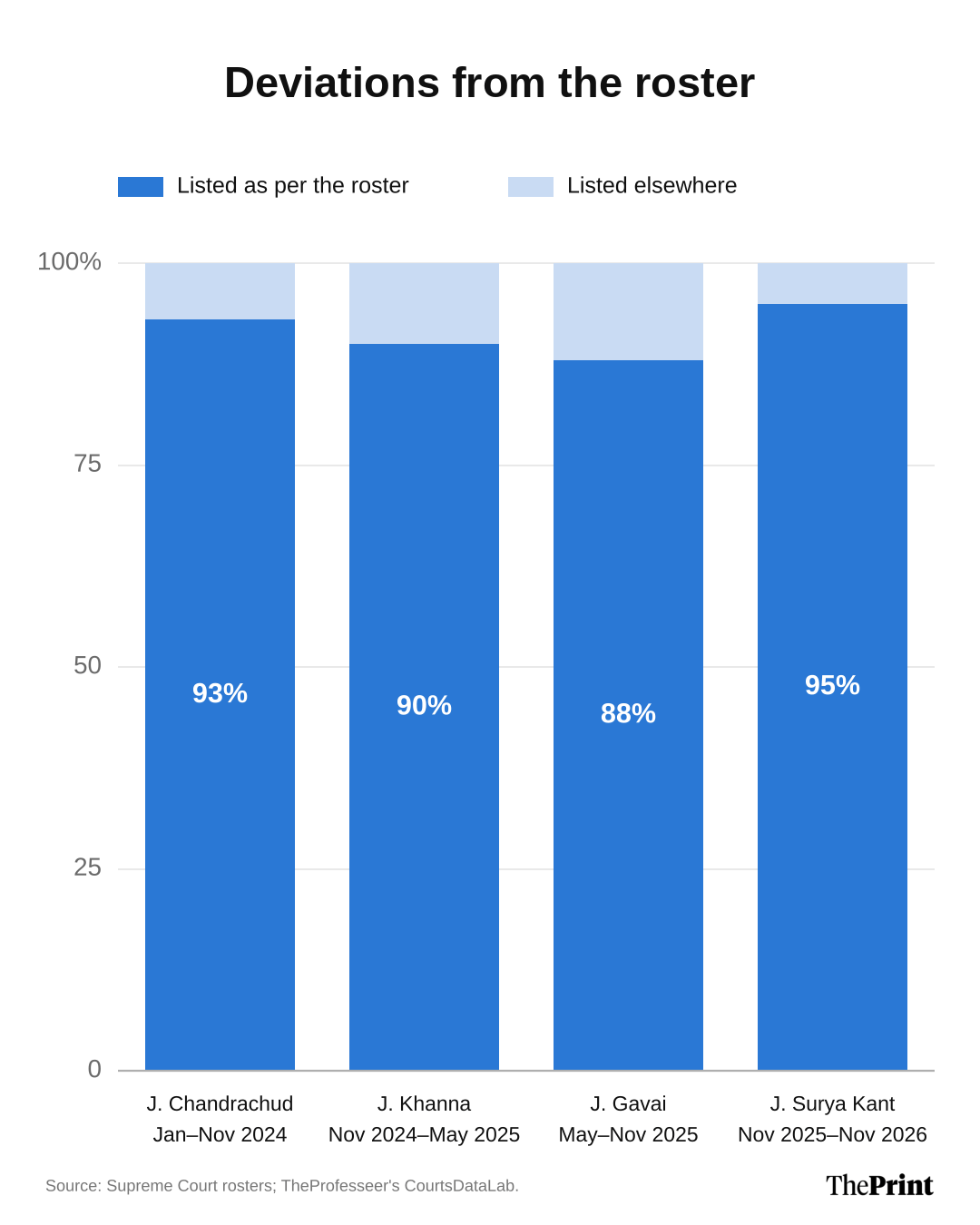
Prima facie, the court seems to stick by its roster over time, and departures genuinely seem negligible. Of course, a lawyer might argue that the unit of justice is the case, not the percentage. But these deviations, however small, are problematic. They may well be the most consequential cases sent conveniently to specific benches out of turn.
It must also be noted that over time the roster categories have become increasingly generalised and wide.
In January 2024, Supreme Court Justice Vikram Nath’s list read: “labour matters, service matters, criminal matters, family law matters, ordinary civil matters, simple money and mortgage matters, eviction under the Public Premises Act, consumer protection”.
Eight heads in all.
Today his list runs to 35, from “arbitration law” and “aviation laws/airports” to “public trust, religious endowments, waqfs”. Direct tax, once on four of 16 benches’ lists, is now on 12 of 18.
The wider the list, the easier it is to follow. This makes compliance a poor test over time. Another way to test potential arbitrariness in case allotment, then, is to look at how successive CJIs have allotted some of the most sensitive matters: grant of bail.
Also Read: Indian courts are sitting on a data goldmine. Delhi HC has a chance to tap it first
Who you get decides your odds
It is often said that India has not one Supreme Court but many, as many voices as it has judges. Unlike the US Supreme Court, where all nine judges hear every case, our 38 judges—the chief justice and 37 others—cannot. The sheer number of cases splits them into benches, mostly of two. So outcomes can vary a great deal. Nowhere is this clearer than in bail, where each case turns on its own facts.
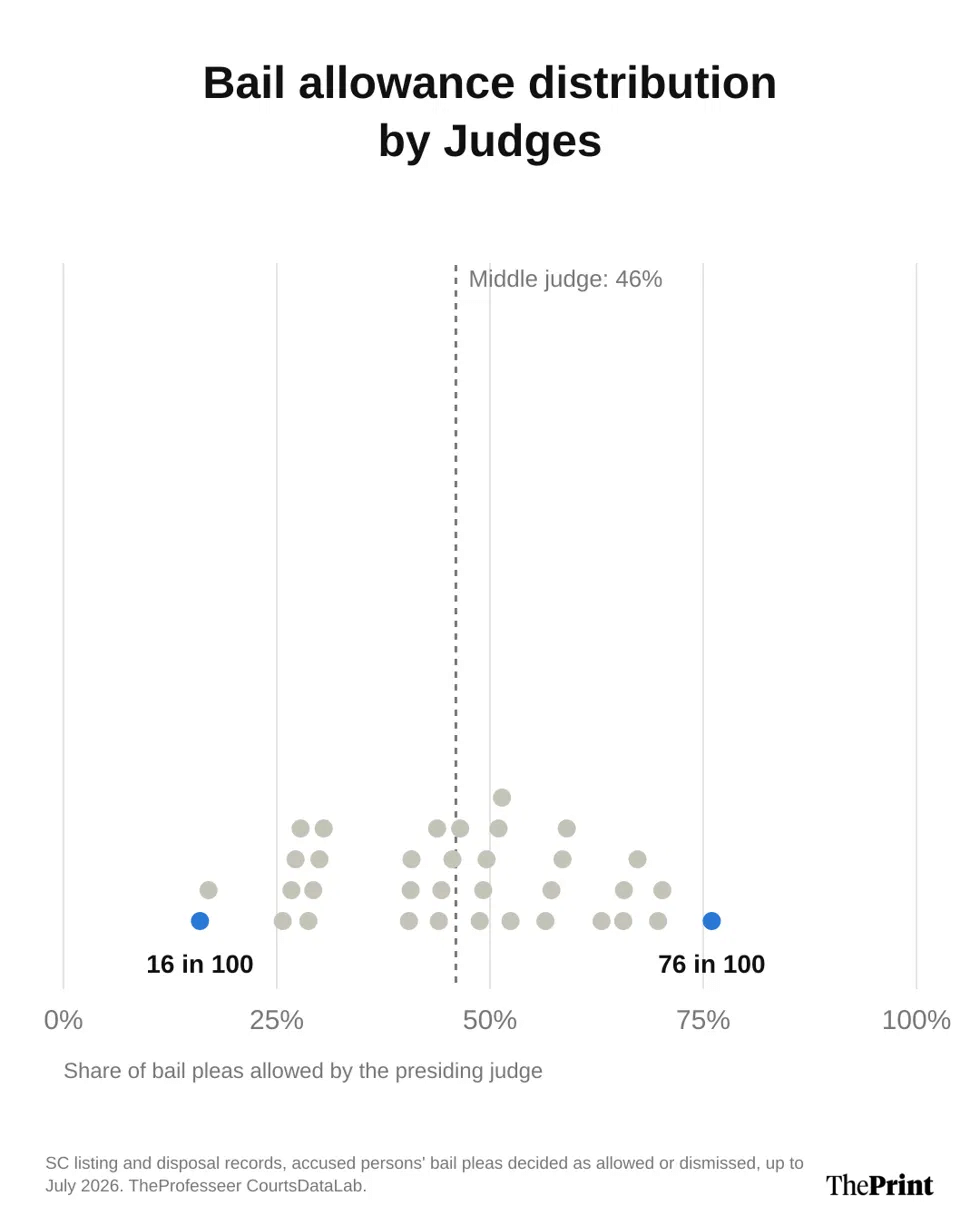
For this experiment, we took every judge who has presided over more than 100 decided bail pleas—35 judges and 27,007 pleas up to July 2026—and worked out how often each allowed bail. The presiding judge is the senior-most judge on the bench, who is named first in the Court’s list. Each dot in the figure above is one judge, left unnamed intentionally. It is striking that the same singular Supreme Court hosts judges that grant around 16 pleas in 100, and some others that grant around 76 in 100. Certainly, it would seem, which judge a case gets allotted to matters supremely.
These rates are not random either. A judge’s bail record tends to hold over time. So we asked: where did each chief justice send bail pleas?
At the start of each month, we took the judges, then sitting, who had already decided more than 100 bail pleas, and split them into four equal groups by their record so far. We then saw where that month’s bail pleas were listed, and averaged the months over each chief justice’s term.
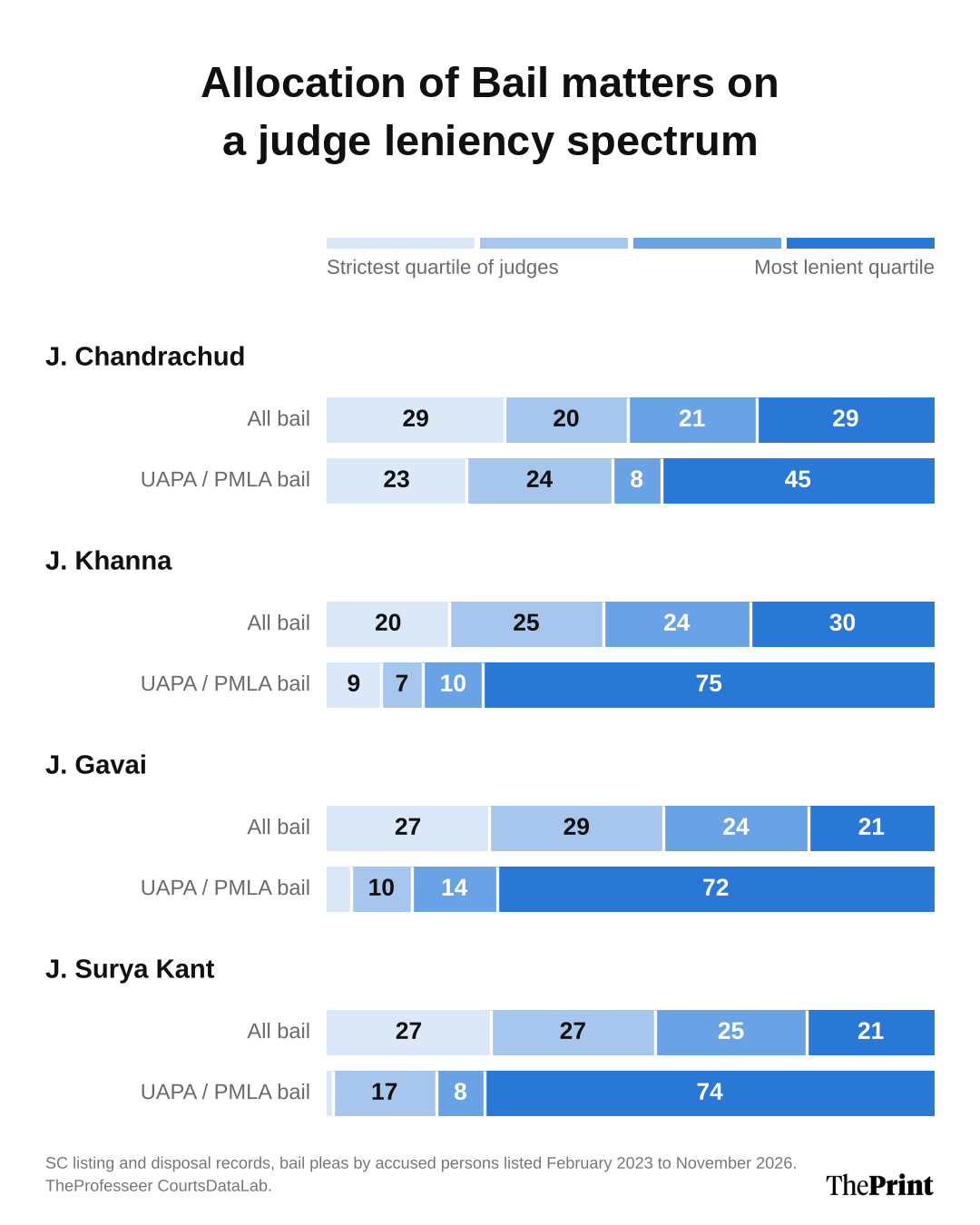
The answer is: roughly even.
Under every CJI, each group got between about 20 and 30 of every 100 bail pleas. No chief justice has stacked bail before the strictest judges, and the Court’s overall bail rate has stayed at about 47 in 100 under each.
But what about sensitive bail, under the anti-terror and money-laundering laws? Here, allocation leans strongly towards the most lenient quarter. Under Justice Chandrachud, 45 in every 100 UAPA and PMLA bail pleas went to the most lenient group of judges. Under each chief justice since, it has been more than 70.
This is, of course, not without exceptions. The bail pleas of Umar Khalid and Sharjeel Imam are often cited as cans kicked down the darkest stretch of the road.
Khalid’s 2023 appeal was listed on 15 dates before ten different pairs of judges. Justice Bela Trivedi, among the strictest judges in our data, sat on 12 of them, while the judges beside her kept changing. When the Delhi riot appeals Khalid, Imam, Gulfisha Fatima and others returned in 2025, all 17 hearings were before one presiding judge, Justice Aravind Kumar.
On average, though, whether in ordinary bail or under the stricter laws, we do not see the apex court pushing politically contentious bail towards the judges least likely to grant it. Listings that resemble Khalid’s are, statistically, the exception.
Big questions sent to larger benches
For the most politically and socially contentious questions, the Court often refers a case to a larger bench. These are a rough proxy for the most charged matters of our time: think Sabarimala, or whether the Aadhaar Act could be passed as a money bill, or if private property counts as a “material resource of the community”. Only the CJI can set up the larger bench. So he alone decides when, or whether, these questions are answered in his tenure.
An evasive master of the roster can deprioritise these matters. We tried to count the references each chief justice inherited, from Justice NV Ramana onward in August 2022, and how many they listed before a larger bench.
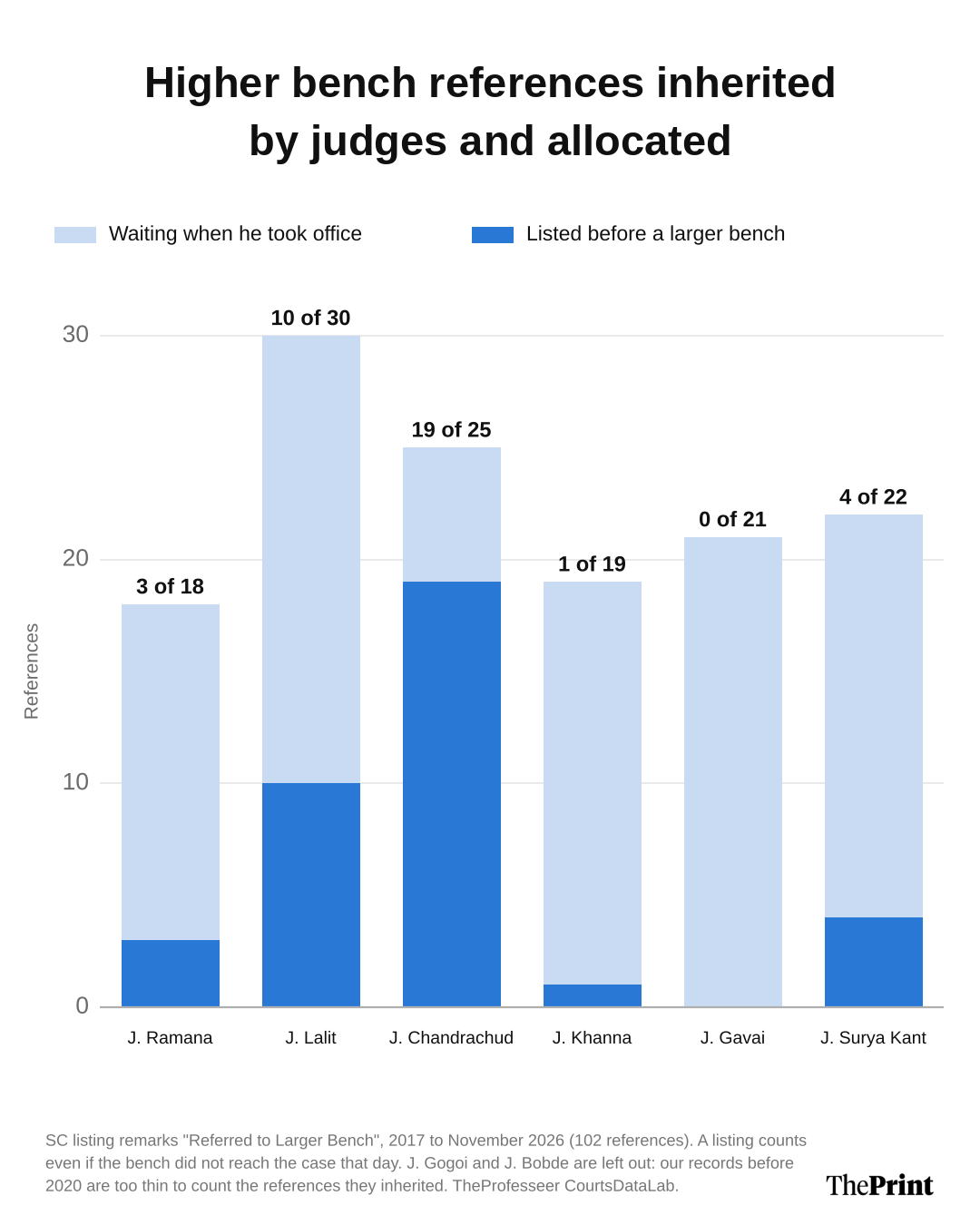
Here, we find highly variable behaviour. Justice Chandrachud’s tenure saw 19 of the 25 references waiting for him duly listed. It has dropped since: Justice Sanjiv Khanna listed one of 19, Justice BR Gavai none of 21, and Justice Surya Kant four of 22 so far. Justices Khanna and Gavai had short terms, about six months each, and Justice Surya Kant has a few months left of his near 15-month tenure. Yet, it is remarkable that Justice UU Lalit, who hardly had three months, listed 10 of 30 such matters.
What stands out is that for these “hot potato” constitutional questions, listing is more a function of the chief justice’s preference than urgency.
Also Read: India’s courts have a distance problem. Justice shouldn’t depend on your postcode
Why leave it to doubt?
Simple statistical analysis does not allow us to conclude that chief justices bias outcomes at large.
The master of the roster is neither the tyrant that popular anecdotes make him out to be, nor a clerk following a timetable.
Cases listed outside the roster seem very few, but it is certainly worrying that rosters are vague and broad enough to render them almost meaningless. Bail matters seem to be uniformly allotted, and the stricter ones given to more lenient judges. While constitutional benches may be constituted erratically, the overall problems of the roster master’s discretion may be overstated. But the larger question remains: why leave this to doubt and suspicion at all?
The current system hands the CJI a power checked by nothing but his own conscience, and its choices can be read only after the fact, from patterns in the data. And this problem is hardly new.
In the 80s, after the Minerva Mills case, Justice PN Bhagwati famously protested that Chief Justice YV Chandrachud had not let the judges deliberate as they should. Similar allegations surrounded the 2018 press conference by four puisne judges of the Court against Chief Justice Dipak Misra. History seems to repeat itself over and over again—albeit in this case, retaining a surname as well.
We can learn from best practices elsewhere. Germany’s constitution requires that a case’s judge be fixed in advance by general rules, and US federal district courts assign cases by random draw. Random allocation gives litigants predictability, and it rules out the outliers that feed suspicion of targeted and selective justice.
When departures are inevitable due to conflicts or other compulsions, reasons can be recorded in writing.
Moreover, for the sake of public record and to facilitate research, the Court should host past rosters instead of archiving them without reason. Deviations of all kinds from standard operating procedure should be traceable and explainable. The Indian Supreme Court—like Caesar’s wife—should be above suspicion.
Gokul K. Sunoj is the Founding Lawyer at TheProfesseer. He tweets @GokulSunoj. Siddarth Raman is co-founder and CTO at The Professeer. Views are personal.
(Edited by Insha Jalil Waziri)