





Automotive sales are booming in India, but there is one segment that is growing faster than every other—vehicles powered by Compressed Natural Gas (CNG). It is not just commercial vehicles and taxis that run on CNG anymore. Nope. A spate of launches in the past few weeks has made it very clear that CNG vehicles are now moving up the value chain.
Let us look at some numbers. In Financial Year 2020 (FY20) data from the Society of Indian Automobile Manufacturers pegged CNG’s market share at just 6.3 per cent. At the close of FY26, that number stood at 21.98 percent.
CNG today is the second-highest ‘fuel option’ chosen by Indian car buyers after pure petrol vehicles. There is a little misnomer here though, which I should clarify. CNG vehicles are ‘bi-fuel’—they run on both CNG and petrol, so the fear of running short of gas does not fill owners with dread.
Ignored sibling of fuels
The government has been pushing for more CNG sales as well, as gas-powered vehicles are generally considered cleaner. Mahindra recently revealed that the total number of CNG stations in January 2026 stood at around 9,026 across India, Maharashtra and Uttar Pradesh leading with over 1,300 each, although Delhi-NCT itself had 459 CNG filling stations. And it is expected that by 2032, the overall number will double, led by states such as Madhya Pradesh and Tamil Nadu.
The main reason for CNG’s popularity is the extremely low running cost for CNG vehicles. A gas efficiency of between 25-30 kilometres per kilogram, and CNG prices hovering around Rs 87-88, amounts to a running cost of Rs 3 per kilometer on smaller vehicles and Rs 4 per kilometre for larger SUVs that come with factory-fitted CNG options. Compare that to a smaller hatchback running on petrol; costing Rs 102-110/litre across India. Even with the most economical driving, it would cost around Rs 6.50-5.50 per kilomtere. On larger SUVs this could go upwards of Rs 10 per kilometre.
Even with the additional cost of around Rs 50,000 for a CNG vehicle, the savings on running costs meant that private car owners driving 1,000 kilometres a month could recoup the extra expense in as little as a year. For taxi drivers, CNG was a godsend, even if it meant sacrificing almost all the boot space in smaller vehicles.
But, when it comes to performance in particular, CNG has played the role of the ignored younger sibling.
The operating cost math is brilliant but driving a CNG vehicle does not put a smile on your face. A lot of this has to do with the energy density of natural gas compared to petrol and the fact that CNG vehicles usually run a lot hotter. However, that said, they have improved over the years.
I recently drove the Maruti-Suzuki Dzire CNG with Maruti’s ‘Auto Gear Shift’ and it felt perfectly decent to drive in the city. Nothing spectacular, but an automatic option does make it a lot easier in urban situations. The new Tata Aeris CNG with an automatic also provides for a smooth driving experience, although the lack of power did often come through when I needed some ‘get up and go’.
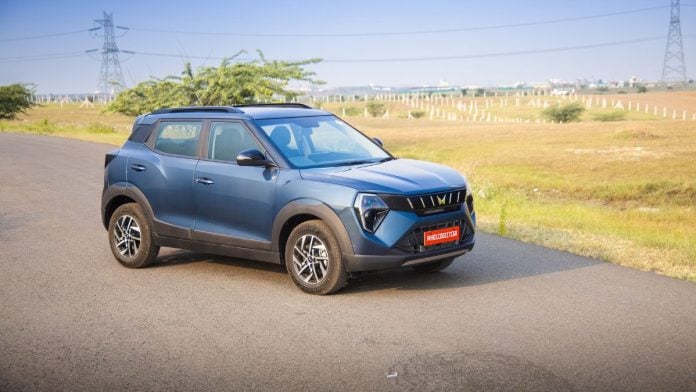
This past week, though, I drove a vehicle that changed my perception of CNG cars: the Mahindra 3XO ZNG, the manufacturer’s first foray into the CNG segment. Maruti Suzuki dominates the segment with a 70 per cent market share, while Tata Motors accounts for most of the remainder.
Mahindra says the ‘Z’ stands for ‘Zero Compromise’. To illustrate this, the company points to the fact that the 3XO ZNG uses the same 1.2-litre, three-cylinder, multi-point fuel-injection (MPFi) engine as the petrol-powered 3XO.
The surprise? Mahindra claims that no matter which fuel the car is running on, gas or petrol, the power output remains the same at 82 kilowatts (114PS). They achieve this by having the gas injected into the cylinders at extremely high pressures. To complement the power output, Mahindra has also tuned the 3XO ZNG’s suspension to improve handling.
Also read: India wants more cars, buses, 2-wheelers. Manufacturers are struggling to catch up
CNG vs EVs
I found myself on a grey Gurugram at a small karting track and out there I got a chance to put this vehicle through its paces. And it was quite fun. It certainly doesn’t feel like a CNG vehicle. The instant acceleration and the fact that I could drive through a short Gymkhana course quickly without wondering where the power went was quite impressive. Again, this is an inexpensive CNG vehicle with ex-showroom prices starting at Rs 9.99 lakh and going up to Rs 12.29 lakh.
Mahindra has figured out that their passenger vehicle is late to the CNG party (you can get CNG variants of the Bolero Pick-Up) and that they need to stand out, and this vehicle certainly does. A point to be noted though is that I barely drove it for too long and I am sure that driving ‘enthusiastically’ does take a toll on the gas efficiency. But with a certified figure of 24.7 kilometres per kilogram of gas, the 3XO ZNG has a 60-litre twin-tank, which ought to be good enough for 8-10 kilograms of CNG at normal pressure. It should easily manage 200-225 kilometers on a full gas tank if you drive normally.
Sure, an electric vehicle is even cheaper to run than a CNG vehicle. Indeed, Mahindra also offers an EV version of the 3XO, which joins the Tata Nexon as vehicles offering all possible drivetrain options (Petrol, Diesel, CNG and Electric) but as I have written before, EVs aren’t for everyone. And the queues at CNG filling stations particularly in Delhi? Well, they are reducing and for private vehicle owners, there are CNG stations out there off the main roads that see far less commercial vehicle traffic. Or you could fill up at off-peak times.
While Tata does offer a Turbo variant on the Nexon iCNG, I hope they and other manufacturers take a lead from this vehicle and offer ‘fun’ variants of CNG cars too. Because CNG vehicles are mainstream and people should really have a chance to have some fun occasionally.
Kushan Mitra is an automotive journalist based in New Delhi. He tweets @kushanmitra. Views are personal.
(Edited by Ratan Priya)