






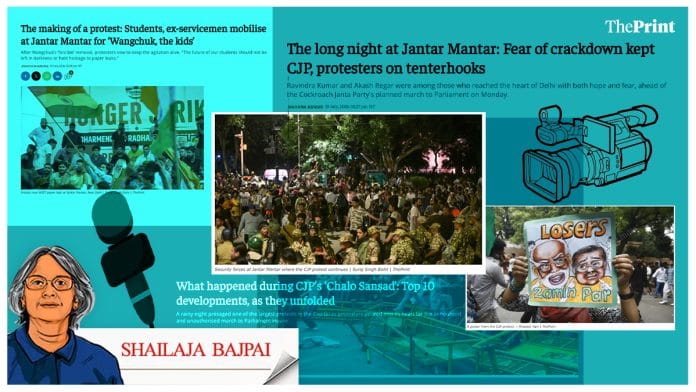


How do you cover and report a protest that began with a few hundred people and swelled to more than 45,000 six weeks later?
That’s what happened with the protest launched by Cockroach Janta Party on 6 June when its founder Abhijeet Dipke landed in Delhi. The movement exploded on 20 July with Delhi Police using tear gas, lathi charges, and the Rapid Action Force firing pellet guns, to control the mass of people marching towards Parliament, some pelting stones.
Well, as a reporter, you go where the protest goes and try to capture its ebb and flow.
Which is precisely what ThePrint tried to do over the last month. Journalists reported from Jantar Mantar, the site of the protest against the examination paper leaks. As it gained momentum, they went there and stayed day after day, having never seen anything like it before.
At no stage did they know what to expect, but it certianly wasn’t a “picnic”.
That is how Praveen Jain, National Photo Editor, and Suraj Singh Bisht, Principal Photojournalist, described the scenes they witnessed at Jantar Mantar and the surrounding streets where the protesters spread out.
“There was outrage against the government, but there was also a lot of enjoyment. Pizzas were being ordered, they were singing and dancing…In my 45-year career, I have covered many protests but I’ve never before encountered such passion,” Praveen said. “It was unique.”
Suraj, who had followed protesters down Delhi’s Sansad Marg during the march to Parliament that Monday morning, said it looked like a “picnic spot”. “There were food stalls—bhel puri, ice-cream vendors, small shops…”
Five things that made this protest different
ThePrint’s team of eight to ten reporters, video journalists and photo journalists who covered the protests agreed that there were five standout factors that made this protest different from anything they had experienced before.
These were: first, that the protest was “massive”. It’s a word several reporters used to describe the crowds, which simply grew and grew around them.
Second, the police action that followed was excessive. “The police miscalculated,” said Ananya Bhardwaj, Senior Associate Editor, who led ThePrint’s reporting team during those heady days. “They were outnumbered, they panicked and reacted in an unprofessional manner,” she added.
In several stories, Mayank Kumar, Special Correspondent, recounted the encounters – and the use of pellet guns. “There was no stopping the crowds, I feared there would be a stampede,” said Mayank, who was with the protesters on 20 July.
Third, it was “organic”. The reporters encountered people from all over India, varying backgrounds and age groups. People had come from faraway places –villages and cities in Madhya Pradesh, Rajasthan, Bihar, and Jharkhand. There were children from Chhapra, Bihar; a subedar from Kota; a 71-year-old man; a visually-challenged student; and people from Manipur.
Fourth, this protest may have begun as a CJP-led demonstration against exam leaks and demanding the resignation of Union Education Minister Dharmendra Pradhan, but it soon became a place where people with grievances against the government came forward.
“It was an umbrella for all complaints,” said Mayank Kumar.
“It was no longer just about CJP and exams,” said Alisha Dutta, Principal Correspondent. “This was a place where people came to express themselves. The anger was directed towards PM Modi and issues such as unemployment.”
Lastly, the reporting team realised that this was not just a street battle. After spending days and some nights at the protests between Saturday, 18 July, when social activist Sonam Wangchuk was removed from Jantar Mantar by Delhi Police, and 25 July, when Pradhan resigned, they learnt that this was being fought digitally, too.
The protesters put out a constant stream of short videos, reels, posts from social influencers like Ahir in Mumbai, who stood in front of a police van transporting protesters, innovative memes, and plenty of humour.
“It was a new kind of resistance,” explained Manisha Mondal, Senior Multimedia Journalist. “Gen Z is a performance generation. They used social media, humour, parodies on Instagram, and instant reels of latest developments. If there was an encounter with a policeman, it was filmed and released immediately. People dressed up as Spiderman or Batman—who would have thought of Spiderman as the face of a demonstration?” asked Manisha.
Also read: Eight journalists, four states and 1 UT—how ThePrint covered 2026 Assembly elections
‘I will never forget it’
Surprise at the size of the protest, the energy of the crowds, and the general air of festivity made this assignment special for the reporters on the ground.
Most of all, they remember it for the police action.
Barring Praveen Jain, Ananya Bhardwaj and Mayank Kumar, the reporters were young and hadn’t reported on such a powerful protest before—some had never reported on a protest at all.
“I will never forget it. This was my first experience of a lathi-charge and tear gas,” said Saqiba Khan, video journalist. “When they were using tear gas on the students, I tried to capture it on camera, but I couldn’t stop my hands from shaking,” she added.
Once she steadied her nerves, she went on to shoot videos showing the scenes.
For Samridhi Tewari, Special Correspondent, this was her first major protest. The same was true for Alisha Dutta.
“I did try to keep my distance and report the facts faithfully,” said Samridhi. “I stayed through Monday night after the march to Parliament, and so many people told me… it had become like a family.”
The moment that will “stay” with her was an encounter with two school students during her visit to the Bangla Sahib Gurdwara on 21 July. Many protesters had taken shelter there.
“The kids were in Classes 8 and 9. They were from Chhapra in Bihar. One was injured in the march. They said they had left school—“Until we get justice, we won’t go back,” they told me. I stopped writing—I couldn’t do anything. I tried to understand what had made them come all the way to Delhi,” she said.
Nikitha Saxena, a young intern and an alumna of ThePrint School of Journalism, spent several nights at the protest, with her camera.
“The camera changed how people responded to me. Some were suspicious and associated the media with the state, while others shared their stories with honesty. A few men crossed boundaries or behaved in ways that made me uncomfortable. But I navigated those moments,” said Nikitha.
For the more senior reporters, who had covered several protests and violent encounters, such as Mayank Kumar, this was among the “most exciting” assignments he had witnessed. It gave him a lot of “professional satisfaction”. “Normally, I report on crimes or the investigative agencies and base my reports on their inputs. But here, I could report what I saw,” he explained.
During the Nirbhaya rape and murder case agitation at India Gate in 2012, Ananya was an intern at The Indian Express.
“I haven’t seen anything like that until now,” she said. “I met children, grandparents, entire families…”
Also read: ThePrint coverage of AI Summit went beyond goof-ups and shirtless protest
Reporting a protest in real time
The Jantar Mantar protests began on 6 June when Dipke returned from the US to launch the stir. ThePrint reported on his arrival and the rather quiet beginning of the protest.
“We had five reporters out there on 6 June,” said Janki Dave, Editor (Operations), who oversaw all the coverage. These included Manisha Mondal, Mayank Kumar and Samridhi, who said that on that day and the ones that followed, there were only a couple of hundred people there.
More stories followed once social activist Sonam Wangchuk joined the protest on 28 June and went on a hunger strike along with some students.
Ananya had visited the site several times, and on Friday, 17 July, she met Wangchuk, who was too weak to speak. She was also there the next morning, when he was unceremoniously removed by Delhi Police and admitted to Safdarjung Hospital.
It was Saturday, 18 July, two days before the march to Parliament and the subsequent violence.
“Wangchuk’s removal, and the way it was done, angered many people, and by Sunday we saw thousands more joining the protest,” said Ananya.
Suraj Bisht took a photograph of Dipke crying after Wangchuk’s removal. It got 78,600 likes and 4.4 million views on Instagram.
Ananya told her entire team of reporters to be at Jantar Mantar. They did so it in shifts.
“We ensured there was always one reporter and one video journalist at the site around the clock,” added Janki Dave.
For the journalists, the obligation to report clearly and credibly what they saw and experienced was a challenge, for several reasons. The most immediate was the internet blackout at Jantar Mantar and its adjoining areas. Only messaging on the mobile phones was possible.
“We ended up typing our stories in messages, line by line, and sending them to Ananya,” said Alisha.
The alternative was to return to ThePrint office, which was fortunately not far away on Bahadur Shah Zafar Marg, and write the stories from there.
At the office, Ananya and Samridhi pulled the messages together and wrote the stories for the editing desk to quickly vet and publish.
“It was a challenge,” said Janki. “The biggest was getting the videos out on time. It was difficult to keep up.”
Janki said this was largely a “visual story”, with ground reports as the foundation. As the Reuters Institute Digital News Report on YouTube and WhatsApp (June 2026) found, Indians get their news from YouTube (58 per cent) and WhatsApp (56 per cent).
“Also, this was a youth protest, and the major audience is also young, so we had to concentrate on visual feeds from the protest,” added Janki.
Like other news organisations, ThePrint did live reporting throughout this period, with regular updates. It covered the political developments as they occurred and published 50-word edits frequently on the protests—several of which were critical of the police action.
“We didn’t shy away from taking a stand on the RAF, for instance,” said Janki. The Rapid Action Force is accused of firing pellet guns on students, who sustained serious injuries.
According to an independent study by Piyush Zarware, a student at the University of Chicago, the US, ThePrint published 102 stories on the stir—more than any other independent news website or legacy news organisation.
These stories were not always from Delhi or Jantar Mantar. There were reports from Mumbai on the protests, Rakhi Sawant’s support for the protests, and from Haryana on rapper Danda Nyoliwala’s involvement, as well as several on Gen Z’s use of memes.
The social media challenge
The other challenge? There was too much information and misinformation in the public domain. Social media, Instagram and YouTube dominated this protest.
In words and visuals, the reporters stuck to the facts, profile the protesters, and reflect their views, as well as those of the authorities, including the Delhi Police.
However, nothing can beat social media.
Ananya Bhardwaj said that the next time there’s a major protest, the approach to reporting must concentrate more on YouTube and social media—especially Instagram, with short videos and reels.
“That’s where people turn for their news and views—we will have to keep up too,” Ananya said.
Shailaja Bajpai is ThePrint’s Readers’ Editor. Please write in with your views and complaints to readers.editor@theprint.in
(Edited by Prashant Dixit)