



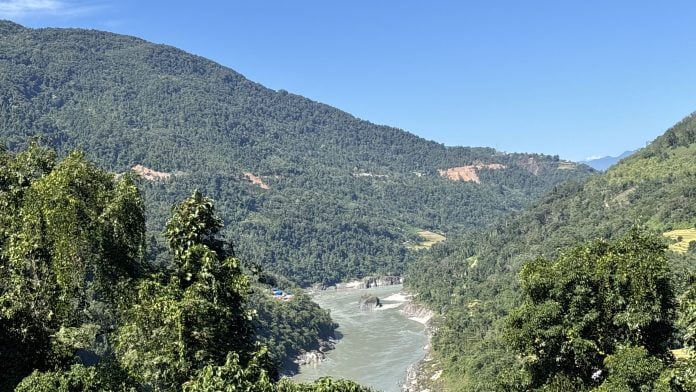
On 19 July 2025, Chinese Premier Li Qiang formally inaugurated the construction of a massive hydropower project on the lower Yarlung Tsangpo. Beijing has described it as the “project of the century”, and Chinese President Xi Jinping’s 2026 New Year message specifically mentioned the construction of the project. Commonly known as the Medog project, it is estimated that its capacity will be 60,000 MW, making it the largest of its kind in the world. The river that it will attempt to tame in Tibetan is called the Yarlung Tsangpo. In Arunachal Pradesh, it is known as the Siang before becoming the Brahmaputra in Assam.
It is true that anywhere in India a river is rarely a river and is more a part of ancestry, history and collective memory. But for the Adi communities of the Siang Valley in Arunachal Pradesh, the great river intersects their livelihood, culture and history, and expectedly any conversation of controlling its waters takes on a whole different meaning beyond engineering, electricity generation or even security.
However, what remains beyond these conversations is the uncomfortable reality that Arunachal Pradesh can no longer afford to overlook. Irrespective of what the debates are in New Delhi or Siang Valley, decisions taken upstream have the capacity to change the lives of the people of the Siang irrevocably, with serious implications for the rest of the country. For instance, the Brahmaputra basin sustains millions of people, and any significant alteration to its flow will be devastating to those who depend on the river, raising not just an environmental or development concern but also a national security one.
Preparing for future disasters
It was in a Rajya Sabha response on 21 August last year that India’s Ministry of External Affairs stated that China’s upstream activities had raised enough concerns that the matter was discussed during ministerial engagements in July and August. India had repeatedly asked for the resumption of hydrological data sharing for the Brahmaputra, which has remained suspended since 2023. Without this critical information, it would be impossible for India to create effective downstream disaster prevention, leading to strategic asymmetry. It means that India might have to bear the consequences of decisions taken in China that it has no knowledge of.
And that is why the proposed Siang Upper Multipurpose Project (SUMP) is strategically significant. It not only includes a hydropower installation but also a reservoir which could help mitigate any sudden flood surges and regulate downstream flows during dry seasons. It is reported that the storage capacity of the reservoir would be approximately 9.2 billion cubic metres, which is likely to help respond to upstream decisions. The strategic principle is foundational to upstream infrastructure manipulations by another country wherein the country that is situated downstream must enhance its operational flexibility and be able to anticipate and absorb hydrological risks reducing vulnerability. Though the scale of impact would depend on project design and operational practices, the fact that there is a lack of transparency itself will have strategic consequences. Furthermore, Arunachal Pradesh lies in a seismically active Himalayan region. The 2000 landslide-induced floods on the Siang demonstrated the vulnerabilities of the settlements. A strategic reservoir as planned could mitigate such disasters.
In the past, it was on the Mekong that Chinese upstream dams altered flow so dramatically that downstream countries now face droughts and floods out of sync with natural cycles and often without advance warning. Even though the Three Gorges Dam is built on the Yangtze and not on the Mekong River, the governance model it represents has strongly influenced how China operates its upstream Mekong dams with tangible downstream effects. The model of the Three Gorges prioritises large reservoirs and controlled releases driven by domestic needs rather than basin-wide coordination.
Additionally, in 2019-2020 it was widely reported that upstream reservoirs holding water during the wet season were the cause of unusually low water levels in the Mekong. This disrupted fisheries in Thailand, weakened the Tonlé Sap flood cycle in Cambodia, and worsened salinity intrusion in Vietnam’s delta. In August 2021, rapid daily fluctuations linked to hydropower peaking caused erosion and safety risks along stretches of the river in Thailand and Laos. Other consequences noted were sediment trapped behind dams reducing downstream sediment flow and accelerating riverbank collapse in Cambodia and Vietnam in 2010 and severe dry season stress and saltwater intrusion on the Mekong Delta shaping vulnerability.
Also read: Siang project is at the heart of India-China theatre and competing claims. It isn’t just a dam
Why PFR is crucial
There is ample evidence of China’s governance model when it comes to dams, but at the moment, the construction of SUMP is not even the immediate concern. The proposed Pre-Feasability Report (PFR), if undertaken, would help understand the terrain so that we are better prepared for future earthquakes, flash floods, and the feasibility of dam construction. It would look at rocks, soil, slopes, river flows and earthquake risks. It would require limited drilling and terrain assessment at two sites covering 3,200 sq metres, — less than the size of half a football field — and would not require any forest clearance or alteration of river flow.
Once PFR is completed, which would take about six months, public consultations would have to be undertaken over 2- 3 years. This would include social impact assessment, environmental management plan, environmental impact assessment, and forest clearances. This would be followed by the finalisation of land compensation and rehabilitation plans that would take 3-4 years. Following this, the construction of the dam would finally commence, which could take nearly 15 years to complete.
Undoubtedly, large dams themselves have risks, therefore, scientific assessment becomes unavoidable for India to weigh its options, making PFR a necessity. India needs to urgently assess its infrastructure options. With China, opacity over developments such as the Medog project will remain at the crossroads of water security, territorial security and national security.
Therefore, strengthening embankments, restoring wetlands, and managing sediment are not development schemes; they are defensive measures. But any decision can be made legally only after detailed public consultations and the successful completion of the PFR, which includes the involvement of the Gram Sabha and Panchayati Raj institutions. For Arunachal Pradesh and the people of the Siang Valley, it is important to reconcile these two legitimate imperatives: the protection of their culture and ecological integrity, and the future not just of their people but also of the millions who depend on their decisions for their own security and future. And a good starting point may be helping collect the scientific data that will determine what comes next.
Rami Niranjan Desai is a Distinguished Fellow at the India Foundation, New Delhi. She tweets @ramindesai. Views are personal.
(Edited by Aamaan Alam Khan)