


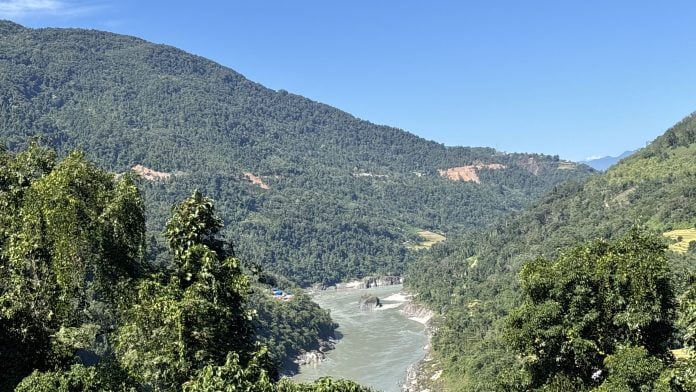
Upper Siang: From a highway blockade to arson at the NHPC (National Hydroelectric Power Corporation Limited) office and attacks on police property, the violence in Arunachal Pradesh’s Pasighat two weeks ago laid bare the widening gulf between the Centre’s strategic ambitions and on-ground resistance to the Siang Upper Multipurpose Project–a dam that New Delhi sees as a strategic bulwark against China’s growing presence upstream on the Brahmaputra.
Late on 23 October, hours after a largely peaceful 12-hour bandh against the proposed Siang dam ended, violence broke out in Pasighat, approximately 260 to 270 KM from capital Itanagar. According to officials, some protesters blocked a highway and the police fired tear gas to disperse them. The situation escalated soon after and the NHPC office, the Pasighat police station and seven to eight police vehicles were were allegedly set on fire.
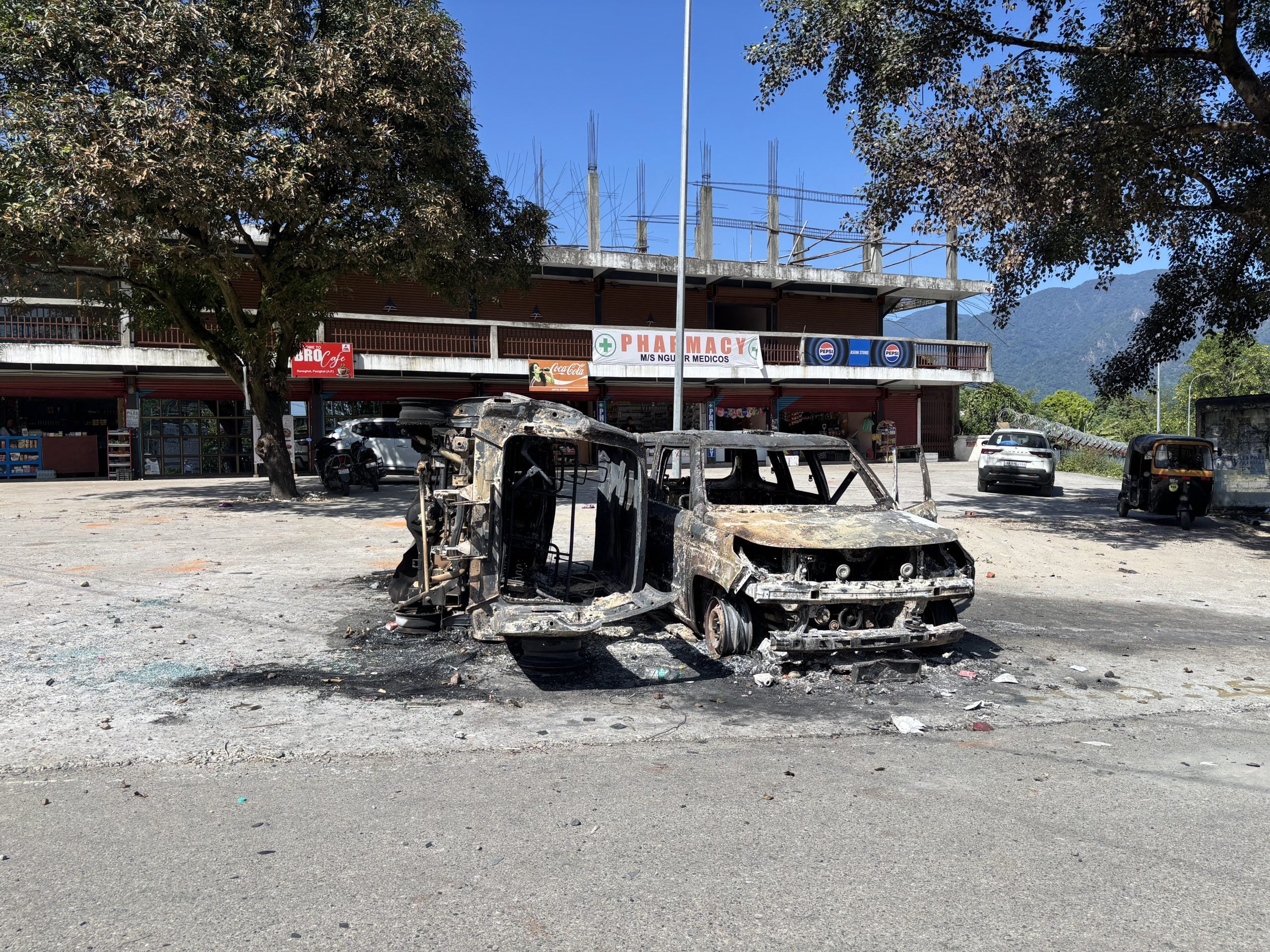
The violence brought into focus a growing conflict in Arunachal Pradesh, where the state government is struggling to push ahead with a project that New Delhi increasingly views as important to countering China’s growing presence upstream on the Brahmaputra.
In the Siang valley, nearly every conversation about the proposed dam eventually arrives at the same word: China. At shops in Pasighat, in the offices of local representatives in Yingkiong, and outside the heavily guarded NHPC office, officials, politicians and security personnel repeat versions of the same argument: China is building upstream; India cannot afford to do nothing.
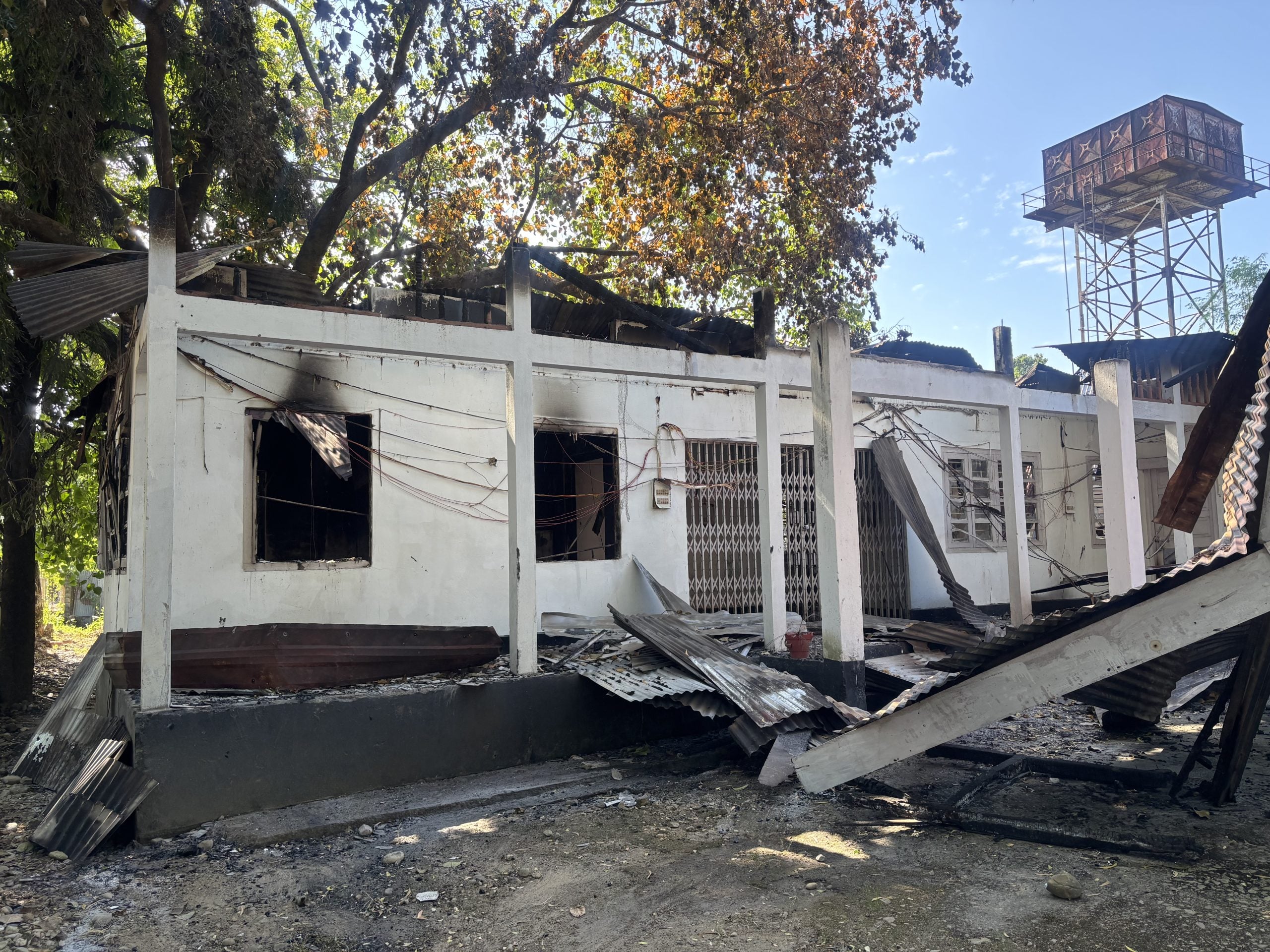
But the argument has also raised questions among residents about why their land and river should bear the cost of a project being presented as a national security necessity.
“This project was announced in December 2024 officially by the government of China without any prior consultation with us and lower riparians, or even prior information,” said Ashok Kantha, former Indian ambassador to China, referring to Beijing’s proposed hydropower project on the Yarlung Tsangpo in Tibet.
China’s project, near the Great Bend of the river, broke ground in July 2025. Five cascading hydropower stations are planned along roughly 50 kilometres of gorge, where the river drops about 2,000 metres. Its proposed capacity is 60,000 MW, around three times that of the Three Gorges Dam.
The Yarlung Tsangpo enters India in Arunachal Pradesh, where it is known as the Siang, before flowing into Assam as the Brahmaputra.
For India, the concern is what a project of this scale upstream could mean for the timing and volume of water reaching downstream areas.
Against this backdrop, New Delhi has renewed its focus on the proposed 11,200 MW Siang Upper Multipurpose Project (SUMP). First proposed by the Brahmaputra Board in 1982–83 and declared a national project in 2008, the project has been discussed for decades.
But China’s plans upstream have given it a new urgency and a sharper strategic dimension.
Intended to generate electricity, store water, regulate river flows and moderate floods, SUMP would also give India a large reservoir on its stretch of the river, with a reported live storage capacity of about 9.2 billion cubic metres.
For New Delhi, the project is therefore about more than harnessing the Siang’s hydropower potential. It is also about establishing India’s ability to build major infrastructure on a river that originates in Chinese-controlled Tibet and flows through a strategically sensitive border region.
The Siang project sits at the intersection of competing priorities. New Delhi sees it as a way to strengthen India’s position in a river system increasingly shaped by China’s upstream plans. For the Adi community, however, the Siang is tied to ancestral land, livelihoods and identity, not simply water or power. The BJP government in Arunachal Pradesh faces a challenge of its own: persuading residents that the project has been properly explained and that their concerns will be heard.
While some experts argue that India has little time to lose in responding to China’s growing infrastructure presence, others warn against turning the fragile Himalayas into a theatre of competing mega-dams. The villagers, meanwhile, say they are asking for something more basic: a conversation.
China’s upstream advantage and India’s diplomatic blind spot
“If we do not build, what message does that send?” a senior official involved in the process said, asking not to be named.
But India’s ability to respond to developments upstream is constrained by an uncomfortable fact: New Delhi has limited control over what happens in Tibet and little clarity about how Beijing intends to operate its proposed project.
Kantha points to three gaps in India’s engagement with China on transboundary rivers: the absence of meaningful cooperation, Beijing’s decision to announce the Medog project without consulting downstream countries, and the limited information available about how the dam will be built and operated.
India and China do not have a comprehensive, legally binding treaty governing the sharing or management of the Yarlung Tsangpo-Brahmaputra waters. Their cooperation has instead rested on limited memoranda of understanding, chiefly for sharing hydrological data during the flood season.
The two countries have signed three MoUs—two for sharing wet-season hydrological data on the Yarlung Tsangpo-Brahmaputra and the Sutlej, and a third on cooperation on transboundary rivers. But these arrangements have not translated into sustained cooperation, Kantha said.
“When we had problems in Doklam, they suspended providing data and allowed MoUs to lapse. MoUs have not been revived yet,” he said.
“When we had problems in Doklam, they suspended providing data and allowed MoUs to lapse. MoUs have not been revived yet,” he said.
NHPC, which is conducting the PFR for SUMP, says most preliminary work—including topographical surveys, geological observations and geophysical tests—has been completed. What remains is core drilling at three shortlisted sites near Parong, Dite Dime and Ugeng, which the company says is necessary to examine rock characteristics up to 200 metres and finalise the dam location.
Amarnath Jha, general manager at NHPC, told ThePrint that drilling has not begun because of local opposition. “Till the condition is not good, survey work cannot be done. We are waiting for that,” he said. He said the drilling would take three to four months, with four boreholes planned at each site.
Until the drilling is completed, NHPC says it cannot finalise the dam site or assess the full extent of submergence and displacement.
Diplomatic engagement has also yielded little progress, in his assessment. Kantha pointed to the readouts from the last three meetings of the India-China Special Representatives, arguing that they largely repeated the same language. A meeting of the mechanism set up to discuss transboundary rivers, which was expected in September, also did not appear to have taken place.
“Just go through the readouts coming from the last three meetings of Special Representatives. You’ll realise that we are not making any progress,” he said. “Even on sharing of hydrological data, let alone anything else, we are not making any progress.”
The information gap matters because the proposed Medog project is barely 50 kilometres from the point where the Yarlung Tsangpo enters India. Kantha said Beijing had not shared sufficient details of its technical specifications or operating procedures with downstream countries. He argued that China, as the upper riparian, has a responsibility to ensure its projects do not harm communities and countries downstream.
He pointed to the Mekong, where China’s upstream hydropower projects have had what he described as a “fairly deleterious impact” on the lower delta and countries along the river.
“They must share all the data because this project is barely 50 kilometres from the place where the Yarlung Tsangpo enters India and becomes the Siang river, and then it becomes part of the Brahmaputra river system,” he said.
For Kantha, the lack of transparency strengthens the case for India to pursue its own storage infrastructure downstream. But the proposed reservoir also raises a question about how much protection it can actually offer if China changes the timing or volume of water released upstream.
A strategic signal
On the ground in Upper Siang, Siang and East Siang, the argument that SUMP is India’s answer to China’s project is met with a question of its own.
“If China is building 60,000 MW, how will our 11,200 MW counter it?” is a question raised by residents and others in the valley.
The question points to a central tension in India’s case for SUMP. The project is often presented as an answer to China’s Medog dam, but its origins predate the current confrontation over the Yarlung Tsangpo.
The Brahmaputra Board first proposed harnessing the Siang in 1982–83, and India declared the then-9,500 MW Upper Siang project a national project in 2008. The present 11,200 MW SUMP is the latest version of that long-running proposal.
What has changed is the strategic context
Mirza Zulfiqur Rahman, a researcher on the Brahmaputra River Basin, said India’s decision to pursue SUMP also carries the value of strategic signalling. Even if the project is never built, he argued, taking it forward signals that India is prepared to develop major infrastructure on its side of the river.
“Even if they end up making the Siang Upper Multipurpose Project or not, the very intent of going ahead and building it itself is a signalling,” he said.
The distinction matters because SUMP remains at an early stage. The pre-feasibility exercise is incomplete, the final dam site has not been identified, and several assessments and approvals would be required before construction could begin. Its electricity-generating potential therefore remains a distant prospect.
“Hydropower potential is a bit far out in the horizon,” Rahman said.
The strategic message, however, is more immediate. The project signals India’s intention to develop major infrastructure in a region sensitive to the India-China boundary dispute.
Sana Hashmi, an expert on India-China relations, said infrastructure development in Arunachal Pradesh also carries a territorial message. China claims the state as part of what it calls South Tibet, and development in border areas can help India strengthen its presence and connect these regions more closely with the rest of the country.
“The more development is there, the more consolidated your claim becomes,” she said.
Hashmi said Chinese commentary has linked India’s military presence in Arunachal Pradesh, the renaming of places in the state, China’s Medog project and the protests against SUMP to question New Delhi’s position in the region. Some Chinese articles have portrayed the protests as evidence that people in Arunachal Pradesh are unhappy with the Indian government and that their welfare and environmental concerns are being neglected.
“They are highlighting on the people part. The people are protesting and people in Arunachal Pradesh are not happy with the Indian government,” she said.
She added that Chinese commentary presents Beijing’s infrastructure projects in Tibet as beneficial to local communities, while using opposition to SUMP to question India’s own development plans.
But the strategic rationale for the Indian project raises a more difficult question: whether building a dam downstream can meaningfully protect India’s interests against decisions taken upstream.
The Indian government has cited water security and the possibility of establishing first user rights among the reasons for pursuing the project. Rahman, however, questioned how such rights could be enforced in the absence of a bilateral water-sharing agreement or a binding framework between the two countries.
“Even if you establish first user rights, where do you enforce them?” he asked.
A reservoir in Arunachal Pradesh, Rahman cautioned, cannot by itself guarantee protection against changes in the quantity or timing of water flowing into India.
Hashmi, meanwhile, said water had remained an understudied dimension of India-China relations, with attention traditionally focused on military and boundary disputes.
“It is just not about the border. It is just not about the military aspect of it,” she said. “Water is absolutely one of the major areas of contention.”
The national security argument meets local resistance
In the villages of the Siang valley, residents say they are tired of being told that their concerns are somehow “pro-China”.
“We are not against development, we can even consider the dam if there is a proper two way conversation around it,” Nobung Boreng, the president of the Siang Indigenous Farmers Forum (SIFF), said before entering a community hall in Geku where dam-affected villagers had gathered to discuss the project.
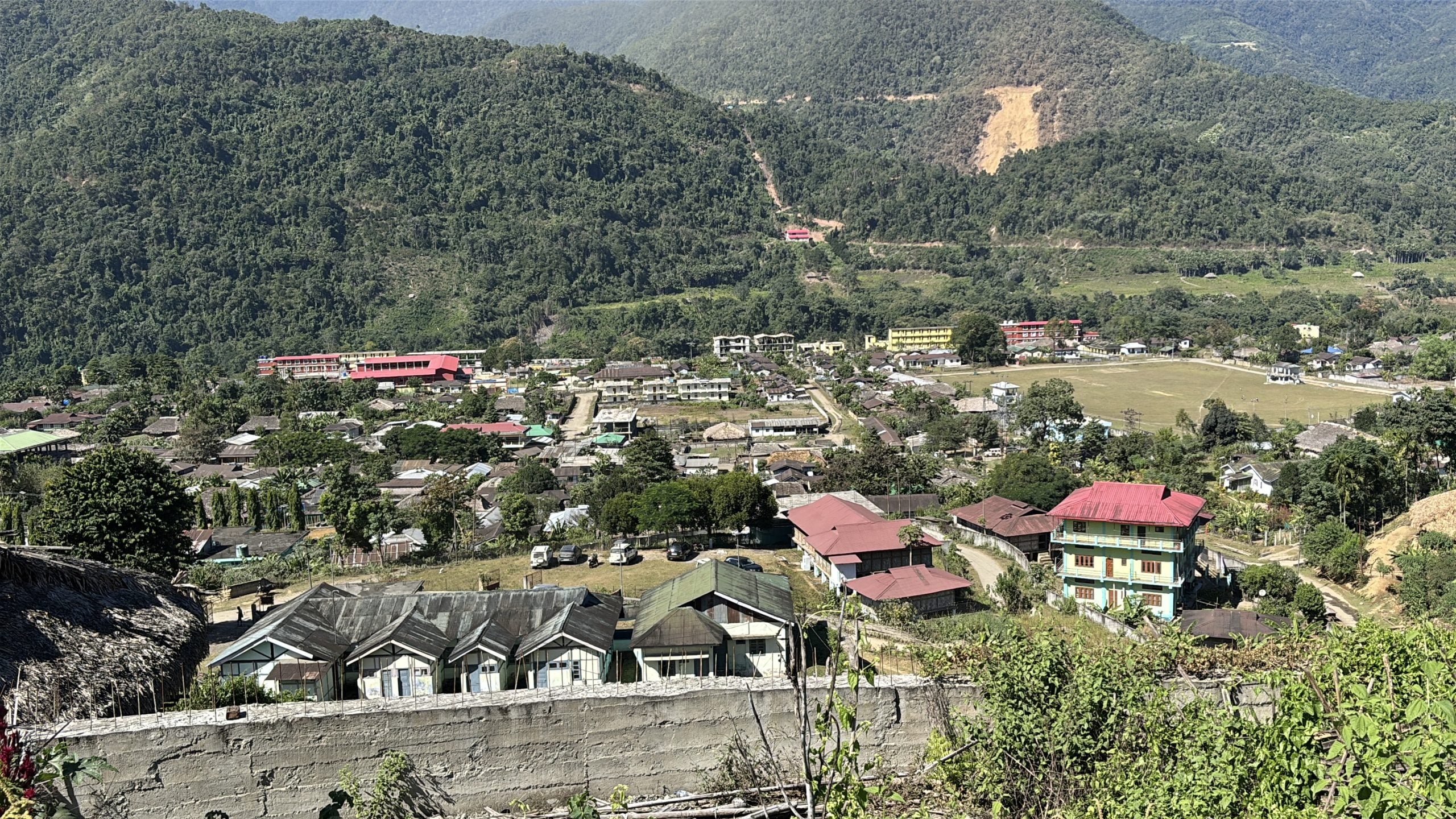
“We are asking about our land. Why is that being treated as anti-national?”
The mood along the Siang has hardened into open opposition. Villages have held protests and bandhs, blocked roads and refused to allow survey teams to enter their land. Several residents and community activists have been detained, while the deployment of security forces has deepened distrust rather than eased it.
For many villagers, the issue is no longer simply whether they support or oppose a dam. They say they will not consent even to the pre-feasibility report, let alone the project, until the detentions are cancelled and the large deployment of forces in the area is withdrawn.
At the centre of the resistance is the Adi community, one of the largest tribes in Arunachal Pradesh. For the Adi, the Siang is not merely a river or a potential source of electricity; it is tied to ancestral land, livelihoods, memory and identity. Community organisations say the state is asking them to accept a process whose consequences they cannot fully assess, while offering too little assurance about land, displacement and long-term benefits.
Chief Minister Pema Khandu has sought to reassure communities that the government is not seeking approval for construction at this stage.
“Let me be clear. We are not talking about dam construction at this stage,” he said in an open letter, adding that the government was considering only a pre-feasibility report (PFR) to assess the project’s viability and potential implications.
He maintained that preparing the PFR would not amount to granting approval for construction.
“I want to assure you that your voices, your land, your homes and our beloved ‘Aane Siang’ remain at the heart of every consideration. Your concerns will be addressed through open dialogue, transparency and meaningful public consultation,” he said.
The chief minister said the project, declared a national project in 2008, gained strategic significance following China’s commencement of construction of its massive hydropower project on the Yarlung Tsangpo in Tibet in July 2025.
But SIFF and other community organisations have refused to hold peaceful talks until the detentions are cancelled and the large deployment of forces in the area is withdrawn.
The disagreement is also visible among local political representatives.
Alo Libang, the MLA from Tuting-Yingkiong, said the project could bring much-needed infrastructure and economic opportunities to a region where people had long waited for development.
“As a representative of the people, I want to look for their benefits as well,” he said. “If I want something from you, I have to work with you and not forcefully.”
Libang said the region’s development needs had moved from livelihood support to upgrading infrastructure, and that these activities needed to be taken forward faster. Younger people, he said, wanted better opportunities and the ability to work comfortably in their own region. He felt some residents were being misled into believing that the project would not benefit them.
But he also acknowledged that the government had failed to handle the process properly. People from outside the region arriving without informing local representatives had fuelled panic, he said.
“The planning of the government is not good, considering this is the biggest national project,” he said, warning that any attempt to push it through forcefully could make the situation worse.
Libang said misinformation was also circulating about how India’s proposed 11,200 MW project could counter China’s 60,000 MW project. He said this reflected a misunderstanding of the purpose and scale of the projects, which were being discussed in terms of their electricity-generating capacity.
For some local representatives, China’s upstream project makes SUMP more urgent. They argue that opposition to the Indian project could weaken the country’s position in a sensitive border region. But this argument has not persuaded all those who stand to be affected by the dam.
Katon Moyong, a representative of the youth wing of SIFF, told ThePrint that invoking China to justify the project risked turning local opposition into a national security issue.
“The government needs to stop pushing us. If it doesn’t, China will take advantage of the situation. And that won’t be good for Arunachal Pradesh or our country,” Moyong said. “From the 1980s to 2025, there was no national security threat. Now the narrative is being changed to weaken our opposition.”
The risks of a Himalayan dam-building race
The strategic case for SUMP is being made even as researchers warn against treating the Himalayas as a testing ground for competing mega-projects. Their concerns extend beyond the safety of individual dams to the cumulative impact of construction and operation on river systems, ecosystems and communities.
Rahman said governments tend to focus on extreme scenarios when assessing the safety of large dams, such as whether a structure can withstand a high-magnitude earthquake. But this can divert attention from the environmental changes that take place during construction and operation.
“During the construction of the dam also there will be a daily impact on ecology and a widespread impact on ecology as well,” he said.
He argued that engineering assurances cannot substitute for long-term scientific research into the effects of construction, changes in river flows and the disruption of ecosystems and livelihoods. He also cautioned against assessing each proposed dam in isolation, saying the combined impact of multiple projects across a river basin could be much greater than the effects of any one project.
For him, the answer lies in long-term, verifiable research before projects are taken forward, alongside sustained engagement with communities living along the river. He pointed to the Mekong basin, where research and engagement with affected communities have been undertaken over several decades.
The question facing both governments, then, is not simply who can build the bigger dam. It is whether strategic competition will leave enough room for scientific scrutiny and the voices of the people who live along the river. As Rahman put it:
“We cannot get into a big dam-building race in the Himalayas because at the end of the day, who will suffer is not Delhi and Beijing, but the communities living along the river basin,” Rahman said.
(Edited By Raunaq Lekhi)